


This article was automatically translated from the original Turkish version.
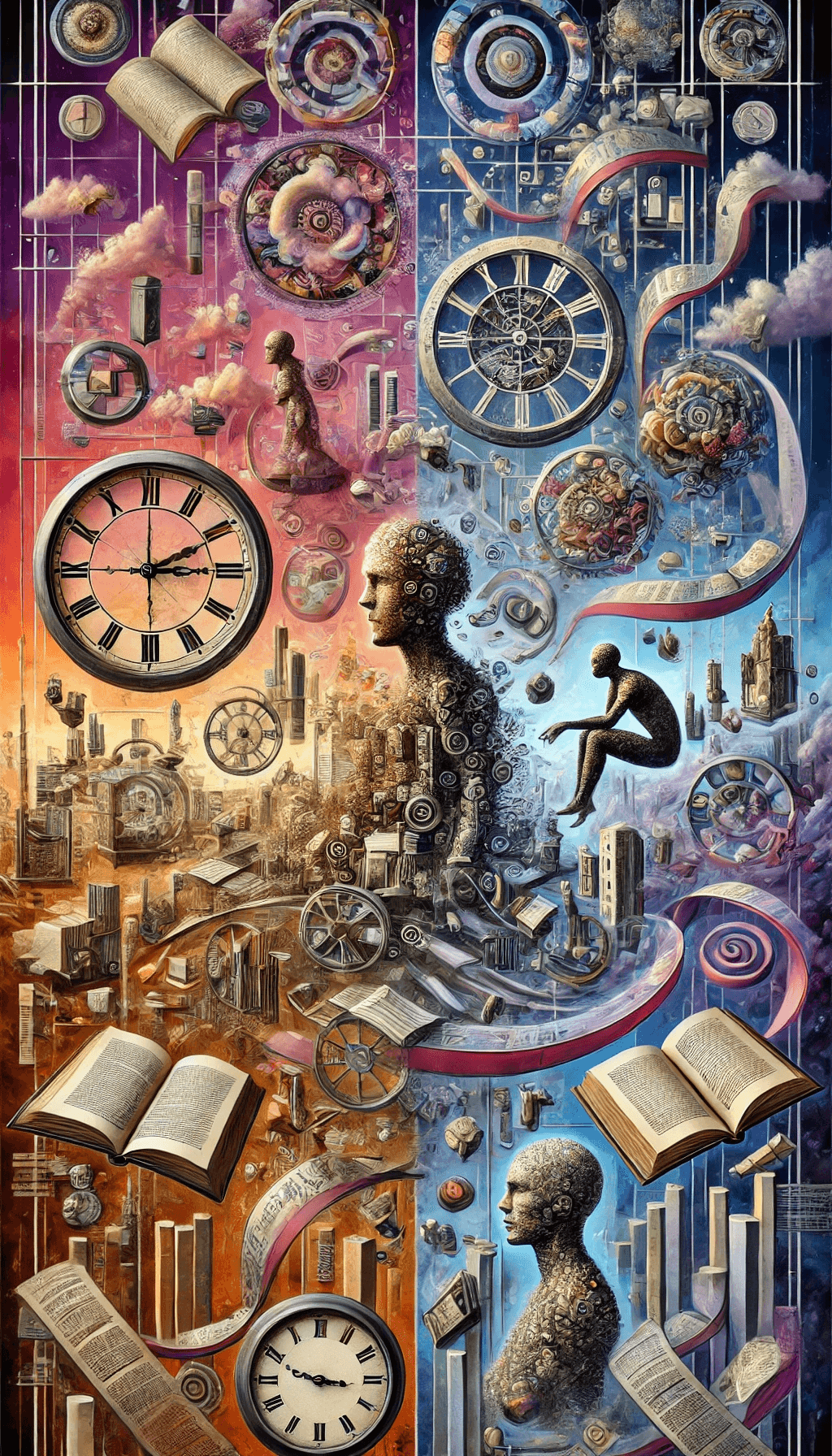
Postmodern Historiography (Generated by Artificial Intelligence)
Thinkers and Representatives | Jacques Derrida (1930–2004) Georg Iggers (1926–2017) Frank Ankersmit (1945–) Michel Foucault (1926–1984) Jean-François Lyotard (1924–1998) Keith Jenkins (1943–2023) Hayden White (1928–2018) | ||||||||
|---|---|---|---|---|---|---|---|---|---|
Postmodern history is an approach that argues the past cannot be treated as a fixed and objective reality; rather, historical writing is a process constructed through language, discourse, power relations, and the historian’s subjective interpretation. This approach approaches grand narratives (meta-narratives) with skepticism and asserts that history is merely a reinterpretation produced within specific contexts and always open to revision. Postmodern history emphasizes that truth may have multiple interpretations and that no narrative can legitimately claim absolute or universal validity. In this context, it highlights the central role of language and discourse in the production of historical knowledge. Inspired by Jacques Derrida’s deconstructive ideas, it argues that texts do not possess fixed meanings, and, within Michel Foucault’s framework of “discourse,” historical writing is shaped by ideological and power relations. Postmodern history rejects the notion that written and visual sources of the past reflect a neutral reality; instead, it accepts that historians’ narratives about the past are shaped by aesthetic, political, and ideological preferences.

Depiction of Postmodern History (Generated by Artificial Intelligence)
Postmodern historiography emerged in the second half of the 20th century, particularly from the 1960s onward, shaped by critiques of modern historiography and broader intellectual transformations within the social sciences. Key factors triggering its emergence include growing skepticism toward modernism’s grand narratives, heightened awareness of the role of language and discourse in historical writing, and theoretical approaches such as deconstruction and the linguistic turn. During this period, modern historiography’s claims to objectivity, truth, and neutrality were questioned, and the ideological, aesthetic, and discursive dimensions of historical writing were brought to the fore.
In this era, modern historiography’s positivist and causal approaches were challenged by post-structuralist perspectives such as Jacques Derrida’s deconstruction theory and Michel Foucault’s discourse analysis. Derrida argued that texts lack fixed meanings and that language is always open to interpretation, asserting that history is a textual construction. This view emphasizes that history cannot present an objective reality because every interpretation of the past is shaped by language, ideology, and power relations. Michel Foucault demonstrated that historical writing reflects not only the past but also contemporary relations of power and knowledge. Foucault contended that history is shaped by dominant discourses, which function as mechanisms of power over individuals and groups.
Postmodern historiography was also shaped by critiques of modernist grand narratives. Jean-François Lyotard defined postmodernism as “the end of belief in meta-narratives,” describing it as a condition in which large, comprehensive explanations are replaced by local, fragmented, and pluralistic narratives. This perspective holds that there is no single truth or objective reality in historical writing; every narrative depends on context, linguistic choices, and the historian’s ideological stance. Within this framework, postmodern historiography embraces a pluralistic and inclusive perspective by centering the historical experiences of marginalized groups such as women, minorities, and colonial peoples.
The emergence of postmodern historiography was also influenced by the social and political movements of the 1960s and 1970s. Feminist history, postcolonial studies, and efforts to make the histories of minority groups visible brought significant changes to historical writing during this period. Hayden White’s book Metahistory (1973) drew attention to the aesthetic and rhetorical dimensions of historical narratives, arguing that history is less a scientific truth than a form of narrative. White asserted that historians inevitably make ideological and aesthetic choices when representing events, and therefore historical writing cannot be an objective activity.
The differences between modern and postmodern history manifest in their epistemological, methodological, and ideological approaches to historiography. Modern history assumes that the past is an objective reality and that the historian’s task is to uncover this reality through scientific methods. Within this framework, history is written based on evidence, establishing causal relationships within frameworks of continuity and progress. Events of the past are treated as part of a coherent whole, and grand narratives (meta-narratives) dominate historical writing. Concepts such as the rise of the nation-state, modernization, the Enlightenment, or class struggle serve as central themes that give meaning to history. The modern historian claims objectivity by identifying cause-and-effect relationships among events and seeks to arrive at definitive knowledge through the scientific method.
Postmodern history, by contrast, fundamentally rejects these assumptions. According to the postmodern understanding of history, the past is not a fixed reality; rather, history is continuously reconstructed through the historian’s interpretations and discourse. Truth is no longer seen as a universal category but becomes contextual, linguistic, and relative. Thinkers like Michel Foucault argue that history is shaped not by objectivity but by power relations. Postmodern historiography critiques grand narratives, claiming they are repressive, one-sided, and homogenizing. Instead, history is approached through a pluralistic perspective that seeks to make visible the voices of marginalized groups such as women, minorities, and colonial peoples.
While modern history emphasizes the chronological examination of events in an orderly manner, postmodern history questions this order and argues that history contains multiple perspectives rather than a unified whole. Historians like Hayden White assert that historical writing is merely a form of narrative, shaped by aesthetic preferences, rhetorical strategies, and ideological tendencies. Consequently, postmodern history does not seek to make definitive judgments about the past; instead, it opens the past to debate through multiple discourses and views historical writing not only as a process of knowledge production but also as a cultural practice of power.
In postmodern historiography, the relationship between event, text, history, historian, and reader does not follow a linear or hierarchical structure as in traditional historical understanding. Events are no longer seen as fixed realities experienced in the past with all their details; instead, events themselves are reshaped through the narratives constructed by the historian’s writing. What an event “is” depends on the sources the historian selects, the manner in which these sources are interpreted, and the language employed. In this context, writing does not merely record events; it functions as a linguistic and ideological tool that constructs their meaning. Writing itself exists within a discursive field and is shaped by the historian’s linguistic choices, rhetorical strategies, and metaphors. Thus, history is understood not as a representation of an objective truth but as a layer of meaning produced through written texts and constantly subject to change.

Visual Representation of the Historian-History-Reader Relationship (Generated by Artificial Intelligence)
According to the postmodern approach, the historian is not a neutral arbiter but an actor who reconstructs the past within their own context and produces meaning through language. The sources they choose, the interpretations they make, and the narratives they construct are inevitably linked to the historian’s own ideological, cultural, and social position. This means the historian does not merely describe the past but transforms it. When constructing historical narratives, the historian reflects their own perspective, biases, and assumptions into the text. This situation reveals that historical knowledge is not a direct reflection of the past but a product of the historian’s narrative efforts.
On the other hand, the reader also plays a significant role in the postmodern understanding of history. The reader moves beyond being a passive consumer of the text and becomes an active subject who interprets and re-creates meaning based on their own context. The reader’s perspective, cultural background, and ideological history directly influence the interpretation of the text. Within this framework, history is continuously rewritten and reinterpreted not only by the historian but also by the reader. Just as the relationship among event, text, and historian is constructive, so too is the relationship between text and reader—equally constructive and pluralistic.
In postmodern historical approaches, sources and methodology question the traditional claim to access objective knowledge and instead prioritize analyzing the context and discursive structures in which texts are constructed. Sources are not treated merely as repositories of information but as structures that generate meaning through ideological, cultural, and linguistic contexts. This approach argues that sources must be examined not for their reliability but for the language and ideology that shaped them.
Postmodern methodology critiques classical historiographical methods such as deductive or empirical approaches. Instead, it proposes analyzing historical narratives through methods like deconstruction and discourse analysis. Jacques Derrida’s deconstructive method argues that the apparent meanings of texts can be misleading and that hidden assumptions and power dynamics underlying these meanings must be exposed. Michel Foucault’s discourse analysis foregrounds the study of how historical texts are produced within linguistic and social practices, examining relations of power and their effects on knowledge.
In terms of sources, postmodern historiography does not limit itself to written documents; literary texts, visual arts, cultural practices, discourses, and even silences can be treated as sources. However, these sources are not viewed as data offering fixed and immutable meanings but as texts open to multiple interpretations. Methodologically, the historian’s approach to sources must be critical and pluralistic. Each source is analyzed as a structure produced within a relationship and imbued with meaning within a specific context.
The postmodern method reminds the historian to pay attention to intertextual relationships, ideological biases, and the polysemic nature of language. In the process of producing historical knowledge, a critical awareness is required regarding both the conditions under which sources were produced and how historians have used them. Therefore, postmodern methodology views the past not merely as a “rediscovery” but as a critical reconstruction.
Critiques and debates surrounding postmodern historiography have centered on fundamental questions concerning objectivity, reality, language, methodology, and the function of historical writing. Traditional historians have questioned the core arguments of postmodern historiography and raised various criticisms against this approach.
The first critique targets the concepts of objectivity and reality. The postmodern claim that history does not reflect an “absolute reality” and that historiography is a textual construction has been criticized for undermining historians’ responsibility to interpret the past. Historians such as Richard J. Evans argue that such approaches, by completely rejecting historical reality, weaken history’s claim to be a scientific discipline. According to Evans, history must be grounded in verifiable facts, and the postmodernist emphasis on extreme relativism damages the legitimacy of history. Critics further argue that the centrality of language and linguistic analysis directs attention away from historical events themselves and toward their narratives, thereby obscuring the true meaning of the past.
The second critique focuses on the functionality of historical writing. The postmodern rejection of grand narratives and its treatment of every historical narrative as mere interpretation have led to the claim that history loses its importance as a space of social consensus. In particular, the fragmentation of narratives concerning national histories or major social struggles implies that historiography can no longer be used to construct social identity or serve political purposes. Critics argue that this renders historiography ineffective by detaching it from political and social contexts.
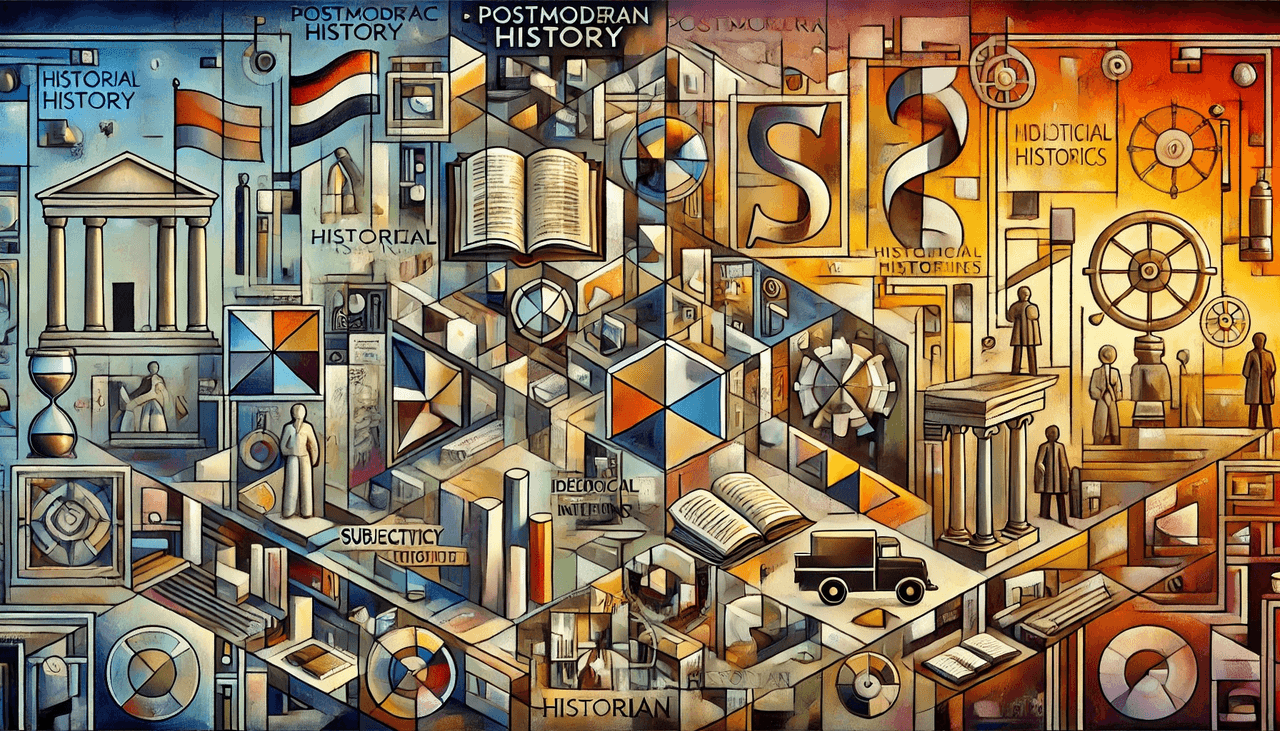
Depiction of Postmodern History (Generated by Artificial Intelligence)
A third debate centers on methodology and epistemology. It is argued that postmodern historiography’s methods—such as deconstruction and discourse analysis—contradict traditional source criticism and verification methods. Critics claim that postmodernists can assign unlimited meanings to historical texts without any objective criteria, thereby opening the door to arbitrariness in historical writing. Hayden White’s definition of historiography as a literary narrative has been criticized for causing history to lose its autonomy as a discipline.
Finally, critiques have emerged regarding social and ethical responsibility. Despite its claim to amplify the voices of victims and marginalized groups, postmodern historiography’s tendency to question the truth of historical events has been criticized for creating ambiguity in matters such as genocide and human rights violations. For instance, concerns have been raised that it could provide a foundation for Holocaust denial. The extreme relativism of postmodern historiography is viewed as problematic in relation to ethical responsibility and historical justice.
Despite these debates, the critiques introduced by postmodern historiography have prompted historians to pay greater attention to elements such as language, ideology, power relations, and the role of narrative, leading to the development of more critical and self-aware approaches in historical writing. However, critics argue that when these contributions are taken to extremes, they threaten the functionality of the historical discipline.
Appleby, Joyce, Elizabeth Covington, David Hoyt, Michael Latham, and Allison Sneider, ed. Knowledge and Postmodernism in Historical Perspective. 1st ed. London: Routledge, 1996.
Bentley, Michael. Modern Historiography: An Introduction. 1st ed. London: Routledge, 1999.
Derrida, Jacques. Of Grammatology. Baltimore: Johns Hopkins University Press, 1976.
Donnelly, M., and C. Norton. "The Future of History." Doing History, 173–190. London and New York, 2011.
Evans, Richard J. In Defense of History. New York: W. W. Norton, 2000.
Harvey, David. The Condition of Postmodernity: An Enquiry into the Origins of Cultural Change. Oxford: Blackwell Publishers, 1992.
Jenkins, Keith, ed. The Postmodern History Reader. 1st ed. London: Routledge, 1997.
Keskin, A. "Post-Modern Dünyada Modern Tarih Yapmak Üzerine." Uludağ Üniversitesi Fen-Edebiyat Fakültesi Sosyal Bilimler Dergisi 9, no. 15 (2008): 353–362. Accessed November 19, 2025.
O’Brien, Patrick. “What Is History?” *History in Focus*. Accessed November 7, 2024. https://archives.history.ac.uk/history-in-focus/Whatishistory/obrien.html
Tosh, John. "The Limits of Historical Knowledge." The Pursuit of History, 173–209. Harlow: Longman, 2010.
Öymen Gür, Şengül, and Serap Durmuş. “Tarihyazımına Bir Kayıt Düşmek.” *Yapı Dergisi*, 2017. Accessed November 7, 2024. https://yapidergisi.com/tarihyazimina-bir-kayit-dusmek/
Postmodern Historiography (Generated by Artificial Intelligence)
Thinkers and Representatives | Jacques Derrida (1930–2004) Georg Iggers (1926–2017) Frank Ankersmit (1945–) Michel Foucault (1926–1984) Jean-François Lyotard (1924–1998) Keith Jenkins (1943–2023) Hayden White (1928–2018) | ||||||||
|---|---|---|---|---|---|---|---|---|---|
The Emergence of Postmodern Historiography
Differences Between Modern and Postmodern History
The Relationship Between History, Historian, and Reader
Sources and Methodology in Postmodern Historiography
Critiques of Postmodern Historiography