
 Recently Added:
This article was automatically translated from the original Turkish version.
President Erdoğan’s Visit to Saudi Arabia (2026) is an official visit by President Recep Tayyip Erdoğan to the Kingdom of Saudi Arabia on 3 February 2026, at the invitation of Crown Prince Muhammed bin Selman. This visit marks President Erdoğan’s first foreign trip of 2026.
During the visit, bilateral relations between Türkiye and Saudi Arabia were discussed, and talks were held to enhance cooperation in various fields, particularly energy, investment, trade, and technology. Following the meetings, four agreements with intergovernmental character covering energy, investment, trade, and technology were signed between the two countries.

President Recep Tayyip Erdoğan and his wife Emine Erdoğan depart from Ankara Esenboğa Airport for Saudi Arabia, 3 February 2026 - (Anadolu Ajansı)
Presidential Communications Director Burhanettin Duran announced that President Erdoğan traveled to Riyadh at the invitation of Crown Prince Muhammed bin Selman. It was stated that during the talks, additional steps to deepen cooperation between the two countries and discussions on regional and global developments would be addressed.
In a message posted on his social media account, Communications Director Duran stated: “Our President, Mr. Recep Tayyip Erdoğan, will visit Saudi Arabia on 3 February 2026 and Egypt on 4 February 2026. During the talks in Riyadh with His Royal Highness Crown Prince Muhammed bin Selman of the Kingdom of Saudi Arabia, additional steps will be taken to deepen Türkiye-Saudi Arabia cooperation, alongside discussions on regional and global developments.”
On 3 February, President Erdoğan departed for Riyadh, the capital of Saudi Arabia, aboard the Presidential aircraft “TUR”. He was escorted off from Esenboğa Airport in Ankara by Presidential Deputy Cevdet Yılmaz, Ankara Governor Vasip Şahin, and other officials.
A delegation accompanied President Erdoğan on his visit to Saudi Arabia. The delegation included:

President Erdoğan in Saudi Arabia, 3 February 2026 - (Anadolu Ajansı)
Upon landing at King Khalid International Airport in Riyadh, President Erdoğan was received by Riyadh Emir Prince Faisal bin Bandar Al Saud, Saudi Arabia’s Ambassador to Ankara Fahad bin Assad Abualnasr, Türkiye’s Ambassador to Riyadh Emrullah İşler, and his wife Ayşenur İşler. Following the welcome ceremony, President Erdoğan proceeded to Yamama Palace, where he was received by Crown Prince Muhammed bin Selman of Saudi Arabia.
At the ceremony at Yamama Palace, the national anthems of both countries were played, and President Erdoğan engaged in conversation with Crown Prince Selman until the palace entrance.
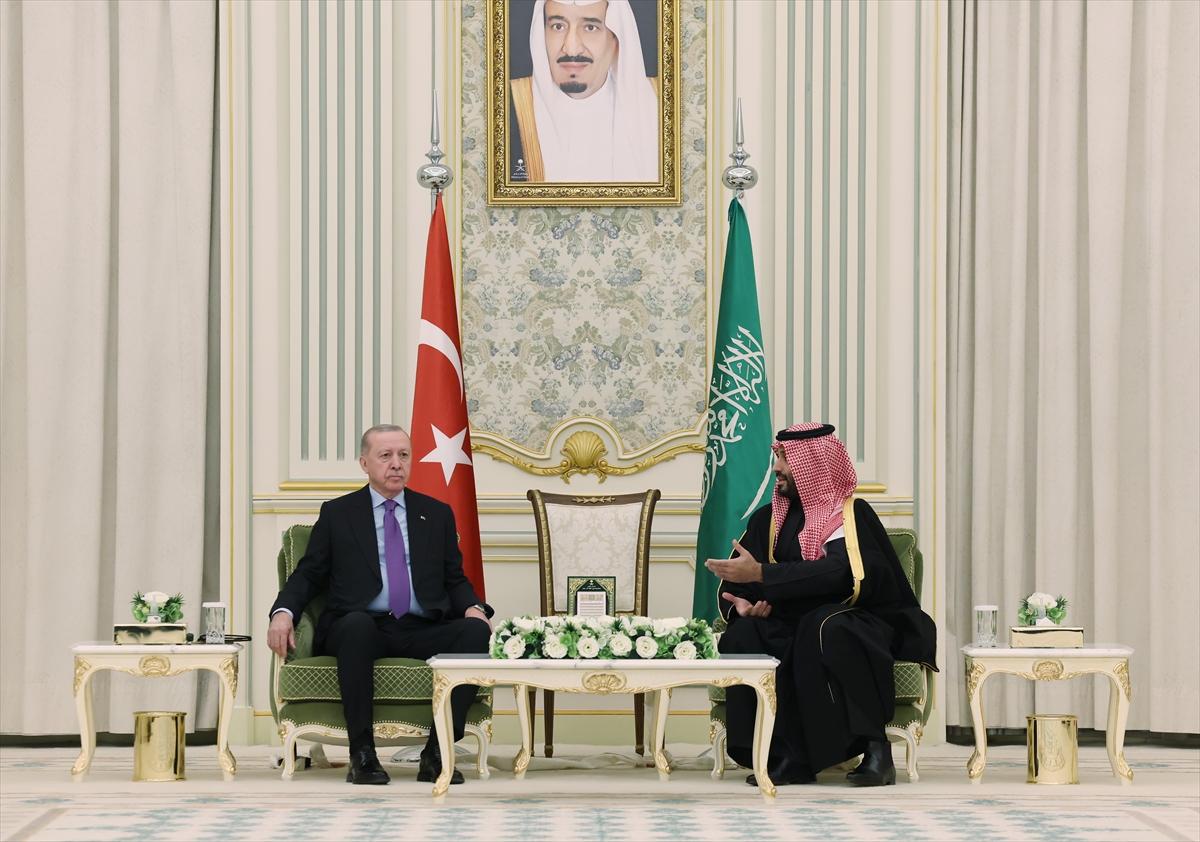
During his visit to Saudi Arabia, President Recep Tayyip Erdoğan met with Crown Prince Muhammed bin Selman at Yamama Palace. President Erdoğan was received by the Crown Prince at the palace entrance, followed by introductions of the delegations from both countries. Subsequently, a one-on-one meeting and a delegation-level meeting were held.

President Erdoğan meets with Saudi Crown Prince Selman, 3 February 2026 - (Anadolu Ajansı)
The meeting was held off the record. According to the statement issued by the Presidential Communications Directorate, the following topics were discussed:
President Erdoğan stated that Türkiye is determined to elevate its relations with Saudi Arabia to a higher level through new initiatives in areas such as renewable energy and defense industry. During the meeting, Erdoğan emphasized Türkiye’s continued efforts to achieve lasting peace in Palestine and the reconstruction of Gaza, and called for intensified efforts to end the humanitarian crisis as soon as possible.
Erdoğan noted that preserving Syria’s territorial integrity benefits not only Türkiye but the entire region, and that Türkiye will continue its support for Syria’s stability across multiple areas. He also stated that Türkiye will work in cooperation with Saudi Arabia on Syria’s reconstruction. The current situation in Yemen and developments in East Africa were also discussed in detail.

President Erdoğan in Saudi Arabia, 3 February 2026 - (Anadolu Ajansı)
As part of the visit, Crown Prince Muhammed bin Selman hosted a formal dinner in honor of President Erdoğan at Yamama Palace. The dinner was held off the record.
Following the talks between President Recep Tayyip Erdoğan and Crown Prince Muhammed bin Selman of Saudi Arabia, four agreements were signed between the two countries. According to the statement issued by the Presidential Communications Directorate, these agreements cover the areas of energy, investment, trade, and technology.
Minister of Energy and Natural Resources Alparslan Bayraktar signed the “Intergovernmental Agreement on Renewable Energy Power Plant Projects” with Saudi Arabia’s Minister of Energy, Abdulaziz bin Selman Al-Suud, in Riyadh.
Following the signing, Bayraktar told journalists that the delegations had held talks during President Recep Tayyip Erdoğan’s official visit to Saudi Arabia. Bayraktar stated that they had implemented the vision set forth by President Erdoğan and Crown Prince Muhammed bin Selman to elevate bilateral trade and investment levels.
Bayraktar highlighted Türkiye’s ambitious goals in renewable energy, saying: “Our President announced this at COP29 in Baku: ‘Türkiye will reach 120,000 megawatts of installed capacity in solar and wind by 2035.’ To achieve this target, we must add 8,000 to 10,000 megawatts of new capacity annually.”
Regarding the renewable energy plant project signed with Saudi Arabia, Bayraktar said: “The project’s scope is approximately 5,000 megawatts. The first phase we signed includes 2,000 megawatts of solar projects. Of this, 1,000 megawatts will be in Sivas and 1,000 megawatts in Taşeli, Karaman. For the Taşeli project specifically, we will purchase the electricity generated at a price of 1.99 euro cents per kilowatt-hour. Türkiye will purchase electricity at this price for approximately 25 years.”
Bayraktar noted that large-scale projects implemented through intergovernmental agreements will provide Türkiye with cheaper electricity in the long term: “We will be purchasing electricity at the lowest price ever seen in Türkiye to date, and we hope to deliver it to our citizens. This first phase of the 2,000-megawatt project represents an investment of approximately two billion dollars. This also means direct foreign financing is coming to our country, partly from local sources and partly from international financial institutions.”

President Erdoğan in Saudi Arabia, 3 February 2026 - (Anadolu Ajansı)
Bayraktar stated that they require 50 percent local content for the project: “We aim to implement a project of this scale, which can meet the electricity needs of approximately 2.1 million households, following these signed agreements. We hope to lay the foundation in 2027 and complete the first phase by the end of 2027, with full completion of the project targeted for 2028 and 2029.”
Bayraktar added that they discussed further projects to extend electricity cooperation between the two countries: “Especially regarding the establishment of an electricity transmission line and interconnection from Saudi Arabia to Türkiye, we hope our partners will return soon to begin work. This will be a truly significant and large-scale project affecting our entire region.”
As part of President Recep Tayyip Erdoğan’s visit to Saudi Arabia, the “Saudi Arabia–Türkiye Investment Forum” was organized in cooperation between the Council of Foreign Economic Relations (DEİK) and Saudi Arabia’s investment institution Invest Saudi.
The forum was held in Riyadh and opened by Saudi Arabia’s Minister of Investment, Khalid bin Abdulaziz Al-Falih, and Türkiye’s Minister of Trade, Ömer Bolat. A total of over 700 business leaders and public representatives from both countries participated, including 230 from Türkiye.
Bolat noted that this meeting was the most attended event between business communities in Saudi Arabia and Türkiye. He explained that in recent years, the friendship and close cooperation between the leaders of both countries have elevated Türkiye-Saudi Arabia relations to a high level in political, economic, defense industry, trade, transportation, energy, and many other areas.
Bolat referred to the recent stagnation in the global economy and international trade, stating that expectations in these areas are anticipated to be revised upward in the coming months. The minister said: “This decision to elevate economic, political, defense industry, and energy relations between the two countries to a strategic level is the result of the visionary perspectives and ideas of the esteemed leaders of both nations.”
Minister Bolat stated: “This visit will witness the signing of numerous agreements between the ministries and business organizations of both countries. These agreements will elevate Türkiye-Saudi Arabia relations to much higher levels, firmly cementing our unshakable friendship and brotherhood in the economic sphere.”
Bolat outlined Türkiye’s progress over the past 23 years in areas such as the economy, investment, per capita national income, gross domestic product, and growth, sharing detailed economic data. He noted that Türkiye’s export-led growth model, incentives for international and domestic investment, reforms, and the Customs Union have played a significant role in this economic advancement.
Bolat stated that Türkiye’s total goods and services trade reached $820 billion by the end of 2025, exceeding half of Türkiye’s national income. He reported that Türkiye’s goods exports rose to $273.5 billion, services exports reached $123 billion, and imports of goods and services totaled $420 billion.
Bolat emphasized Saudi Arabia’s significant importance to Türkiye in both energy and contracting sectors, adding: “Turkish contractors have completed 434 projects in Saudi Arabia, worth $32.5 billion. In the new era, Saudi Arabia’s 2030 Vision projects, the hosting of Expo 2030 Riyadh, and Saudi Arabia’s hosting of the 2034 FIFA World Cup demonstrate that major joint projects will be undertaken in the contracting and construction sectors.”
Bolat noted that bilateral trade volume has exceeded $8.6 billion and said: “Our leaders have a fixed goal of increasing bilateral trade volume to $10 billion in the short term and $30 billion in the long term. As ministers and representatives of the business communities of both countries, we will work tirelessly to achieve these targets. We hope 2026 will be the year we reach the $10 billion target.”
Minister Bolat stated that cooperation between the two countries in the energy sector has accelerated, adding: “There are already significant Saudi investments in renewable energy in Türkiye, and investments exist in other sectors as well. We believe these investments, currently valued at $2 billion, will increase by several billion dollars through new projects under discussion. Türkiye has also made $117 million in international investments in Saudi Arabia. In all our efforts, we aim to increase trade and energy cooperation, expand and improve transportation corridors, and boost direct foreign investment in both countries. Cooperation in the defense industry between Türkiye and Saudi Arabia is also accelerating in terms of supply and joint production.”
Bolat thanked Saudi officials for their cooperation, saying: “The Türkiye-Saudi Arabia alliance will achieve great successes in many more projects, collaborations, and defense industry initiatives.”
Bolat stated that the two countries can sign major cooperation agreements on the reconstruction of Gaza and Ukraine, as well as other third countries: “We are ready to cooperate with Saudi firms on this. I am confident that Türkiye and Saudi Arabia will undertake major cooperation in the reconstruction of Gaza, helping our Palestinian brothers whose country and region have suffered immense oppression and destruction.”
Following the talks during President Recep Tayyip Erdoğan’s visit to Saudi Arabia, a 31-point joint statement was issued between the Republic of Türkiye and the Kingdom of Saudi Arabia.
The full text of the joint statement issued at the conclusion of President Erdoğan’s visit to the Kingdom of Saudi Arabia is as follows:
1) His Excellency President Recep Tayyip Erdoğan of the Republic of Türkiye, based on fraternal ties, distinguished relations, and deep historical connections between the leaders and peoples of the Republic of Türkiye and the Kingdom of Saudi Arabia, paid an official visit to the Kingdom of Saudi Arabia on 3 February 2026, corresponding to 15 August 1447 AH.
2) His Excellency President Recep Tayyip Erdoğan of the Republic of Türkiye held a meeting with His Royal Highness Prince and Prime Minister Muhammed bin Salman bin Abdulaziz Al Saud. His Royal Highness conveyed the greetings of Custodian of the Two Holy Mosques King Salman bin Abdulaziz Al Saud to His Excellency President Erdoğan, along with wishes for his continued health and well-being and for the further advancement and prosperity of the Republic of Türkiye and its fraternal people. His Excellency President Recep Tayyip Erdoğan requested His Royal Highness convey his heartfelt wishes for the continued health and well-being of Custodian of the Two Holy Mosques King Salman bin Abdulaziz Al Saud. During their official talks, the two fraternal countries discussed their historical relations and ways to enhance them in all areas.
3) At the outset of the meeting, the Turkish side praised the level of coordination between the two countries in ensuring the comfort of pilgrims, umrah visitors, and guests from Türkiye, and commended the Kingdom of Saudi Arabia’s efforts in serving the Two Holy Mosques and their visitors.
4) Both sides praised the positive outcomes of His Royal Highness Crown Prince and Prime Minister’s visit to the Republic of Türkiye on 22 June 2022, corresponding to 23 November 1443 AH, and President Recep Tayyip Erdoğan’s visit to the Kingdom of Saudi Arabia on 17 July 2023, corresponding to 29 December 1444 AH.
Economy, Trade, and Investment:
5) Both sides expressed appreciation for the strength of economic ties between the two countries in the fields of economy, trade, and investment, and agreed on the importance of strengthening these ties in sectors of mutual priority. They also agreed on the importance of leveraging investment opportunities presented by the Saudi Vision 2030 and Türkiye’s Vision 2023 for mutual benefit. They praised the level of trade volume and emphasized the importance of continued joint efforts to enhance non-oil trade, intensify mutual visits between public and private sector officials, and organize trade events in both countries through the Türkiye-Saudi Arabia Business Council. The Republic of Türkiye emphasized the importance of concluding free trade agreement negotiations between Türkiye and the Gulf Cooperation Council countries.
6) Both sides appreciated the level of mutual investments, including Saudi investments in finance, insurance, real estate, manufacturing, and services. Both sides welcomed the vital role played by Turkish companies operating in various fields such as engineering, construction, real estate development, and manufacturing. The Saudi side commended Turkish construction and consulting firms for their projects in Saudi Arabia, and both sides expressed readiness to enhance cooperation for implementing more infrastructure and superstructure projects under the Kingdom’s 2030 Vision.
7) Both sides also appreciated the positive outcomes of the Türkiye-Saudi Investment Forum held in Riyadh on 3 February 2026. The forum witnessed broad participation from major companies in both countries and highlighted promising investment opportunities and expertise sharing in tourism and hospitality, construction, communications and information technology, life sciences, and healthcare.
Energy and Climate Change:
8) Both sides emphasized the importance of their roles in significantly contributing to the energy supply of their regions and global markets. The Turkish side highlighted the pioneering role of the Kingdom of Saudi Arabia in enhancing the reliability and stability of global oil markets in a manner that serves the interests of producers and consumers and supports global economic growth. Both sides agreed to strengthen cooperation in oil, petroleum products, and petrochemical supply, jointly evaluate investment opportunities in petrochemical and agricultural food sectors, and collaborate on innovative uses of hydrocarbons.
9) Both sides reaffirmed their desire to strengthen cooperation in electricity and renewable energy by leveraging their extensive experience in renewable energy integration and Saudi Arabia’s large-scale energy investments. They committed to accelerating feasibility studies for an electricity connection between the two countries, exchanging expertise in electricity and renewable energy technologies and grid automation, grid security and resilience, renewable energy projects, grid interconnection, and energy storage technologies, and encouraging the participation of companies from both countries in implementing these projects. They also emphasized the importance of strengthening cooperation in energy efficiency and conservation, raising awareness of the importance of this issue, and exchanging expertise and building capacity in the energy services sector.
10) The parties welcomed the opportunity to explore cooperation in the field of clean hydrogen, develop technologies for hydrogen transportation and storage, and exchange expertise and experience to implement best practices in clean hydrogen. They agreed on the necessity of strengthening cooperation in developing and sustaining energy supply chains and enabling collaboration between companies in both countries to utilize local resources, thereby contributing to more flexible and efficient energy supply.
11) Both sides agreed to strengthen cooperation in the exploration, extraction, and processing of mineral resources. They also emphasized the importance of international cooperation and joint initiatives in securing supply chains critical to the global energy transition.
12) Both sides emphasized the importance of adhering to the principles of the United Nations Framework Convention on Climate Change (UNFCCC) and the Paris Agreement, and the necessity of developing and implementing climate agreements focused on emissions rather than resources. The Kingdom of Saudi Arabia welcomed Türkiye’s presidency of the 31st Conference of the Parties (COP31) to the UNFCCC and its hosting of COP31 in Antalya from 9 to 20 November 2026. The Turkish side praised Saudi Arabia’s stance and efforts in the field of climate change. Additionally, they emphasized the importance of joint cooperation in developing circular carbon economy applications as a tool, alongside other mitigation approaches, to manage emissions and achieve climate goals.
Türkiye-Saudi Coordination Council and Other Areas of Cooperation:
13) Both sides appreciated the level of coordination and cooperation under the framework of the Türkiye-Saudi Coordination Council for achieving common interests and advancing into new horizons across all sectors. They emphasized the importance of strengthening cooperation and partnership in the following areas: (1) digital economy, artificial intelligence, new technologies, and space technologies; (2) transportation, logistics, and civil aviation; (3) law and justice; (4) culture; (5) tourism; (6) sports and youth; (7) scientific and educational cooperation; (8) media; (9) environment, water, agriculture, and food security; (10) customs; (11) defense industries; (12) health.
Defense and Security:
14) In the field of defense and security, both sides agreed that the agreements signed in the area of defense cooperation between the two countries must be implemented. The parties reaffirmed their desire to strengthen and develop defense relations through multilateral cooperation platforms, including, to serve their mutual interests and contribute to regional security and stability. They emphasized the importance of enhancing existing security cooperation and coordination in areas of mutual interest, including combating all forms of crime, extremism, and terrorism and their financing, as well as strengthening cooperation in cybersecurity to serve the interests and national security of both countries.
International Cooperation:
15) Both sides emphasized the importance of continuing cooperation in international forums and organizations and multilateral financial and economic institutions. The Turkish side expressed its support for Saudi Arabia’s aspiration to host the G20 Summit in 2030.
Agreements and Memoranda of Understanding:
16) Both sides welcomed the signing of four agreements during this visit in various areas, including justice, renewable energy, peaceful use of outer space, and R&D and innovation cooperation.
Regional and International Issues:
17) The parties reaffirmed their commitment to continue coordination and intensify efforts to preserve international peace and security. They exchanged views on matters of mutual interest at regional and international levels and emphasized their determination to strengthen cooperation and joint coordination on these issues. They also stated they would continue to support all efforts aimed at establishing peace and stability in the region and the world.
18) The parties engaged in comprehensive consultations on regional developments, expressed concerns regarding conflicts, tensions, and rising risks of escalation in the region, and emphasized the importance of regional cooperation. In this context, they affirmed their support for collective initiatives aimed at ensuring regional stability, peace, and prosperity.
Palestine:
19) Regarding recent developments in Palestine, both sides expressed deep concern over the deteriorating humanitarian situation in the Gaza Strip, ongoing Israeli attacks, and the obstruction of humanitarian aid and border crossings. They emphasized the importance of ensuring all crossings along the Strip are opened without hindrance to facilitate intensified humanitarian assistance. They also stressed the need for the international community to pressure Israeli occupation authorities to guarantee the protection of civilians, avoid targeting vital infrastructure, and comply with international law and international humanitarian law. They further emphasized the necessity of strengthening the ceasefire, ending the occupation of Gaza, enabling the Palestinian National Authority to resume its responsibilities in the Gaza Strip, and ultimately ending the occupation and establishing an independent Palestinian state with East Jerusalem as its capital within the 1967 borders, in accordance with international law and the 2002 Arab Peace Initiative.
20) Both sides welcomed their countries’ participation in the Peace Council, led by U.S. President Donald Trump, to support peace efforts. They welcomed the launch of the second phase of the comprehensive peace plan for Gaza and the commencement of work by the Independent National Committee for Gaza’s governance, and appreciated the international efforts in this regard. The Saudi side appreciated Türkiye’s mediation efforts and achievements in partnership with the guarantor states of the peace agreement. The Turkish side appreciated Saudi Arabia’s co-chairmanship role in the United Nations High-Level Conference on the Peaceful Solution of the Palestinian Issue and the Implementation of the Two-State Solution, which led to successive international recognition of the State of Palestine.
21) Both sides reaffirmed the vital and critical role of the United Nations Relief and Works Agency for Palestine Refugees in the Near East (UNRWA) in providing basic services to the Palestinian people. They strongly condemned Israeli forces for destroying UNRWA buildings in occupied Jerusalem and fully rejected the Israeli occupation authorities’ violations of international norms and laws. They called on the international community to confront these practices and crimes against international humanitarian organizations.
22) Both sides reiterated the vital role of the Organization of Islamic Cooperation in defending the Palestinian cause and appreciated the work of the Arab-Islamic Gaza Contact Group. Both sides agreed to encourage the development of dialogue and cooperation between Türkiye and the League of Arab States.
Yemen:
23) The parties reaffirmed their support for the legitimate Yemeni government represented by the President of the Presidential Leadership Council of the Republic of Yemen. They emphasized the importance of preserving Yemen’s sovereignty, unity, and territorial integrity. They stressed the necessity of opposing any attempts to support internal forces seeking to divide Yemen or undermine its security and stability. The Turkish side expressed support for the Kingdom of Saudi Arabia’s important role in Yemen and its response to the call for a comprehensive conference in Riyadh, involving all southern groups, to resolve the crisis and strengthen national reconciliation in Yemen.
Somalia:
24) The parties affirmed their unwavering support for the sovereignty, territorial integrity, and unity of the Federal Republic of Somalia and their commitment to preserving Somalia’s stability, the welfare of its people, and its development. They rejected the mutual recognition declaration between Israeli occupation authorities and the so-called “Somaliland” region, which they viewed as part of the Federal Republic of Somalia, as a unilateral secessionist act violating international law and escalating regional tensions. They also rejected attempts to impose parallel structures undermining Somalia’s unity.
Sudan:
25) The parties reaffirmed their firm stance on preserving Sudan’s unity, security, stability, and sovereignty. They rejected any illegitimate or parallel structures outside the framework of legitimate Sudanese state institutions. They also emphasized the importance of preventing Sudan from becoming a scene of conflict and unlawful activities and stopping the illicit entry of foreign weapons into the country. They stressed the necessity of respecting the protection of civilians under International Humanitarian Law and the Jeddah Declaration of 11 May 2023, and facilitating the delivery of humanitarian aid and relief supplies to all regions of Sudan. They emphasized the importance of preserving Sudanese state institutions and initiating a Sudanese-led political process through the establishment of a civilian government that does not include extremist groups and entities committing crimes against the Sudanese people.
26) The Turkish side appreciated the Kingdom’s efforts to achieve peace in Sudan, end the war, preserve the country’s unity, security, and stability, and alleviate the suffering of the Sudanese people. The Saudi side expressed appreciation for Türkiye’s humanitarian aid activities and efforts in response to the humanitarian crisis in Sudan.
27) The parties welcomed the decision of the Sudanese Armed Forces to keep the Chad–Adré border crossing open for a longer period and to reopen the airfields in Kassala, Dongola, and El Obeid, as well as the Kadugli border crossing, for the delivery of humanitarian aid.
Syria:
28) The parties appreciated the efforts of their fraternal Syrian government and the responsible steps and measures taken to safeguard Syria’s security, stability, and territorial integrity. They also appreciated international community efforts to support the Syrian government and lift imposed sanctions. They supported the implementation of the ceasefire and integration agreement announced on 30 January and confirmed their full support for the Syrian government’s efforts to prevent terrorist organizations threatening Syria’s and the region’s stability and to promote civil peace. They affirmed their commitment to preserving Syria’s sovereignty and territorial integrity and fulfilling the Syrian people’s aspirations for development and prosperity. They reiterated their condemnation of repeated Israeli occupation violations and aggressions against Syrian territory and sovereignty. These violations and aggressions clearly breach international law, threaten regional security and stability, and create an environment conducive to increased violence and extremism. They reiterated their call for Israel’s immediate withdrawal from all occupied Syrian territories.
Russia–Ukraine Crisis:
29) On the Russia–Ukraine crisis, both sides reaffirmed their strong support for a comprehensive solution based on negotiations consistent with international law and the United Nations Charter, aimed at ensuring lasting peace, stability, and prosperity in the region and beyond.
Conclusion:
30) At the conclusion of the visit, His Excellency President Recep Tayyip Erdoğan expressed his gratitude and appreciation to Custodian of the Two Holy Mosques King Salman bin Abdulaziz Al Saud and His Royal Highness Crown Prince and Prime Minister Muhammed bin Salman bin Abdulaziz Al Saud for the warm reception and generous hospitality extended to him and his delegation. His Royal Highness Crown Prince Muhammed bin Salman bin Abdulaziz Al Saud conveyed to His Excellency wishes for his health and well-being and for the progress and prosperity of the fraternal Turkish people.
31) His Excellency President Recep Tayyip Erdoğan expressed his sincere desire to host His Royal Highness Custodian of the Two Holy Mosques King Salman bin Abdulaziz Al Saud and His Royal Highness Crown Prince and Prime Minister Muhammed bin Selman bin Abdulaziz Al Saud in Türkiye.

President Recep Tayyip Erdoğan, accepting an invitation from Saudi Crown Prince Mohammed bin Salman, traveled to Riyadh on 3 February 2026 to begin official talks focusing on Türkiye–Saudi Arabia relations as well as regional and global developments. President Erdoğan is accompanied by an official delegation of ministers and senior officials during the visit. The visit is expected to include assessments of additional steps to deepen cooperation between the two countries.
No Discussion Added Yet
Start discussion for "President Erdoğan's Visit to Saudi Arabia (2026)" article
February 3, 2026
Scope of the Visit
February 3, 2026
Delegation and Farewell Ceremony
February 3, 2026
Arrival and Welcome Ceremony
February 3, 2026
Meeting Between President Erdoğan and Prince Selman
February 3, 2026
Signed Agreements
February 3, 2026
Trade and Economic Discussions
February 3, 2026
Joint Statement