


This article was automatically translated from the original Turkish version.
+2 More
Location | Aksu Türkiye Isparta | ||||||||
|---|---|---|---|---|---|---|---|---|---|
Elevation(s) | 1300 m | ||||||||
Length(s) | 765 m | ||||||||
Type(s) | Semi-active Karstic Cave | ||||||||
Archaeological Structure | Open-air Temple from the Roman Period | ||||||||
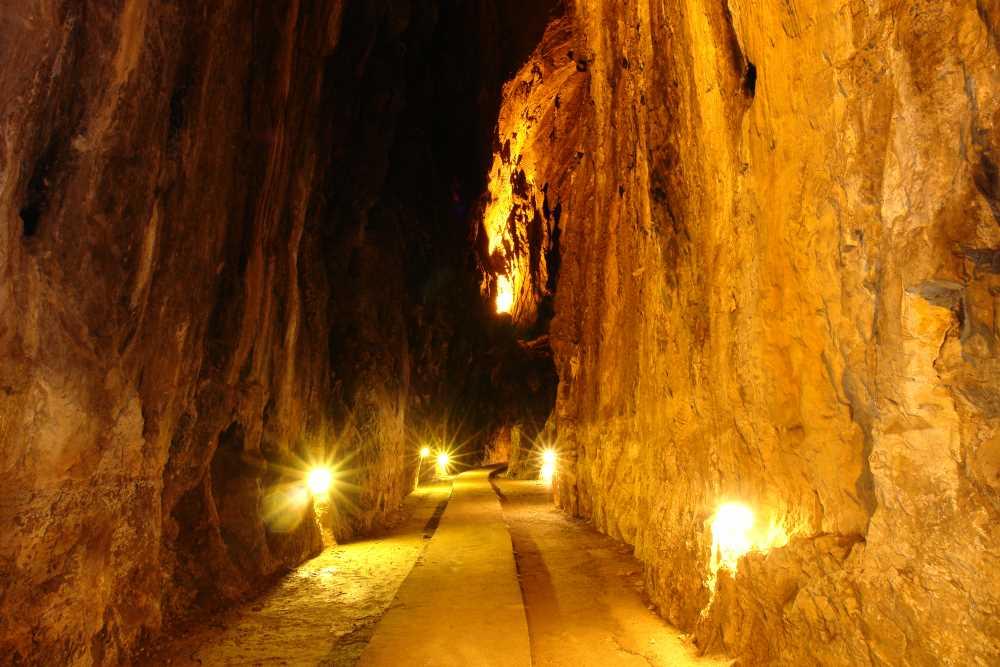
Zindan Cave is located approximately 2 kilometers northeast of the Aksu district of Isparta, on the southern slope of the Aksu Çayı gorge, at an elevation of 1300 meters above sea level. The cave, which extends 765 meters in length, has developed horizontally and constitutes a semi-active karstic system. It is characterized by the presence of stalactites, stalagmites, columns, and an underground stream, while miniature canyon formations are also observed in certain sections. At the cave’s end, in a section known as the “hamam,” mosaic-like calcite crystals are found. Water analysis of the stream flowing inside has revealed it to be rich in calcium and magnesium.

Zindan Cave (Republic of Türkiye Isparta Governorship)
Zindan Cave formed along a north-south trending joint within the Resian (Upper Triassic) Karaçam Formation, which is part of the tectonic structure known as the Isparta Angle of the Western Taurus. The carbonate rocks in which it developed exhibit thick-bedded, locally massive, oolitic, brecciated, and dolomitic characteristics. The cave has been shaped by a tectonically controlled system, with its development occurring primarily along major fault and joint systems. Rounded basalt pebbles are found within the cave, which are believed to have been transported from the Karadere Formation to the north.
At the entrance of the cave lies an open-air temple constructed by the Romans and identified as having been used for worship. The temple was built on three terraced levels and constructed from grey brecciated and white recrystallized limestone. The building stones used show similar characteristics to those of the Gavurçalı and Tekedağı formations surrounding the cave. Additionally, brick samples recovered from excavations opposite the cave contain minerals such as sanidine, muscovite, and quartz, indicating high-temperature firing. These bricks are thought to have been manufactured from clays sourced either from the clay-rich layers of the Çayır Formation approximately 2.5–3 kilometers north of the cave or from alluvial deposits near Pazarköy to the south.

Zindan Cave (Republic of Türkiye Isparta Governorship)
The Eurymedon Sacred Area, located in front of Zindan Cave, is associated with the ancient city of Timbriada. Inscriptions and archaeological remains found at the site indicate that the sacred area was constructed no later than the 1st–2nd centuries CE. Dedicated to the goddess Cybele, the area is also referred to as “Meter Theon Vegeinon.” Within this site, where cults of Eurymedon (the god of the Köprüçay River), Zeus, Hermes, and Demeter were practiced, a mosaic and statue dedicated to Eurymedon have been discovered. The statue is currently on display at the Isparta Museum.
Anadolu Ajansı. “Zindan Mağarası Ziyaretçilerini Doğa ile İç İçe Tarihte Yolculuğa Çıkarıyor.” Accessed June 15, 2025. https://www.aa.com.tr/tr/yasam/zindan-magarasi-ziyaretcilerini-doga-ile-ic-ice-tarihte-yolculuga-cikariyor/2578096
T.C. Isparta Valiliği. "Aksu Fotoğrafları." Accessed June 15, 2025. http://www.isparta.gov.tr/aksu-fotograflari
T.C.Aksu Kaymakamlığı Governorship. "Zindan Mağarası." Accessed June 15, 2025. http://www.aksu.gov.tr/aksu
Türkiye Kültür Portalı. "Aksu Zindan Mağarası – Isparta." Türkiye Kültür Portalı. Accessed June 15, 2025. https://www.kulturportali.gov.tr/turkiye/isparta/gezilecekyer/zindan-magarasi

Location | Aksu Türkiye Isparta | ||||||||
|---|---|---|---|---|---|---|---|---|---|
Elevation(s) | 1300 m | ||||||||
Length(s) | 765 m | ||||||||
Type(s) | Semi-active Karstic Cave | ||||||||
Archaeological Structure | Open-air Temple from the Roman Period | ||||||||
Geological Structure
Archaeological Structures
Mythological and Religious Elements