

This article was automatically translated from the original Turkish version.
+2 More
Pulur Höyük is a significant mound settlement in Eastern Anatolian archaeology, located within the boundaries of the Aziziye district of Erzurum province, featuring uninterrupted settlement layers spanning from the Neolithic period to the end of the Early Iron Age. Excavations have revealed that the mound has a settlement history of approximately seven thousand years, demonstrating a continuous way of life based on agriculture, animal husbandry, and production. Pulur Höyük contributes to the understanding of early settled life in the region through its stratigraphic integrity, architectural remains, and artifact groups.
Pulur Höyük is situated approximately 20 kilometers west of the city center of Erzurum, within the boundaries of Ömertepe Village of Aziziye district. Its proximity to the Pulur Çayı river has provided an environmentally favorable setting for settlement throughout history, offering access to arable land, rock outcrops, and obsidian sources. The mound rises about 15 meters above the plain level and extends over a wide area.
The first archaeological excavations at Pulur Höyük were conducted in 1960. After a long interval, excavation work was restarted in 2021 under the leadership of the Erzurum Museum Directorate. The research has been carried out with the permission and support of the Ministry of Culture and Tourism of the Republic of Türkiye and later acquired the status of “Presidential Authorized Excavation” by presidential decree. The scientific direction of the excavations is led by Assoc. Prof. Dr. Rabia Akarsu of the Department of Archaeology at Atatürk University.

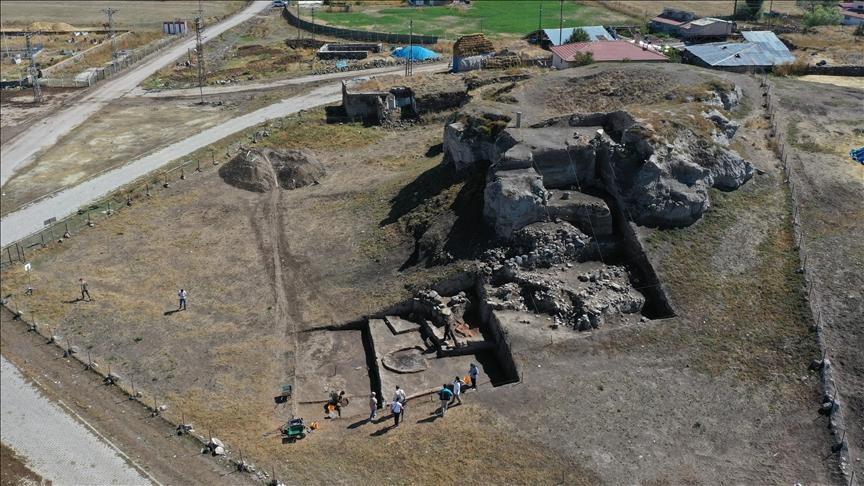
Pulur Höyük Excavations (AA)
Excavations have identified seven main cultural layers at Pulur Höyük. The earliest layers date to the Early Chalcolithic period, extending back approximately seven thousand years. Upper layers reveal settlement traces belonging to the Middle Chalcolithic, Early Bronze Age, Middle Bronze Age, and Early Iron Age. Radiocarbon analyses indicate that settlement at the mound continued uninterrupted between approximately 4300 and 1000 BCE.
The architectural remains uncovered at Pulur Höyük reflect construction techniques from different periods. Circular stone foundations, walls built with mud bricks, workshop structures, production ovens, and grain storage pits have been identified. Particularly, fixed circular hearths provide significant evidence regarding production and daily life activities within the settlement. These architectural elements demonstrate the presence of a continuous and planned settlement organization at Pulur Höyük.
Among the artifacts recovered during excavations are ceramics, animal bones, obsidian tools, fixed and portable hearths, structures for grain storage, and workshop remains. Ceramic finds reflect production techniques and formal diversity across different periods. Notably, ceramics associated with the Karaz culture and sacred hearths illustrate Pulur Höyük’s position within regional cultural networks.

Pulur Höyük (AA)
Pulur Höyük is one of the few settlements in the Erzurum region and Eastern Anatolia where the stratigraphic sequence from the Neolithic to the Chalcolithic periods can be clearly traced. The absence of cultural disruption at the site indicates long-term and continuous habitation. With these characteristics, Pulur Höyük constitutes an important reference site for the study of the development of early settled life, regional cultural continuity, and production activities in Anatolian archaeology.

Geographical Location and Physical Characteristics
Research and Excavation Activities
Stratigraphy and Chronology
Architectural Remains
Archaeological Finds
Archaeological Significance of Pulur Höyük