


This article was automatically translated from the original Turkish version.
+1 More
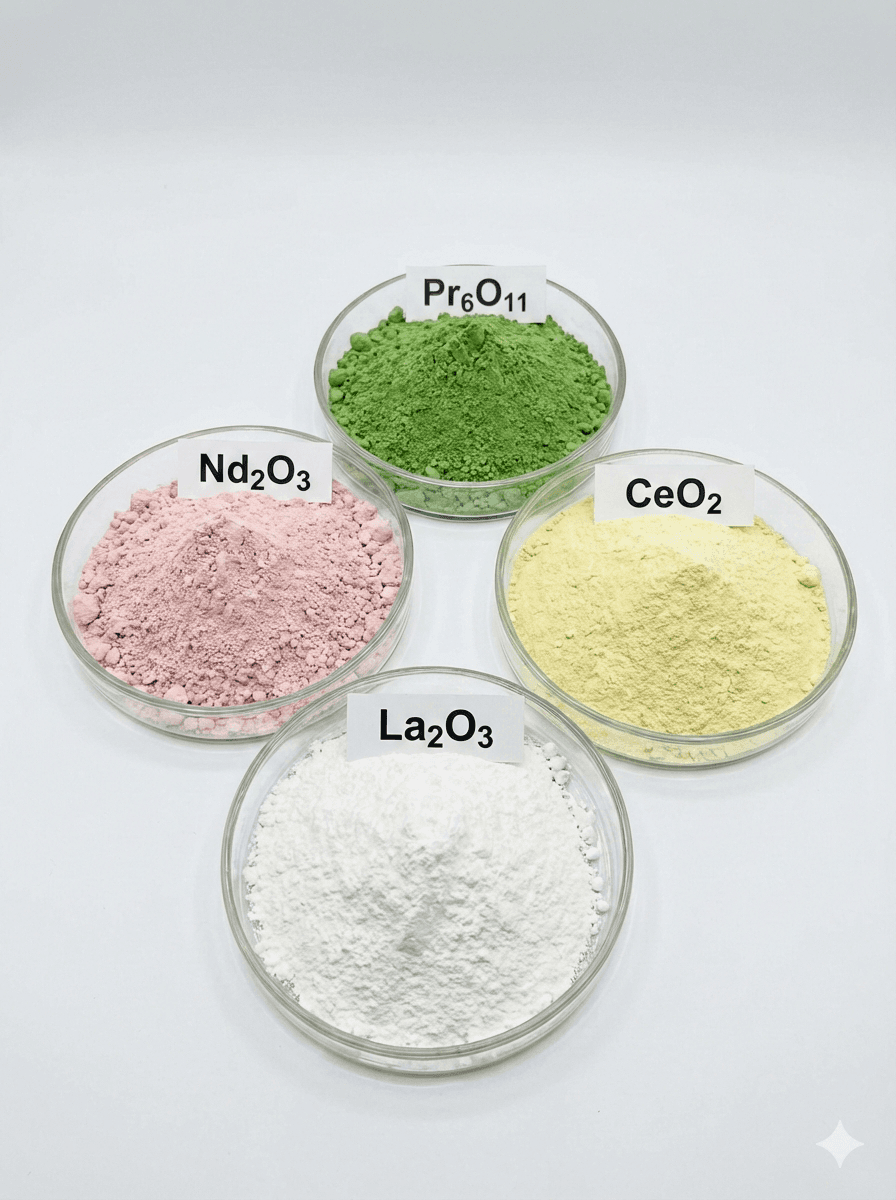
NTE Oxides
Generated by Artificial Intelligence
Valence | Chemical equivalence +3 oxidation state | ||||||||
|---|---|---|---|---|---|---|---|---|---|
Isomorphism | Co-precipitation Similar crystal structure | ||||||||
Lanthanide Contraction | Picometer differences Ionic radius contraction | ||||||||
Transition Metals | Electron shielding 4f orbitals | ||||||||
Lanthanides | La (57) - Lu (71) | ||||||||
Crystallography | Atomic Physics | ||||||||
Rare earth elements (REEs) purification is the process of separating the 15 lanthanide elements along with scandium and yttrium, which are commonly found together in nature and exhibit extremely similar chemical properties, into high-purity individual products suitable for high-technology applications. Although these elements occur in the Earth’s crust in abundance comparable to metals such as copper or lead, they are termed “rare” due to the difficulty of obtaining them in pure form.
The primary obstacle in purifying REEs lies in the nearly identical electron configurations of their outer shells and, consequently, their nearly identical chemical behavior. As one moves along the lanthanide series, added electrons occupy inner 4f orbitals rather than the outermost shell. These 4f orbitals are shielded by outer electron shells and do not directly participate in chemical bonding; this results in all lanthanides predominantly existing in the +3 oxidation state with very similar chemical properties.
The fundamental reason for the extreme chemical similarity among rare earth elements (lanthanides) is a systematic atomic-scale reduction in size known as lanthanide contraction. As the atomic number increases, the number of protons in the nucleus rises, strengthening the electrostatic attraction to electrons. Normally, inner electron shells would shield this increased nuclear charge; however, in lanthanides, the shielding effect of electrons in the 4f orbitals is very weak. Consequently, outer electrons are drawn more tightly toward the nucleus, causing ionic radii to decrease systematically across the series. This reduction is very small, typically on the order of just a few picometers, yet it has decisive effects on chemical behavior.
This phenomenon directly affects not only atomic size but also the complexation tendency, hydration energy, crystal lattice parameters, and solubility characteristics of lanthanides. For example, heavy lanthanides such as Dy, Ho, and Er form stronger bonds with ligands due to their smaller ionic radii, increasing complex stability. In contrast, light lanthanides such as La, Ce, and Pr exhibit different coordination numbers and bonding geometries due to their relatively larger ionic sizes. Although these subtle differences could theoretically be exploited for separation, their extremely small magnitude makes practical separation exceptionally challenging.
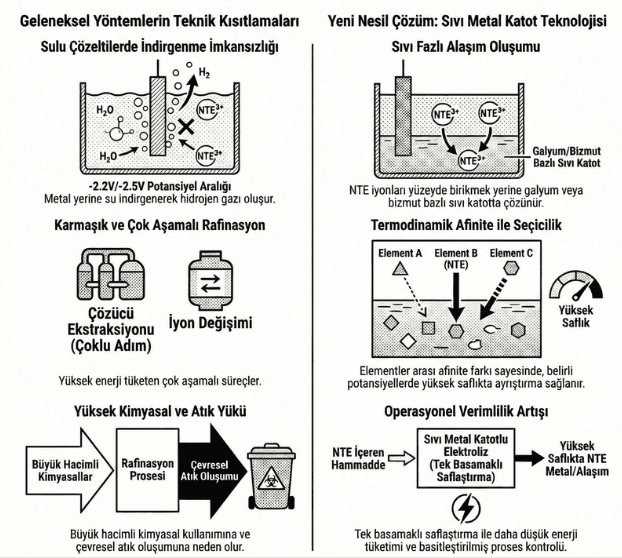
Technological Transformation in REE Refinement (Generated by Artificial Intelligence)
Traditional separation techniques—particularly fractional crystallization, ion exchange, and precipitation methods—rely on differences in solubility or binding affinity. Due to the minimal physicochemical differences between lanthanides, these techniques alone cannot provide sufficient selectivity; therefore, industry employs multi-stage, hundreds-step solvent extraction cascades. In these systems, each stage achieves only a very slight separation, requiring long process chains to reach the desired purity level. As a result, lanthanide contraction is the fundamental principle explaining why the chemical separation of rare earth elements is among the most complex hydrometallurgical processes in the world.
This phenomenon also influences the properties of elements in later parts of the periodic table, not only rare earth chemistry. For instance, due to lanthanide contraction, 5d transition metals exhibit atomic radii closer to those of 4d metals than expected; this shapes many properties, from chemical reactivity to alloy behavior. Thus, lanthanide contraction is not merely an atomic size effect but is recognized as one of the fundamental concepts in modern materials science and elemental chemistry.
The primary technology used for commercial separation of REEs is liquid-liquid solvent extraction (SX). This method exploits the minimal differences in distribution coefficients of REE ions between immiscible aqueous and organic phases.
The standard reduction potentials of rare earth elements (REEs) are highly negative (approximately −2.2 V to −2.5 V). These values make electrochemical reduction in aqueous solution practically impossible, as water molecules are reduced before the metal ions, producing hydrogen gas. Consequently, classical aqueous electrolysis methods are unsuitable for REE production. Therefore, industrial-scale metallic refinement is carried out in anhydrous systems such as molten salt electrolysis at high temperatures. These environments typically consist of fluoride- or chloride-based salt mixtures that enhance both ionic conductivity and metal recovery efficiency.
Traditional REE separation processes rely on multi-step solvent extraction, ion exchange, and incremental purification steps. However, these methods require high energy consumption, complex process control, and large volumes of chemicals. To mitigate these challenges, recent research has focused intensively on “single-step purification” approaches. Among the most promising technologies in this context is liquid metal cathode electrolysis systems.
In this modern method, the cathode is not a solid metal but a liquid alloy (e.g., based on gallium, bismuth, or tin). During electrolysis, reduced rare earth metal ions dissolve into the liquid metal phase rather than depositing on the cathode surface, forming an alloy. The basis of separation in this process lies in the thermodynamic affinity differences between the liquid metal and various REE ions. Since each rare earth element forms alloys of different stability with the liquid cathode metal, selective reduction of specific elements can be achieved by applying appropriate potential ranges. This aims to achieve high-selectivity purification without the need for multi-step chemical separation chains.
Advantages of this approach include lower chemical consumption, reduced waste generation, improved energy efficiency, and potential for process simplification. However, research is still ongoing to address challenges related to alloy stability, electrode durability, molten salt stability, and process kinetics before the method can be widely adopted industrially. Current studies focus on optimizing electrochemical parameters and thoroughly analyzing alloy phase diagrams to enhance the commercial feasibility of this technology.
Türkiye has emerged in recent years as one of the most strategically significant countries regarding rare earth elements (REEs). The approximately 694 million ton ore reserve identified in the Eskişehir-Beylikova (Kızılcaören) region holds global strategic importance due to its REE content and diversity. This deposit is regarded as the second-largest REE deposit in the world after Bayan Obo in China. The reserve is not only significant in volume but also constitutes a multi-component strategic resource due to its co-occurrence with other critical minerals such as boron, fluorite, barite, and thorium.
Research indicates that Türkiye’s primary strategic goal in this field is not to remain merely a raw ore exporter but to become a value-chain country engaged in processing, separation, and production of advanced technology materials. In this direction, pilot-scale enrichment and refining facilities have been established, and domestic process technologies are being developed to extract, purify, and upgrade REE oxides from ore to industrial-grade quality. These pilot plants play a critical role in testing technical feasibility and generating engineering data for full-scale industrial production.
Another dimension of the strategic vision is to avoid exporting REEs solely as raw materials and instead produce high-value intermediate and final products within Türkiye, such as magnets, battery components, defense industry alloys, optoelectronic materials, and renewable energy technologies. This approach aims to gain influence in global critical mineral supply chains and reduce external dependency.
From a geopolitical perspective, rare earth elements are now indispensable raw materials for energy transition, electric vehicles, wind turbines, microchip manufacturing, and defense technologies. Therefore, Türkiye’s substantial reserves are viewed not only as an economic asset but also as a strategic advantage in terms of technological independence and national security.
.
Lyon, Kevin L. “Separation of Adjacent Rare Earth Elements Using Solvent Extraction.” Master's thesis,Idaho Üniversitesi, 2016. Accessed February 11, 2026. https://objects.lib.uidaho.edu/etd/pdf/Lyon_idaho_0089N_10815.pdf
Srivastava, Vaibhav, Joshua Werner ve Rick Honaker. “Design of Multi-Stage Solvent Extraction Process for Separation of Rare Earth Elements.” Mining 3, sy. 3 (2023): 552–578. Erişim 11 Şubat 2026. https://www.mdpi.com/2673-6489/3/3/31
Tural, Servet, Yusuf Kenan Haspolat, and Bilsen Tural. *Nadir Toprak Elementleri: Gizli Güçler 1.* Ankara: Orient Yayınları, 2025. Accessed February 11, 2026. https://orientyayinlari.com.tr/magaza/spor/nadir-toprak-elementleri-gizli-gucler-1/


NTE Oxides
Generated by Artificial Intelligence
Valence | Chemical equivalence +3 oxidation state | ||||||||
|---|---|---|---|---|---|---|---|---|---|
Isomorphism | Co-precipitation Similar crystal structure | ||||||||
Lanthanide Contraction | Picometer differences Ionic radius contraction | ||||||||
Transition Metals | Electron shielding 4f orbitals | ||||||||
Lanthanides | La (57) - Lu (71) | ||||||||
Crystallography | Atomic Physics | ||||||||
No Discussion Added Yet
Start discussion for "Purification of Rare Earth Elements" article
Scientific Foundations of Separation Challenges
Lanthanide Contraction
Industrial Purification Methods
Metallic Refinement and Modern Approaches
Strategic Position in Türkiye