



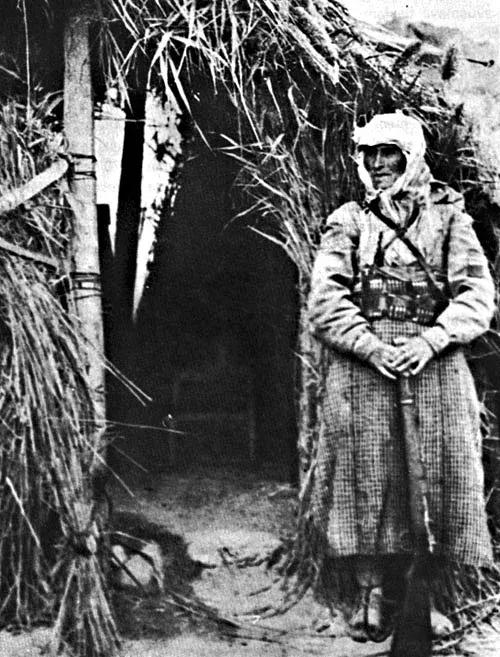
Rahime Hatun
Birth Year | 1890 | ||||||||
|---|---|---|---|---|---|---|---|---|---|
Death Year | 1920 | ||||||||
Birth Place | Osmaniye, Türkiye | ||||||||
Title(s) | Rahime Onbaşı Tayyar (Uçan) | ||||||||
Rahime Hatun was born in 1890 in the Kanlıgeçit neighborhood of Kayalı village (formerly known as Raziyeler), Osmaniye. Her father’s name was Abdullah, and her mother’s name was Hatice. The region where she lived, Cebelibereket, was a strategically significant settlement area during that period, characterized by its mountainous and forested terrain, playing an important role in both the Ottoman settlement policies and the National Struggle.
Although documented details about Rahime Hatun’s early life are limited, her conduct during the years of resistance reveals a courageous, aggressive, and warrior-like character. When armed resistance movements against the French occupation began, she joined a local militia group organized by Hüseyin Ağa. After joining the group, Rahime Hatun was granted the rank of “onbaşı” (corporal), and she was commonly referred to in local sources as “Rahime Onbaşı.” During the struggle, she primarily served as a cavalry soldier but also fought as an infantry soldier in certain engagements. Due to her agility and rapid movements on the battlefield, she earned the nickname “Tayyar” (the Flying One).
Among the actions attributed to her, not only her military skill but also her moral and leadership influence stand out. It is recounted that during one battle, when morale was low, she turned to her comrades and said:
"I am a woman and I do not fear the enemy; why then do you, as men, hesitate?"
Her words rekindled the group’s determination and prompted them to launch a renewed attack.
Such accounts demonstrate that Rahime Hatun functioned not merely as a fighter but also as a figure who sustained the spirit of resistance. However, since these narratives are rooted in local collective memory and memoirs, a cautious approach is required in historical interpretation. In this sense, Rahime Hatun’s biography has been shaped as much by social memory as by historical events.
Rahime Hatun’s involvement in the Kuva-yi Milliye resistance began after Osmaniye was occupied by the French. On 25 December 1918, Osmaniye was first occupied by British forces and then by French troops. The French forces, in collaboration with local Armenian elements, implemented repressive and violent policies against the local population, which triggered the emergence of armed resistance movements in Osmaniye and its surroundings.
During this period, Rahime Hatun joined the resistance group led by Hüseyin Ağa, which operated in the Kanlıgeçit region. The resistance units employed guerrilla-style defense and attack tactics, taking advantage of the region’s mountainous and forested terrain.
Rahime Hatun’s participation in the militia was not merely symbolic but an active engagement in armed struggle. The rank of “onbaşı” conferred upon her is evidence of this active role. According to sources, she served as a cavalry soldier and frequently fought in the front lines.
The exact number of battles Rahime Hatun participated in remains unknown, but one of the most significant was the raid on 5 August 1920 in Alibeyli neighborhood, Osmaniye, during which she lost her life.
Rahime Hatun’s life ended during one of the most intense phases of the resistance against the French occupation forces in Osmaniye. On 5 August 1920, a raid was planned against the house of Hacı Ökkeş Ağa in Alibeyli neighborhood, Osmaniye, which had been used by French forces as a headquarters. Rahime Hatun actively participated in this raid. The engagement is recorded as one of the direct attacks carried out by local resistance forces against the French. During the raid, fierce fighting erupted, and due to intense enemy fire, the resistance groups temporarily lost their positions. Rahime Hatun was severely wounded by enemy fire. At the moment of her death, she is reported to have turned to her comrades and said:
"Comrades, do not let my body fall into enemy hands."
She then attained martyrdom. Her words and demeanor during this moment reveal that she was not only a resistance fighter but also a figure who consciously embraced the meaning of her own death.
Following this incident, her body was removed from the battlefield by her comrades before it could be captured by the enemy and later buried in the Osmaniye Martyrs’ Cemetery. On her tombstone, the following quatrain commemorates her spirit of resistance and sacrifice:
“O youth, heir to tomorrow, know well
The one who lies here in eternal peace
For the sake of truth, for the sake of the flag, gave his life
And bequeathed to you the sacred homeland.”
Rahime Hatun, as one of the 65 resistance fighters who fell in this battle, holds an important place in the history of Osmaniye’s liberation.
Kütükçü, Murat. “Hatıralarda Osmaniye’nin Kurtuluş Mücadelesi.” Tarih Araştırmaları Dergisi 41, no. 71 (2022): 483–495. https://dergipark.org.tr/tr/pub/tariharastirmalari/issue/69248/1066570
Ministry of National Education of the Republic of Türkiye. "Rahime Hatun Kimdir?" Rahime Hatun Vocational and Technical Anatolian High School Official Website. Accessed June 6, 2025. https://rahimehatunmtal.meb.k12.tr/icerikler/rahime-hatun-kimdir_32431.html
Payaslı, Volkan. “Fransız İşgalinde Osmaniye (Cebel-i Bereket) ve Rahime Hatun Üzerine Bir Değerlendirme.” Atatürk Yolu Dergisi 61 (Fall 2017): 269–308. https://dergipark.org.tr/en/pub/ankuayd/article/542484
Önder, Ali Rıza. “Cebelibereket Sancağı ve Rahime Hatun.” Paper, Osmaniye and Surroundings’ 100th Anniversary of Liberation from Occupation International Symposium, January 5–7, 2022. https://turkoloji.cu.edu.tr/turkoloji_cu_edu_tr/CUKUROVA/sempozyum/semp_1/onder_2.pdf
Şavkılı, Cengiz, and Oğuz Kösesler. “Millî Mücadele’nin Çukurova Havalisinde Kadın ve Çocuklar.” Kahramanmaraş Sütçü İmam Üniversitesi Sosyal Bilimler Dergisi 20, no. 1 (2023): 258–276. https://dergipark.org.tr/tr/pub/ksusbd/issue/77055/1221086

Rahime Hatun
Birth Year | 1890 | ||||||||
|---|---|---|---|---|---|---|---|---|---|
Death Year | 1920 | ||||||||
Birth Place | Osmaniye, Türkiye | ||||||||
Title(s) | Rahime Onbaşı Tayyar (Uçan) | ||||||||
Participation in and Struggle with the Kuva-yi Milliye
Martyrdom and Final Battle