

This article was automatically translated from the original Turkish version.
+2 More
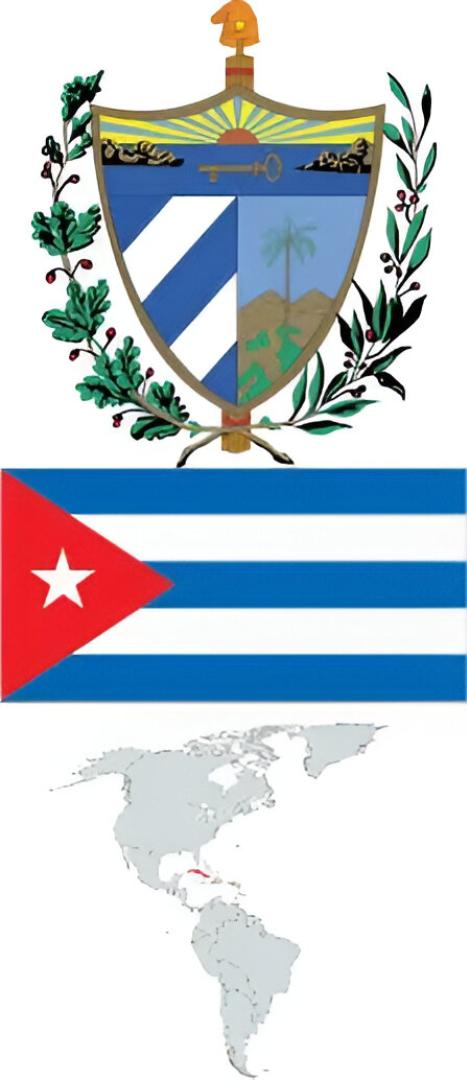
Republic of Cuba
Official Name | Republic of Cuba (República de Cuba) | ||||||||
|---|---|---|---|---|---|---|---|---|---|
Form of Government | Single-party socialist republic | ||||||||
Date of Independence | 1 Ocak 1959 (Küba Devrimi'nin Zaferi) | ||||||||
Capital | Havana (La Habana) | ||||||||
Head of State | Miguel Díaz-Canel (President of the State and First Secretary of the Communist Party of Cuba) | ||||||||
Official Languages | Spanish | ||||||||
Common Languages | Spanish | ||||||||
National Day | January 1 (Liberation Day / Victory of the Revolution) and July 26 (National Rebellion Day) | ||||||||
Area | 110,860 km² | ||||||||
Total Population | ~11.08 million | ||||||||
Climate | Tropical climate | ||||||||
GDP (Nominal) | ~81.165 billion USD | ||||||||
GDP per Capita | ~23,700 USD | ||||||||
Ethnic Groups | %64.1 White %26.6 Mixed (Mulatto/Mestizo) %9.3 Black | ||||||||
Religious Affiliation | Secular, predominant beliefs: Roman Catholicism and Santería (Afro-Cuban belief) | ||||||||
Telephone Code | +53 | ||||||||
Internet Domain Code | .cu | ||||||||
The Republic of Cuba is an island nation encompassing the largest island in the Caribbean Sea. Geographically, it lies at the eastern end of the North American continent. Cuba is separated from the United States and the Bahamas to the north by the Florida Strait, from Haiti to the east by the Windward Passage, and from Mexico to the west by the Yucatán Channel. The country has a total land area of approximately 110,860 square kilometers and a coastline of about 1,250 kilometers. Its capital and largest city is Havana.

The Antonio Maceo Monument Located in Havana, the Capital of Cuba (AA)
Since the 1959 Revolution, Cuba has been governed as a one-party socialist republic. The country’s political system is defined by its constitution, which identifies the Communist Party of Cuba (PCC) as the leading force of society and the state. The president of the state may also serve as the first secretary of the Communist Party of Cuba.
Demographically, the vast majority of Cuba’s population speaks Spanish. The society’s origins are a mixture of Spanish, African, and mixed-race (mulatto/mestizo) heritage. Catholicism is the most widespread religious belief, often blended with African-derived traditional beliefs in a syncretic structure.
The economy is based on the centralized planning system adopted after the revolution. A large portion of the means of production is state-owned. The primary agricultural product is sugarcane. Since the economic crisis of the 1990s known as the “Special Period,” the economy has evolved toward a mixed (hybrid) model that permits tourism and limited private enterprise (cuentapropista) initiatives.
The economic embargo imposed by the United States since the 1960s is viewed as the primary factor limiting Cuba’s foreign trade and financial access. Cuba is distinguished by its social policies; education and healthcare services are free, and it maintains strong international ties, particularly with Russia and China.
Human settlements on the island of Cuba date back to 2000 BCE. These early communities arrived on the island as part of migration movements across the Caribbean. Over time, three main indigenous groups developed culturally distinct identities: the Guanahatabey, the Ciboney, and the Taíno. The Guanahatabey lived as small, mobile hunter-gatherer groups that did not produce ceramics and used simple stone tools. The Ciboney had a more advanced material culture and subsisted through fishing and limited agriculture. The Taíno, who constituted the largest portion of the island’s population, were of Arawak origin and developed a more complex social structure based on agriculture, pottery production, and hierarchical chieftaincies. Cassava, sweet potato, and maize cultivation formed the economic foundation, while religious rituals and ceremonial sites were central to social life. Just before Spanish contact, the indigenous population is estimated to have numbered between 100,000 and 300,000 people.
Christopher Columbus reached the Cuban coast in 1492 and claimed the island for the Kingdom of Castile. Permanent settlement began in 1511 with the founding of Baracoa by Diego Velázquez de Cuéllar, followed shortly by the establishment of new settlements such as Santiago de Cuba and Havana. During this period, the indigenous population faced harsh labor and taxation systems imposed by Spanish colonial authorities.
Under the encomienda system, forced labor, the collapse of social structures, and epidemics introduced from the Old World—such as smallpox, influenza, and measles—decimated the indigenous population within a few decades. The discovery of the island by Christopher Columbus in 1492 and the permanent establishment of Spanish colonial rule in 1511 triggered a demographic collapse among the native population. This decline was caused both by the lack of immunity to Old World diseases and by the systematic exploitation inherent in the Spanish forced labor regimes.
Cuba’s strategic location at the center of Spanish trade routes in the Americas made it vital. Havana became a gathering port for Spanish silver fleets and a key military base in the Caribbean defense network. During this period, the island’s economy initially relied on livestock and tobacco production, and by the 17th and 18th centuries, Cuban tobacco gained international renown. The British occupation of Havana from 1762 to 1763 disrupted the island’s economic structure and paved the way for large-scale importation of African slaves. After Spain regained control, reforms implemented by the Spanish government encouraged the rapid expansion of sugar production.
In the 19th century, Cuba became one of the world’s leading centers of sugar production. Rising international demand due to the Industrial Revolution, the production vacuum created by the Haitian Revolution, and the adoption of modern sugar machinery transformed Cuba into a monoculture sugar economy. The labor-intensive nature of sugar cultivation led to the forced importation of hundreds of thousands of African slaves. By the mid-century, the slave population in Cuba exceeded 400,000, and the economy became heavily dependent on this system. As international pressure led to the end of the Atlantic slave trade from the 1860s onward, a labor shortage emerged. To fill this gap, contract laborers were brought from China. However, these workers were subjected to conditions closely resembling slavery.
By the late 19th century, corruption and lack of political representation under Spanish rule triggered nationalist movements.
The Ten Years’ War (1868–1878) was the first major armed conflict launched by Cuba against Spanish colonial rule. Initiated by sugar plantation owners and anti-slavery elements, the war laid the foundation for the emergence of Cuban nationalism and deepened the desire for independence. Although the Spanish forces suppressed the rebellion and did not immediately grant independence, the conflict provided crucial experience and served as a symbolic beginning for future struggles. Limited outcomes included the gradual abolition of slavery (1886) and some reforms by the Spanish government.
One of the most important figures to emerge from this first major struggle was José Martí. Martí, the intellectual and symbolic leader of Cuban independence, established the moral and ideological foundation of the movement. He sought not only to end Spanish rule but also to prevent potential U.S. intervention and to establish a fully independent, democratic republic inclusive of all Cubans, free from racial discrimination.
To promote these ideals and unite Cubans in exile, he founded the Cuban Revolutionary Party (Partido Revolucionario Cubano) in 1892. In the early stages of the Second War of Independence, which he launched in 1895, Martí was killed in the Battle of Dos Ríos. His sacrifice and dedication transformed him into a moral and spiritual cornerstone of Cuban nationalism, earning him the title “Apostle of the Fatherland.”
Cuba’s path to independence became complicated when the United States declared war on Spain in 1898. The sinking of the USS Maine in Havana harbor provided the U.S. with a pretext for military intervention. After the Spanish-American War, Cuba declared independence under U.S. military occupation.
In 1901, the United States inserted the Platt Amendment into the Cuban constitution, granting itself the right to intervene in Cuba’s internal and external affairs and to establish a naval base at Guantánamo Bay. This mechanism severely restricted Cuban sovereignty until its repeal in 1934.
Despite the repeal of the Platt Amendment, U.S. economic and political influence persisted. Fulgencio Batista seized power in a 1952 coup and established a dictatorship. The Batista era was characterized by large U.S. investments, particularly in tourism and gambling, which fostered widespread corruption and a perception of foreign dependency.
The deepening social inequalities and increasing repression under Fulgencio Batista’s regime culminated in the successful 1959 revolution led by Fidel Castro and the 26th of July Movement. The new government established after the revolution quickly embarked on a profound economic transformation. Key steps included large-scale nationalizations of private property, including assets owned by American companies, and land reforms aimed at alleviating rural poverty.
Among the revolution’s key commanders, Ernesto "Che" Guevara served as both Minister of Industry and President of the Cuban Central Bank during this period and became one of the principal architects of the nationalizations and the transition to a centrally planned economy. To defend the revolution and mobilize the population, popular militias (milicias) were established early on. These militias, composed of loyal citizens, rapidly organized as a security force alongside the traditional military to counter internal and external threats.
These nationalizations, which directly targeted U.S. interests, prompted the U.S. government to impose a comprehensive economic embargo beginning in 1960. This U.S. retaliation pushed Cuba to seek alternative economic and military support to avoid economic collapse, leading the country to align closely with the Soviet Union (USSR) and formally adopt a socialist path.
The Bay of Pigs Invasion was a failed attempt by a U.S.-backed and financed paramilitary force composed of Cuban exiles (Brigade 2506) to overthrow Fidel Castro’s government by landing on Cuba’s southern coast.
With the approval of U.S. President John F. Kennedy, the operation failed within three days due to the lack of expected local popular support and the effective resistance of the Cuban Armed Forces. This failure strengthened Castro’s domestic authority and legitimacy and significantly increased Cuba’s dependence on the Soviet Union for future security guarantees.
The Cuban Missile Crisis emerged when U.S. U-2 spy planes detected the secret deployment of Soviet medium-range ballistic missiles capable of carrying nuclear warheads on Cuban soil. It became the most critical nuclear confrontation of the Cold War. U.S. President Kennedy imposed a naval “quarantine” on the region and demanded the immediate removal of the missiles.
The crisis was resolved through secret and open diplomatic negotiations between U.S. and Soviet leaders. The Soviets agreed to withdraw the missiles, and in return, the United States gave a formal assurance not to invade Cuba. This resolution solidified the survival of the Cuban regime and laid the groundwork for the first steps toward global nuclear arms control.
The Cuban Crisis caused a major shake-up in Turkey’s trust in the United States. During secret negotiations to resolve the crisis, the Soviet Union (USSR) proposed the removal of 15 U.S. nuclear Jupiter missiles stationed in Turkey as part of the deal. The United States committed to removing these missiles without consulting the Turkish government. This led to the perception in Turkey that it had been abandoned by the United States and that a critical decision regarding its national security had been made without its involvement.

Wall Mural Depicting Fidel Castro, Che Guevara, Camilo Cienfuegos, and Raúl Castro, Who Helped Launch the Revolution (CIA the world factbook)
Until 1990, Cuba followed a centrally planned economic model based on significant subsidies provided by the Soviet Union. During this period, Cuba prioritized social welfare programs in health and education and played an active role internationally.
The collapse of the Soviet Union in 1991 and the cessation of its aid triggered the “Special Period in Time of Peace,” a crisis that caused an 80% collapse in foreign trade and severe shortages of energy and food. Despite drastically reducing defense spending, the government implemented a “humane austerity” policy to preserve social gains. This crisis necessitated economic reforms, including a shift toward tourism investment and the allowance of limited private sector initiatives.
The Raúl Castro era (post-2008) led to the emergence of a “public-private hybrid” economic model, maintaining state control while introducing reforms such as leasing state land and encouraging self-employment.
Today, Cuba continues to exist as a one-party authoritarian state. Economic stagnation, exacerbated by the U.S. embargo since the 1960s and structural problems, triggered the largest migration wave in modern history after 2021. Cuba seeks to mitigate the effects of the U.S. blockade by strengthening ties with new global powers such as China and Russia, continuing its geopolitical balancing strategy.
The national anthem of the Republic of Cuba, "La Bayamesa", is regarded as one of the most important symbols of Cuba’s struggle for independence. Its origins date back to the Ten Years’ War (1868–1878), during which Cuba fought against Spanish colonial rule. The music was composed in 1868 by Cuban composer and revolutionary Pedro (Perucho) Figueredo and rapidly became a patriotic and revolutionary anthem following the war’s outbreak.
It acquired its name, “The Song of Bayamo,” after the city of Bayamo, Figueredo’s birthplace, was captured by insurgents on October 20, 1868. The lyrics, also written by Figueredo, carry a combative and militant message, calling on the Cuban people to resist Spanish domination, fight for freedom, and refuse to surrender. One line reads: “Morir por la Patria es vivir.” (To die for the Fatherland is to live.) “La Bayamesa” was officially adopted as the national anthem in 1902 upon the founding of the Republic of Cuba and continues to represent the spirit of Cuban independence and national sovereignty.
Cuban National Anthem (Ian Berwick)
The national symbol of the Republic of Cuba, known as the “Flag of the Lone Star” (La Bandera de la Estrella Solitaria), emerged during the struggle for independence from Spanish colonial rule. The flag’s basic design was created in 1849 by Venezuelan General Narciso López while in exile in New York, and its final design was completed by the poet Miguel Teurbe Tolón. First used in 1850 as a rebel banner during independence expeditions, the flag was officially adopted as the national flag on May 20, 1902, when Cuba gained full independence from the United States. The symbolism of the flag includes: three blue stripes representing the three military regions that formed the country; two white stripes symbolizing the purity and justice of the independence ideal; the red equilateral triangle on the hoist side representing the blood shed for independence and the principles of liberty, equality, and fraternity; and the white five-pointed star in the center emphasizing Cuba’s absolute sovereignty and independence.
The Republic of Cuba is an archipelago consisting of the island of Cuba—the largest in the Caribbean Sea—and approximately 1,600 smaller islands and islets. The country’s total land area is approximately 110,860 square kilometers. Cuba’s location has held critical geopolitical importance throughout history, as it lies at the entrance to the Gulf of Mexico and just north of the Tropic of Cancer. Cuba’s second most important island is Isla de la Juventud (Isle of Youth), located south of the main island.

Map of the Island of Cuba in the Caribbean Sea (CIA World Factbook)
Coastline and Borders: Cuba’s coastline is approximately 3,735 kilometers long. Cuba’s only land border is the 29-kilometer boundary with the U.S. Naval Base at Guantánamo Bay on Cuban territory.
Due to its geographic position, Cuba was historically known as the “Key to the Gulf” of the Spanish Empire and became the geographic center of superpower rivalry between the United States and the Soviet Union during the 20th century.
The island of Cuba is long and narrow, stretching approximately 1,250 kilometers in length. Topographically, the country is divided into two main structural regions.
Approximately three-quarters of the country’s territory consists of extensive, fertile plains. These lowlands enable intensive agricultural activity, particularly sugarcane cultivation.
One-quarter of the country consists of mountainous regions. The most important mountain range is the Sierra Maestra, located in the southeast. Cuba’s highest point, Turquino Peak (2,005 meters), is located in this range.
Hydrologically, Cuba is rich in water resources, but disparities in water infrastructure and urban-rural access create administrative challenges. The country’s longest river is the Rio Cauto, approximately 370 kilometers long.
Cuba generally has a subtropical climate. The average annual temperature is around 26°C, with minimal seasonal temperature variation. The climate is divided into two main seasons.
Rainy Season (May–October): The majority of annual rainfall occurs during this period.
Dry Season (November–April): Short periods of cooling may occur due to cold winds from the north.
Due to its geopolitical position, Cuba is highly vulnerable to severe tropical hurricanes, particularly in September and October each year.
Cuba’s natural resources and geographic location have played a central role in its economic and political history.
Mineral Resources: Cuba possesses significant reserves of nickel and cobalt. The country hosts a major portion of the world’s nickel production and cobalt reserves. It also has deposits of chromite, manganese, and copper, as well as industrial minerals such as gypsum, kaolin, and marble.
Land Use: Fertile lateritic soils (rich in nickel and cobalt) are crucial not only for mining but also for agriculture.
Although Cuba’s energy sector demonstrates high success in electricity access, it is characterized by excessive dependence on fossil fuels for generation.
According to 2023 estimates, the country’s installed electricity generation capacity stands at 7,264 million kW. Annual electricity consumption is recorded at 11,951 billion kWh. However, high transmission and distribution losses of 3,352 billion kWh represent a critical issue in supply-demand balance.
The distribution of electricity generation sources shows that the vast majority of energy comes from fossil fuels. 95.2% of total installed capacity relies on fossil fuels. The share of renewable energy sources is very low:
Oil is the most significant element demonstrating Cuba’s import dependency in its energy policy. In 2023, daily oil production was estimated at 34,000 barrels, while refined petroleum consumption reached 118,000 barrels per day. This large gap indicates that a significant portion of refined petroleum needs is met through imports. Crude oil reserves were estimated at 124 million barrels as of 2021.
Natural gas production and consumption in 2023 were balanced at 850.133 million cubic meters. Proven natural gas reserves (2021 estimate) stand at 70.792 billion cubic meters.
Coal consumption is low (2023 estimate: 1,000 metric tons), but the majority of consumed coal—8,000 metric tons—is imported. The annual per capita energy consumption, indicating energy intensity, was recorded at 26.07 million Btu/person in 2023.
The country employs a comprehensive infrastructure comprising air, rail, and maritime transport to meet transportation needs.
In aviation, the prefix CU is used for civil aircraft registration. As of 2025 data, Cuba has 120 airports, placing it 43rd globally in terms of airport count. Additionally, there are four heliports.
The railway network, according to 2017 data, totals 8,367 kilometers in length. The majority of this network, 8,195 kilometers, consists of standard gauge (1,435 mm), of which 124 kilometers are electrified. The narrow gauge (1,000 mm) network is 172 kilometers long. As of 2013, 70 kilometers of standard gauge and 12 kilometers of narrow gauge lines were closed to public use.
According to 2017 data, the railway network has a total length of 8,367 kilometers. The majority of this network consists of standard gauge, with only a limited portion electrified. In maritime transport, the commercial fleet consists of 65 vessels.
Ports: As of 2024, the country has a total of 34 ports. Six are classified as major and three as medium-sized. Notably, 14 ports have oil terminals, highlighting their critical role in energy trade. Key ports include Bahía de la Habana, Cienfuegos, and Santiago de Cuba.
The Cuban economy was shaped by strong ties with the Soviet Union (USSR) following the 1959 Revolution and a centrally planned socialist system. The collapse of the USSR (1991) and the long-standing U.S. trade embargo are the primary structural challenges affecting the economy. This situation led to a major economic crisis in the 1990s known as the “Special Period.”
The state owns the majority of the means of production, and state control over the economy remains high. Although limited reforms have been introduced in recent years to encourage small and medium-sized private enterprises and foreign investment, bureaucracy and infrastructure deficiencies constrain economic growth. Key sources of income for the economy include exported medical services and personnel, tourism, and remittances from Cubans abroad. The country remains heavily dependent on imports for basic needs such as food and fuel.
In financial terms, Cuba previously operated a dual currency system (CUC and CUP), but in 2021 it transitioned to a single currency (Cuban Peso – CUP). Nevertheless, due to high inflation and disruptions in the supply chain of essential goods, foreign currency (particularly the U.S. dollar) is widely used in illegal trade.
The following data are presented in constant 2015 U.S. dollar prices:
According to 2023 estimates, the majority of Cuba’s GDP, 70%, is generated by the Services Sector. The industrial sector accounts for 27.5%, and the agricultural sector only 1.3%. The composition of GDP by final use is largely based on household consumption (73.3%) and government consumption (25.5%); exports of goods and services account for 43.5%.
In agriculture, 21% of the labor force is employed, yet due to insufficient production, the country meets 80% of its food needs through imports. In industry, mining, tobacco, and sugar manufacturing are prominent.
The country’s production structure shows diversity in both agriculture and industry. Agricultural products hold significant weight by tonnage. According to 2023 estimates, the top ten most produced products are:
In industry, the main sectors are petroleum, nickel, cobalt, pharmaceuticals, tobacco, construction, steel, cement, agricultural machinery, and sugar. However, industrial production growth rate in 2023 is estimated at -0.9%, indicating a contraction.
Foreign trade data show that Cuba’s export value declined from $14.53 billion in 2018 to $8.768 billion in 2020. According to 2023 data, Cuba’s main export partners are China (34%) and Spain (12%), followed by Germany, Switzerland, and Hong Kong. The top five export products by value are tobacco, nickel, liqueur, zinc ore, and precious metal ore.

Pie Chart Showing Cuba’s Export Destinations (Ministry of Trade)
A similar decline is observed in imports: import estimates fell from $12.567 billion in 2018 to $8.067 billion in 2020. As of 2023, the main import partners are Spain (24%) and China (13%), with the Netherlands, the United States, and Canada also playing significant roles. Major import items include beer, poultry, rice, plastic products, and soybean oil.

Pie Chart Showing Cuba’s Import Origins (Ministry of Trade)
Cuba opened its doors to foreign capital through the Investment Law No. 50, in effect since 1982, which permits joint ventures with Western companies. However, significant steps were taken under the “Guidelines for Economic and Social Policy” adopted in 2011 to restructure the economy and attract more foreign investment.
The most critical development in this area was the enactment of Foreign Investment Law No. 118/2014 on June 28, 2014. This law establishes the main framework for foreign investment regulations. Other complementary regulations include:
To reduce the tax burden on international investors, Cuba has signed Double Taxation Avoidance Agreements (DTAAs) with Spain, Russia, China, Canada, Austria, Vietnam, Portugal, Lebanon, Qatar, Italy, Ukraine, and Venezuela.
Turkey and Cuba held their first round of negotiations for a Double Taxation Avoidance Agreement (DTAA) in 2002, but no agreement was reached. At the most recent technical meetings in 2019, Cuban authorities indicated that progress in negotiations requires first updating their national legislation and completing tax reform processes.
The Republic of Cuba has signed 63 Investment Promotion and Protection Agreements (IPPA) with countries worldwide to enhance investor confidence. The IPPA between Turkey and Cuba was signed in 1997 and entered into force. It was published in the Official Gazette of the Republic of Turkey in 1999, establishing mutual promotion and legal protection of investments between the two countries.

Graph Showing Turkey’s Main Export Products to Cuba (Ministry of Trade)
Cuba is an island nation in the northern Caribbean with a land area of 109,820 square kilometers. As of 2025, the country’s population is approximately 10.9 million. The population growth rate is negative, and the population has been declining in recent years due to low birth rates and emigration. Approximately 77.5% of the population lives in urban areas, and the urbanization rate increases annually by an average of 0.19%.
The most densely populated region is the capital, Havana, which houses approximately one-fifth of the country’s population. Santiago de Cuba, Camagüey, and Holguín are other major urban centers. The majority of the population is concentrated in the western and central regions. The eastern regions, due to their mountainous terrain and limited infrastructure, are more sparsely populated.
Approximately 64% of Cuba’s population is White, 26% is Mixed-race (Mulatto), and 9% is Black. Historically, ethnic diversity emerged from Spanish migration and the mixing of African communities. This structure is reflected in the country’s cultural richness and artistic diversity.
The majority of Cubans are Christian; Catholicism is the most widespread belief system. Protestant communities and local religious traditions such as Santería, known as Afro-Cuban beliefs, are also influential. Religious freedom is constitutionally guaranteed, but historically, the socialist state structure has limited the influence of religion in public life.
As of 2024, 16.4% of Cuba’s population is aged 0–14, 66.8% is aged 15–64, and 16.8% is aged 65 and over. The average age is 42.3 years, reflecting the country’s aging population. The fertility rate is 1.7 children per woman, and the infant mortality rate is 4.4 per 1,000 live births. Life expectancy is 79.9 years; 77.5 years for men and 82.4 years for women. Cuba is among the countries in Latin America with the highest life expectancy.

Graph Showing Age Distribution by Gender in Cuba (CIA World Factbook)
The migration rate is negative, as a portion of the young population emigrates for economic and professional reasons. Emigration, particularly to the United States and European countries, affects the domestic labor force structure and age distribution.
Illegal emigration from Cuba remains an ongoing issue toward the United States. Migrants use various methods, from homemade rafts to forged visas. After the normalization announcement in December 2014, the number of migrants increased, but declined after the end of the “wet foot, dry foot” policy in 2017.
Wet Foot, Dry Foot Policy is a policy that treats Cuban migrants differently depending on where they are apprehended.
“Dry Foot” refers to Cuban migrants who reach U.S. territory by any means, even illegally, and are granted, under the 1966 Cuban Adjustment Act, the right to apply for permanent residency (Green Card) after one year.
“Wet Foot” refers to Cuban migrants intercepted by the U.S. Coast Guard at sea before reaching land and who are generally returned immediately to Cuba.
The primary aim of this policy was to discourage Cubans from undertaking dangerous sea journeys while offering a refuge to those fleeing Cuba. At the end of this policy, U.S. President Barack Obama terminated it on January 12, 2017 as part of efforts to normalize relations with Cuba. Since then, Cuban migrants have been subject to the same general immigration laws applied to citizens of other countries; even if they reach U.S. soil illegally, they no longer automatically qualify for residency rights.
Cuba’s education system, established after the 1959 Revolution, is entirely public and centralized. Education and healthcare services are recognized as constitutional rights for all citizens and are provided free of charge from preschool through higher education. Cuba allocates a significant portion of its GDP (over 10%) to education, demonstrating its strong commitment to this sector.
1961 National Literacy Campaign: The most critical turning point in education was the 1961 National Literacy Campaign. Before the revolution, literacy rates in rural areas were as low as 22%. Within a few months, this campaign dramatically increased literacy levels.
Cuba’s higher education system is centrally managed and supervised by the Ministry of Higher Education (Ministerio de Educación Superior, MES). This system provides higher education exclusively through public institutions.
The philosophy of higher education, transformed after the Cuban Revolution, is based on humanism, scientific approach, social benefit, and free education. The system aims to integrate learning with work, ensuring that universities directly contribute to the country’s socio-economic development.
Universities regularly undergo accreditation processes conducted by relevant ministry commissions to ensure the
Anadolu Ajansı (AA). "Cumhurbaşkanı Erdoğan Küba'da." *Anadolu Ajansı* (Photo Gallery). Accessed November 12, 2025.https://www.aa.com.tr/tr/pg/foto-galeri/cumhurbaskani-erdogan-kubada
Anadolu Ajansı (AA). "Karayipler'in turizm cenneti Küba'ya Türklerin ilgisi artıyor." Anadolu Ajansı, January 12, 2024. Accessed November 12, 2025.https://www.aa.com.tr/tr/yasam/karayiplerin-turizm-cenneti-kubaya-turklerin-ilgisi-artiyor/3455201
Ağdemir, Zeynep. "Küba Ekonomisinin ve Kamu Maliyesinin Genel Görünümü." *Mülkiye Dergisi* 39, no. 4 (2015): 109–146. Accessed November 25, 2025.https://dergipark.org.tr/tr/pub/mulkiye/issue/280/1317
Berwick, Ian. "National Anthem: Cuba - La Bayamesa." YouTube video, 0:56. Accessed November 12, 2025.https://youtu.be/SrQYhssHxPw
Castillo, Orlando Gutierrez and Nélida Gancedo Gaspa. "Tourism Development for the Cuban Economy." *ReVista: Harvard Review of Latin America*, December 18, 2002. Accessed November 25, 2025.https://revista.drclas.harvard.edu/tourism-development-for-the-cuban-economy/.
Council on Foreign Relations (CFR). "U.S.-Cuba Relations." Timeline. Accessed November 11, 2025.https://www.cfr.org/backgrounder/us-cuba-relations.
Dış Ekonomik İlişkiler Kurulu (DEİK). "Türkiye-Amerika İş Konseyleri – Türkiye-Küba İş Konseyi." Accessed November 11, 2025.https://www.deik.org.tr/turkiye-amerika-is-konseyleri-turkiye-kuba-is-konseyi.
Feinberg, Richard E., and Richard Newfarmer. "Tourism in Cuba: Engine of Sustainable Growth and Prosperity?" Washington, DC: Brookings Institution, 2016. Accessed November 12, 2025.https://www.brookings.edu/wp-content/uploads/2016/11/fp_20161202_tourism_cuba_feinberg_newfarmer.pdf
Günay, Halil. "İspanyolların, 1492-1902 Yılları Arasında Sömürgeleştirdiği Latin Amerika Bölgesine Demografik, Sosyokültürel ve İdari Yapısına Etkisi." *Aksaray Üniversitesi İktisadi ve İdari Bilimler Fakültesi Dergisi* 16, no. 1 (2024): 39–50. Accessed November 25, 2025.http://aksarayiibd.aksaray.edu.tr/tr/pub/issue/83935/1403986
Henthorne, Tony L., Babu P. George, and Alvin J. Williams. "The Evolving Service Culture of Cuban Tourism: A Case Study." *Tourismos: An International Multidisciplinary Journal of Tourism* 5, no. 2 (2010): 129-143. Accessed November 25, 2025.https://scholars.fhsu.edu/management_facpubs/3/
Highsmith, Carol M. "University of Havana, Cuba." Picryl. Accessed November 12, 2025.https://picryl.com/media/university-of-havana-cuba
Infomed, Universidad de Ciencias Médicas de Villa Clara. "Símbolos Nacionales." *Instituciones.sld.cu*. Accessed November 26, 2025.https://instituciones.sld.cu/ucmvc/simbolos-nacionales/.
Kirkgoz, Mehmet Turgut. "Intersection in Havana, Cuba." Pexels. Accessed November 12, 2025.https://www.pexels.com/photo/intersection-in-havana-cuba-18374370/.
Library of Congress. "La Bayamesa (Hymno Nacional Cubano) [Textual Transcription]."PDF Belgesi. Accessed November 11, 2025. https://tile.loc.gov/storage-services/service/afc/afc1939013/afc1939013_tt0021/afc1939013_tt0021.pdf .
Library of Congress. "World of 1898: International Perspectives on the Spanish American War." Accessed November 12, 2025.https://www.loc.gov/rr/hispanic/1898/marti.html.
Ministry of Higher Education (MES), Cuba. "Estadísticas." *mes.gob.cu.* Accessed November 11, 2025.https://www.mes.gob.cu/estadisticas/.
Ministry of Higher Education (MES), Cuba. "Instituciones de Educación Superior." *mes.gob.cu.* Accessed November 11, 2025.https://www.mes.gob.cu/instituciones-de-educacion-superior/.
Ministry of Higher Education (MES), Cuba. "¿Cómo acceder a la Educación Superior en Cuba?" *mes.gob.cu.* Accessed November 11, 2025.https://www.mes.gob.cu/formacion-profesional/.
Ministry of Trade of the Republic of Turkey. "Cuba Republic Mining Sector Market Research Report."PDF Belgesi. Accessed November 11, 2025.https://ticaret.gov.tr/data/684d9fcd13b876b9c40cb60a/Kuba_Madencilik_Sektoru_Pazar_Arastirmasi_Raporu.pdf.
Morgan, William Alan. *Cuban Tobacco Slavery: Life, Labor and Freedom in Pinar del Río, 1817-1886*. PhD thesis, University of Texas at Austin, 2013. Accessed November 12, 2025.https://repositories.lib.utexas.edu/server/api/core/bitstreams/7781d5a1-e320-41dd-a588-349f59dc93a6/content
Naval History and Heritage Command. "Sinking of USS Maine." history.navy.mil. Accessed November 11, 2025.https://www.history.navy.mil/our-collections/photography/wars-and-events/spanish-american-war/sinking-of-uss-maine.html.
Office of the Historian, U.S. Department of State. "The Cuban Missile Crisis, October 1962." history.state.gov. Accessed November 11, 2025.https://history.state.gov/milestones/1961-1968/cuban-missile-crisis.
Office of the Historian, U.S. Department of State. "The Spanish-American War, 1898." history.state.gov. Accessed November 12, 2025.https://history.state.gov/milestones/1866-1898/spanish-american-war.
Oficina del Historiador de la Ciudad de La Habana (OHCH). "Plan Maestro: Proyecto de Rehabilitación Integral de La Habana Vieja." planmaestro.ohc.cu. Accessed November 12, 2025.http://www.planmaestro.ohc.cu/
Picryl. "Fidel Castro-MATS Terminal, Washington 1959." Picryl. Accessed November 12, 2025.https://picryl.com/media/fidel-castro-mats-terminal-washington-1959-3dc659.
Picryl. "Joint Task Force Guantanamo, Cuba: A JTF-GTMO Trooper." Picryl. Accessed November 12, 2025.
Raka18. "Sunset in Varadero." Flickr. Accessed November 12, 2025.https://www.flickr.com/photos/raka18/6144108037/
Store Norske Leksikon. "Cubas Historie." Accessed November 11, 2025.https://snl.no/Cubas_historie.
Store Norske Leksikon. "Pinar del Río." Accessed November 12, 2025.https://snl.no/Pinar_del_R%C3%ADo.
Szekely, Pedro. "Malecon, La Habana, Cuba." Flickr. Accessed November 12, 2025.https://www.flickr.com/photos/pedrosz/32890855465/.
T.C. Ministry of Trade. "Küba Cumhuriyeti." PDF Belgesi. Accessed November 11, 2025.https://www.kutso.org.tr/wp-content/uploads/2017/06/Kuba.pdf.
U.S. National Archives. "Platt Amendment (1903)." archives.gov. Accessed November 11, 2025.https://www.archives.gov/milestone-documents/platt-amendment.
U.S.A. Central Intelligence Agency (CIA). "Cuba." The World Factbook. Accessed November 11, 2025.https://www.cia.gov/the-world-factbook/countries/cuba/.
U.S.A. Central Intelligence Agency. "Cuba – Photos." The World Factbook. Accessed November 12, 2025.https://www.cia.gov/the-world-factbook/countries/cuba/images/
UNESCO World Heritage Convention. "Old Havana and its Fortification System." whc.unesco.org. Accessed November 18, 2025.https://whc.unesco.org/en/list/204/.
UNESCO World Heritage Convention. "States Parties: Cuba." whc.unesco.org. Accessed November 18, 2025.https://whc.unesco.org/en/statesparties/cu.
UNESCO World Heritage Convention. "Trinidad and the Valley de los Ingenios." whc.unesco.org. Accessed November 18, 2025.https://whc.unesco.org/en/list/460/.
UNESCO. "Küba Eğitim Profili (Educación en Cuba)." PDF Belgesi. Accessed November 11, 2025.https://siteal.iiep.unesco.org/pais/educacion-pdf/cuba.
Varlı, Dursun. *1962 Küba Krizi'nin Türkiye'ye Etkileri*. Master's thesis, Dokuz Eylül Üniversitesi, Atatürk İlkeleri ve İnkılap Tarihi Enstitüsü, İzmir, 2006. Accessed November 12, 2025.https://avesis.deu.edu.tr/dosya?id=1606815a-a0a5-4c2a-b4d0-d73caf593af8
Vectorportal. "Küba Arması (Küba Arması Vektörü)." vectorportal. Accessed November 15, 2025.https://vectorportal.com/tr/vector/k%C3%BCba-armas%C4%B1.eps/3952.

Republic of Cuba
Official Name | Republic of Cuba (República de Cuba) | ||||||||
|---|---|---|---|---|---|---|---|---|---|
Form of Government | Single-party socialist republic | ||||||||
Date of Independence | 1 Ocak 1959 (Küba Devrimi'nin Zaferi) | ||||||||
Capital | Havana (La Habana) | ||||||||
Head of State | Miguel Díaz-Canel (President of the State and First Secretary of the Communist Party of Cuba) | ||||||||
Official Languages | Spanish | ||||||||
Common Languages | Spanish | ||||||||
National Day | January 1 (Liberation Day / Victory of the Revolution) and July 26 (National Rebellion Day) | ||||||||
Area | 110,860 km² | ||||||||
Total Population | ~11.08 million | ||||||||
Climate | Tropical climate | ||||||||
GDP (Nominal) | ~81.165 billion USD | ||||||||
GDP per Capita | ~23,700 USD | ||||||||
Ethnic Groups | %64.1 White %26.6 Mixed (Mulatto/Mestizo) %9.3 Black | ||||||||
Religious Affiliation | Secular, predominant beliefs: Roman Catholicism and Santería (Afro-Cuban belief) | ||||||||
Telephone Code | +53 | ||||||||
Internet Domain Code | .cu | ||||||||
History
Pre-Colonial Period (2000 BCE–1492)
Colonial Period (1492–1898)
Establishment of Spanish Colonial Rule (1492–1511)
Rise of the Sugar Economy and Slavery (19th Century)
Wars of Independence and José Martí (1868–1958)
U.S. Intervention and the Platt Amendment
Batista’s Dictatorship
Revolution and the Cold War Axis (1959–1990)
Revolution and Socialist Orientation
Bay of Pigs Invasion (1961)
Cuban Missile Crisis (1962)
Contemporary Era (1991–Present)
“Special Period” and Reforms
Current Strategies and Challenges
National Anthem
Flag
Geography
Landforms
Plains and Valleys
Mountains
Rivers and Lakes
Climate and Vegetation
Natural Resources
Energy and Transportation Infrastructure
Electricity Generation, Consumption, and Losses
Distribution of Generation Sources
Oil, Natural Gas, and Coal Balance
Transportation Infrastructure
Air and Rail Networks
Maritime Transport and Port Facilities
Economy
Key Economic Indicators
Sectoral Distribution
Foreign Trade
Foreign Investment and Business Environment
Economic Relations with Turkey
Demography and Education
Key Demographic Indicators
Population Distribution and Urbanization
Ethnic Composition
Religious Distribution
Age Structure and Population Characteristics
Migration and Population Mobility
Education
Education Policy
Cuban Higher Education System
