


This article was automatically translated from the original Turkish version.
Reusable Space Systems are systems designed around the recovery and reuse of all or specific components of launch vehicles and spacecraft after mission completion. This approach is grounded in objectives such as operational continuity, cost amortization, and the gradual enhancement of system reliability over time. Reusability is recognized as a fundamental engineering paradigm aimed at increasing the sustainability of space activities and transforming access to space into a regular industrial endeavor.

Reusable Space Systems (Generated by Artificial Intelligence)
Reusable space systems are designed as integrated structures encompassing launch, orbital insertion, return, and refurbishment phases. In these systems, the first stages of launch vehicles, spaceplanes, or orbital craft return to Earth in a controlled manner, undergo technical inspection, and after necessary maintenance, are prepared for subsequent missions. The primary goal is to eliminate the necessity of manufacturing a new vehicle for each launch, thereby transforming space transportation into a continuous operational activity.
The concept of reusability has been discussed at a theoretical level since the early days of spaceflight. Initial efforts focused particularly on spaceplanes and single-stage-to-orbit vehicles. However, most of these ideas could not be implemented due to the limitations of materials technology and propulsion systems at the time. Later developments of partially reusable systems demonstrated the practical feasibility of controlled return and landing capabilities. These experiences laid the technical foundation for modern reusable systems currently in development.
Reusable space systems are designed according to various architectural approaches. In vertical launch and vertical landing rocket systems, recovery of the first stage is prioritized. In spaceplane concepts, winged vehicles that glide through the atmosphere for landing are preferred. Some systems aim to reuse only specific components, while more advanced designs seek to enable full-system reuse. This architectural diversity is shaped by mission profiles, orbital objectives, and operational requirements.
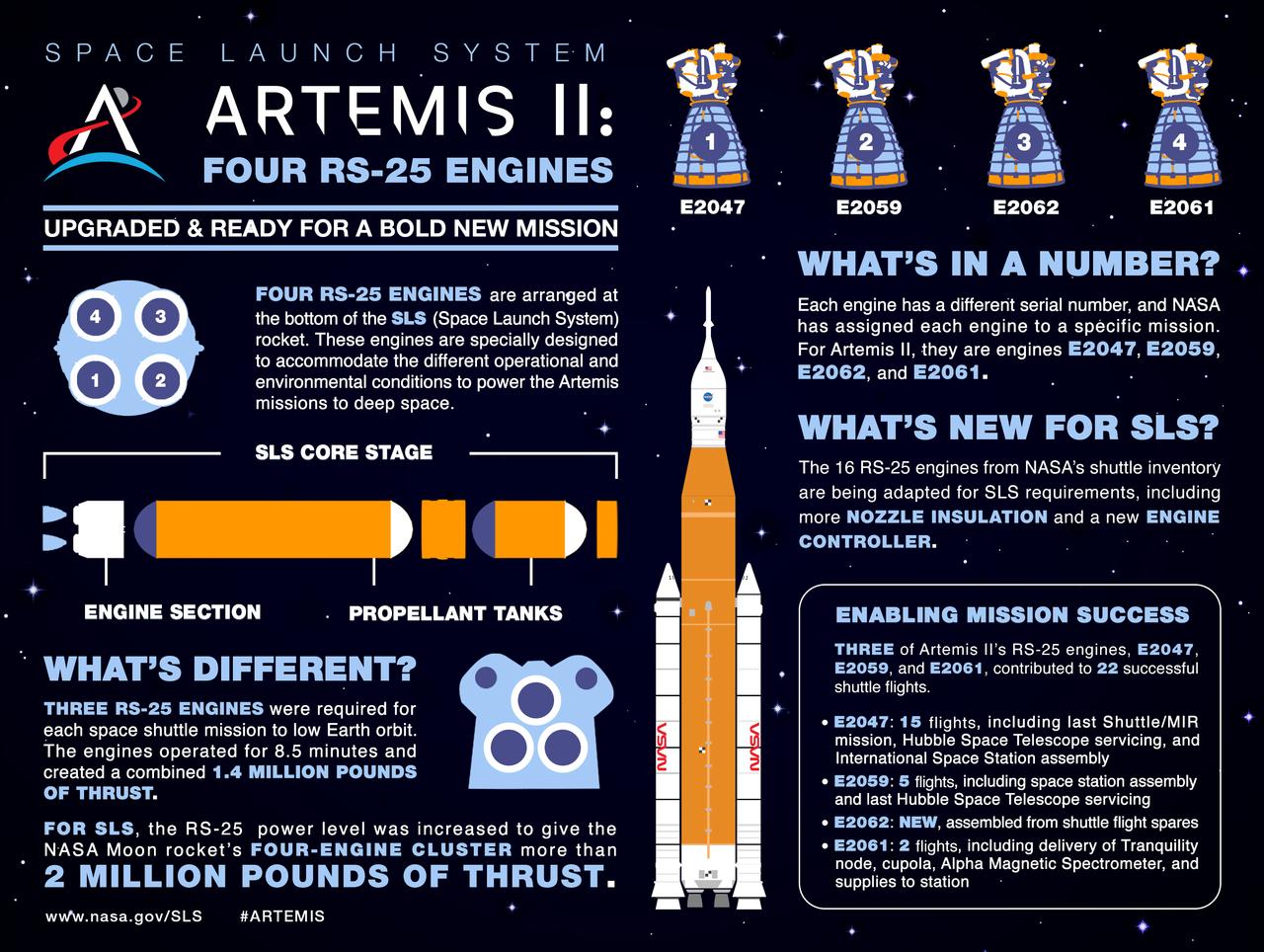
Artemis II Project (NASA)
The success of reusable systems depends largely on propulsion and thermal management technologies. The extreme thermal loads experienced during atmospheric reentry necessitate robust structural protection. Consequently, advanced thermal protection systems are used in conjunction with lightweight and durable materials. Aerodynamic design is optimized to ensure stable flight during both launch and return phases. Propulsion systems not only generate high thrust but also incorporate precise control and restart capabilities.
Operational processes in reusable space systems differ significantly from those of traditional launch systems. Post-mission maintenance encompasses not only damage inspection but also monitoring and improving system performance. The goal is to enable rapid turnaround for subsequent missions without requiring lengthy and costly refurbishment cycles. This approach contributes to the emergence of an aviation-like operational model in space transportation.
Reusability directly influences the cost structure of the space industry. Reusing vehicles spreads manufacturing costs across multiple missions, making launch services more accessible and enabling the emergence of new commercial applications. Furthermore, serial operations accelerate engineering feedback loops and enhance system reliability over time.
Increasing launch frequencies have made environmental impacts more visible. Reusable systems can help mitigate these effects through more efficient fuel use and the reduction of repeated manufacturing processes. However, regulatory frameworks must be updated to ensure the safe and sustainable conduct of space activities. Reusable systems introduce new operational models that necessitate a reassessment of existing space law and safety standards.
Reusable Space Systems hold the potential to transform the technical economic and institutional structure of space access. With advancing materials technologies autonomous control systems and integrated design approaches these systems are expected to become more widespread. In the long term the concept of reusability may extend beyond launch vehicles to become a fundamental design principle for orbital infrastructure and deep space missions.
Bao, Weimin. "A Review of Reusable Launch Vehicle Technology Development." *Acta Aeronautica et Astronautica Sinica* 44, no. 23 (2023): 629555. Accessed December 22, 2025. https://hkxb.buaa.edu.cn/EN/10.7527/S1000-6893.2023.29555
Dietlein, Ingo, Lars Bussler, Stefan Stappert, et al. "Overview of System Study on Recovery Methods for Reusable First Stages of Future European Launchers." *CEAS Space Journal* 17 (2025): 71–88. Accessed December 22, 2025. https://doi.org/10.1007/s12567-024-00557-9
Dresia, Kai, Simon Jentzsch, Günther Waxenegger-Wilfing, Robson Dos Santos Hahn, Jan Deeken, Michael Oschwald, and Fabio Mota. "Multidisciplinary Design Optimization of Reusable Launch Vehicles for Different Propellants and Objectives." *Journal of Spacecraft and Rockets* 58, no. 4 (2021): 1017–1029. Accessed December 22, 2025. https://doi.org/10.2514/1.A34944
Fujikawa, Takahiro, Takeshi Tsuchiya, and Sadatake Tomioka. "Multidisciplinary Design Optimization of a Two-Stage-to-Orbit Reusable Launch Vehicle with Ethanol-Fueled Rocket-Based Combined Cycle Engines." *Transactions of the Japan Society for Aeronautical and Space Sciences* 60, no. 5 (2017): 265–275. Accessed December 22, 2025. https://doi.org/10.2322/tjsass.60.265
Huether, Jacob E., James M. Spears, Carey M. McCleskey, and Russel E. Rhodes. "Space Shuttle to Reusable Launch Vehicle." In *The Space Congress Proceedings, 32nd Space Congress*, April 25, 1995. Accessed December 22, 2025. https://commons.erau.edu/cgi/viewcontent.cgi?article=1624&context=space-congress-proceedings
Jung, Ki-Wook, Sang-Don Lee, Cheol-Goo Jung, and Chang-Hun Lee. "Optimal Landing Guidance of Reusable Launch Vehicles with Dual-Convex Optimization." *International Journal of Control, Automation and Systems* 23, no. 8 (2025): 2198–2218. Accessed December 22, 2025. https://doi.org/10.1007/s12555-024-0628-3
Kim, Gyu Seon, JaeHyun Chung, and Soohyun Park. "Realizing Stabilized Landing for Computation-Limited Reusable Rockets: A Quantum Reinforcement Learning Approach." *arXiv* (2023). Accessed December 22, 2025. https://arxiv.org/abs/2310.06541.
Li, Keshu, Wanqing Zhang, Han Yuan, Jing Zhou, and Ying Ma. "Mission Re-Planning of Reusable Launch Vehicles Under Throttling Fault in the Recovery Flight Based on Controllable Set Analysis and a Deep Neural Network." *Aerospace* 12, no. 3 (2025): 166. Accessed December 22, 2025. https://doi.org/10.3390/aerospace12030166
Mane, Shreya. "Overview on Reusable Space Launch System." *International Journal of Engineering Research and Technology* 12 (2024): 1346–1353. Accessed December 22, 2025. https://www.researchgate.net/publication/383181934_Overview_on_Reusable_Space_Launch_System
NASA. "SLS-4299: Artemis II Engines Infographic (Update)." Accessed February 18, 2026. https://www.nasa.gov/image-detail/sls-4299-artemis-ii-engines-infographic-update/.
National Academies of Sciences, Engineering, and Medicine. *Reusable Launch Vehicle: Technology Development and Test Program*. Washington, DC: National Academies Press, 1995. Accessed December 22, 2025. https://www.nationalacademies.org/read/5115/chapter/1
National Research Council. *Reusable Launch Vehicle: Technology Development and Test Program*. Washington, DC: National Academies Press, 1995. Accessed December 22, 2025. https://archive.org/details/reusablelaunchve0000unse
Song, Zhengyu, Cai Qiaoyan, Han Pengxin, Wang Cong, Pan Hao, Zhang Guangchun, and Li Xujin. "Review of Guidance and Control Technologies for Reusable Launch Vehicles." *Acta Aeronautica et Astronautica Sinica* 42, no. 11 (2021): 525050. Accessed December 22, 2025. https://hkxb.buaa.edu.cn/EN/10.7527/S1000-6893.2021.25050
Xue, Shuai, Zhaolei Wang, Hongyang Bai, Chunmei Yu, and Zian Li. "Research on Self-Learning Control Method of Reusable Launch Vehicle Based on Neural Network Architecture Search." *Aerospace* 11, no. 9 (2024): 774. Accessed December 22, 2025. https://doi.org/10.3390/aerospace11090774

No Discussion Added Yet
Start discussion for "Reusable Space Systems" article
Conceptual Framework and Definition
Historical Development
System Architectures and Design Approaches
Propulsion Aerodynamics and Thermal Protection
Operational Processes and Maintenance
Economic and Industrial Impacts
Environmental and Regulatory Dimensions