


This article was automatically translated from the original Turkish version.

SoFi is a soft-bodied, swimable, and command-guided robotic fish developed by the Massachusetts Institute of Technology (MIT) Computer Science and Artificial Intelligence Laboratory (CSAIL). Made from silicone rubber and flexible plastic, SoFi operates with a tail system that mimics the swimming motions of fish. Measuring 18.5 inches in length and weighing approximately 1.6 kilograms, this robot can dive to depths of up to 18 meters and operate continuously for up to 40 minutes underwater.
SoFi Ocean Swim (MIT CSAIL)
The goal of developing SoFi was to design a vehicle capable of observing underwater ecosystems more closely and without interference. Traditional submarine tools and human divers often disturb marine life, making it difficult to observe natural behaviors. Researchers at MIT CSAIL sought to address this issue by aiming to create a robot that is quiet and realistic enough to blend in with living fish, while its soft structure minimizes environmental impact.
SoFi enables scientists to monitor coral reefs and marine life continuously and up close at a time when marine biology research has gained increased importance in the face of climate change like and environmental threats. The robot’s biomimetic design renders it non-threatening to marine organisms, while its silent operation and remote control via acoustic signals make it possible to collect detailed and continuous data in natural environments.
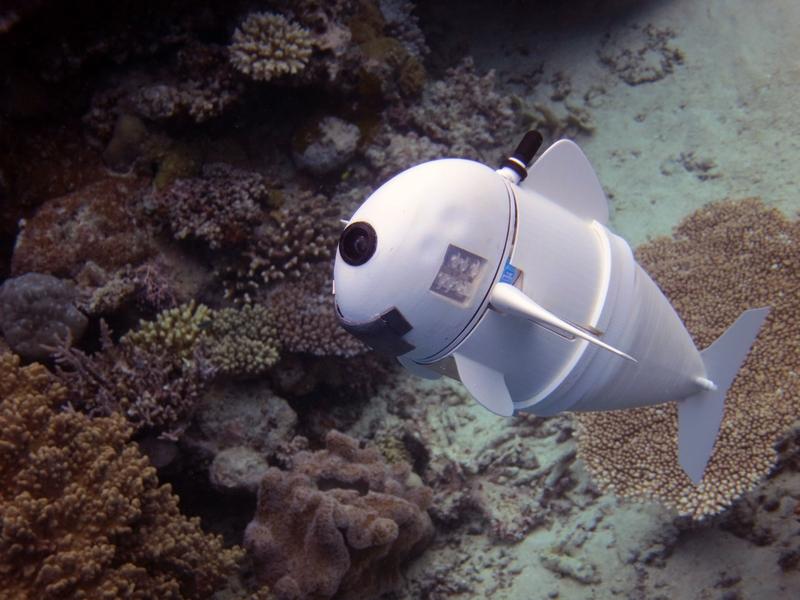
SoFi (Joseph DelPreto/MIT CSAIL)
A hydraulic actuation system located in the tail section enables the robot to perform fish-like undulating swimming motions. The tail moves through the alternating inflation and deflation of two balloon-like chambers filled with liquid. This building allows SoFi to change direction, swim horizontally, dive, and move at varying speeds.
Key components inside the robot’s body include a servo motor, a lithium polymer battery (of the type used in smartphones), and a fish-eye lens camera. SoFi is designed to operate at depths of up to 18 meters and is configured to move at an average speed of 21.7 cm/s. Its three-dimensional mobility is achieved through an acoustic communication module that responds to remote commands. The robot is controlled via a specialized waterproof game remote, operated by a diver, which sends commands for direction, speed, and dive depth.
SoFi’s head section contains a 3D-printed rigid enclosure filled with baby oil to protect electronic components from water ingress. Additionally, the robot’s balance control is achieved through an adjustable weight compartment and a pressure-based balance system inside its body. These technical components enable SoFi to move smoothly in water and conduct observations in targeted areas opportunity.
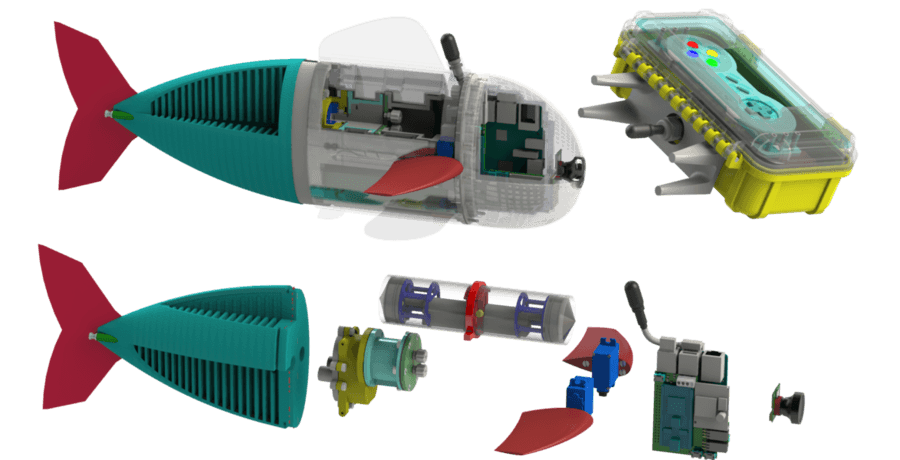
SoFi (Joseph DelPreto/MIT CSAIL)
SoFi’s work principle is based on a hydraulic actuation system designed to move independently and silently in underwater environments. A motor pumps liquid (typically oil) into two balloon-like chambers in the tail, causing them to inflate and deflate alternately, resulting in lateral bending motions of the tail. These oscillating movements imitate the swimming mechanics of real fish, propelling SoFi forward.
The robot’s movements are remotely controlled via a specialized waterproof control device (a modified game controller). Because radio frequencies or radio signals do not propagate effectively through seawater, the system relies on optical communication. Diver, specific sound frequencies can be used to send commands for direction, speed, and diving depth to SoFi. Additionally, balance and depth control during dives are maintained by an adjustable weight compartment and a pressure-regulated balance system within the body. This system allows SoFi to perform basic maneuvers such as straight-line swimming, directional changes, and vertical diving.
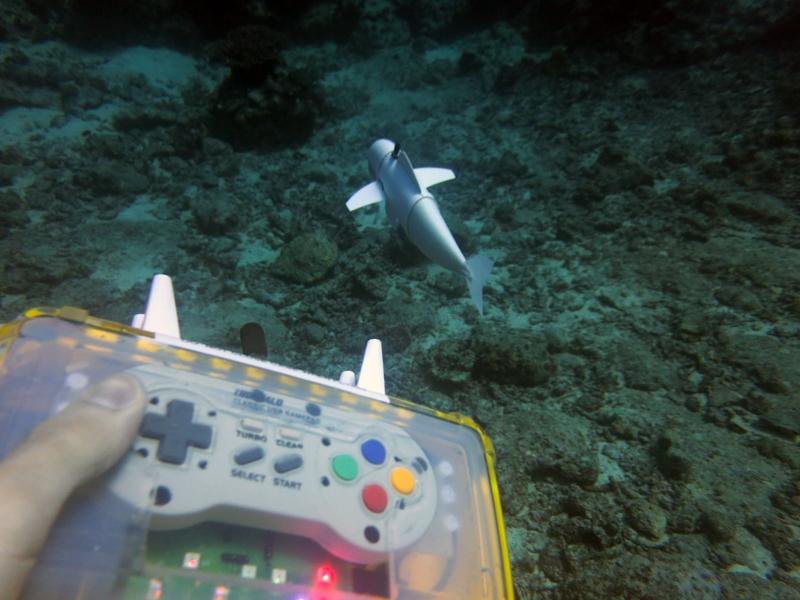
SoFi (Joseph DelPreto/MIT CSAIL)
SoFi is a robotic system specifically developed for use in marine biology and ecosystem research. Thanks to its silent operation and natural swimming motions, it minimizes disturbance to marine life, enabling observation of their natural behaviors. This feature makes it suitable for biological studies such as documenting the lifestyles of underwater organisms, monitoring interspecies interactions, and conducting behavioral analyses.
In addition, SoFi can be used to monitor ecosystem health in sensitive underwater environments such as coral reefs, document environmental changes, and support long-term observational studies. Its camera system allows analysis of factors such as pollution, structural alteration, or biodiversity changes. In the future, it is envisioned that multiple SoFi robots could operate in coordination to form swarm (swarm) robotic systems, enabling broader-scale monitoring of marine environments.

Development Objective
Design and Technical Features
Working Principle
Applications