


This article was automatically translated from the original Turkish version.
The Roman legion system denotes the core institutional and organizational structure of the ancient Roman army. The legion functioned both as a military unit and as a social-institutional space (camps, logistics, and veteran relations), becoming one of the fundamental instruments of Roman political and social order. Legions formed an integrated structure through military hierarchy, discipline, training, logistical organization, and the retirement/discharge system.
The Roman military system underwent significant evolution from the Republican period to the Imperial period. Marius’s reforms transformed the army’s structure, recruitment criteria, and professionalization; as a result, military service became longer-term, soldiers more professional, and more loyal to the army itself. During the Imperial period, Augustus and subsequent emperors institutionalized the legionary structure; legions ceased to be mere combat units and became field administrators of the empire (responsible for border security, colonization, and public works). Furthermore, retirement benefits and veteran settlement programs reinforced army loyalty and supported Rome’s frontier expansion policies.
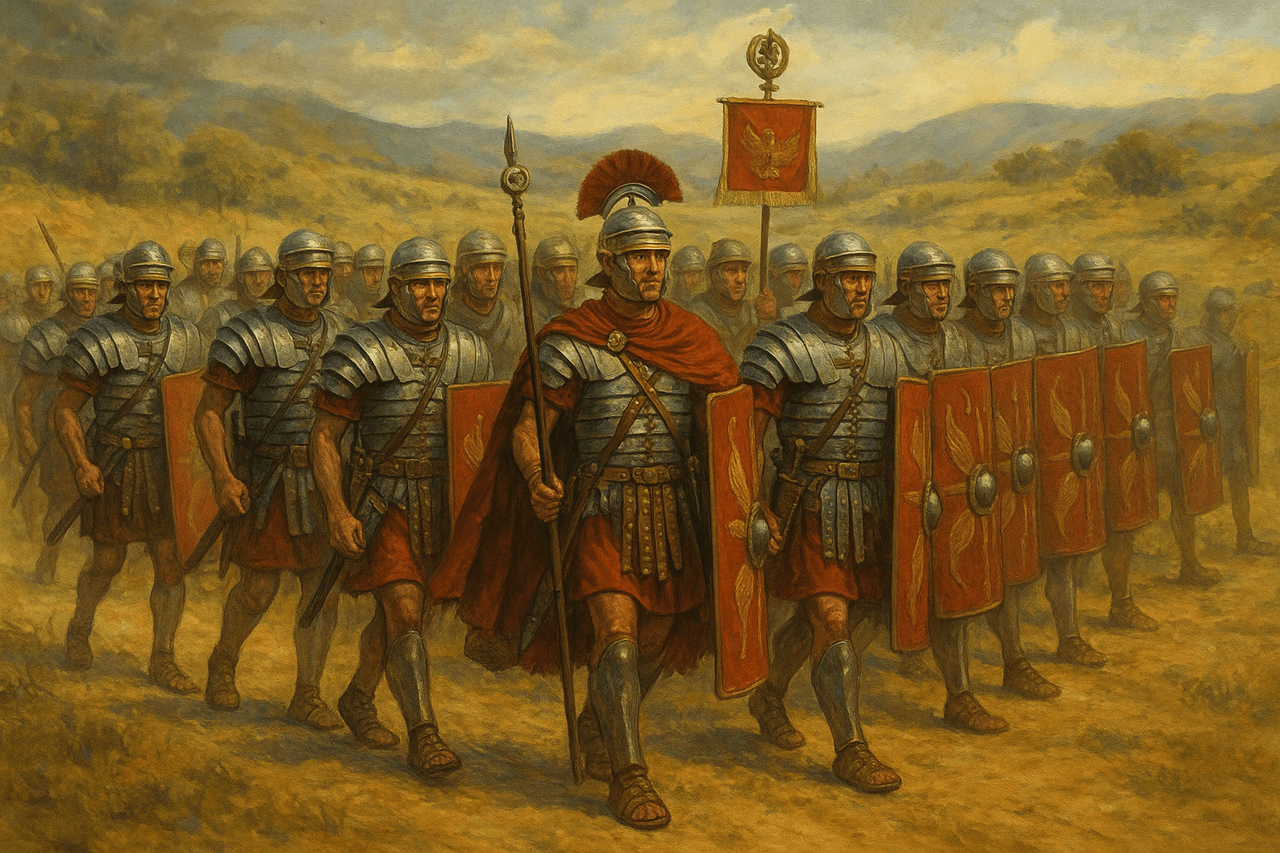
Roman Legion System (Image generated by artificial intelligence.)
The legion’s core administrative and military elements were organized hierarchically. During the Imperial period, a typical legion consisted of several thousand soldiers (numbers varied across periods); the smallest tactical units were the “centuria” (hundred-man units), groups of which formed a “cohort” (company or intermediate unit), and these cohorts were assembled under the legion. High-level command was exercised by the legion commander (legatus); centurions (equivalent to captains) were responsible for discipline and training on the battlefield. Tribunes, praefecti, and other administrative officials managed logistics and judicial functions. This organizational mechanism ensured the ability to respond effectively to duties, discipline, and rapidly evolving combat situations.
Legionary training encompassed both basic combat techniques and marching, camping, construction, and logistical practices. Discipline was a defining feature of the Roman army; unit cohesion was maintained through a system of punishments, rewards, and rank structures. Training also included practical skills such as engineering tasks (ditch digging, road and bridge construction, camp building) and supply preparation; these capabilities enabled Roman legions to be effective not only in warfare but also in infrastructure development and frontier control.
While the equipment, armament, and tactical use of legionaries evolved over time, standardization of equipment and organized logistics remained vital to the Roman army. Legions demonstrated versatile battlefield effectiveness through close combat, trench digging, coordinated attacks, and defensive tactics, often operating alongside auxiliary units when needed. The legion’s marching and camping routines, combined with regular logistical supply chains, sustained the continuity of campaigns and reinforced field dominance.
Roman legionary camps (castra) were constructed according to a standardized plan; this layout provided advantages in both security and rapid deployment. Internal camp arrangements—including command centers, medical facilities (valetudinarium), food storage, workshops, and barracks—enabled the sustained conduct of prolonged operations. The legion’s engineering capacity and logistical organization were decisive in maintaining Rome’s military presence across vast territories.
Roman legionaries (TRT Documentary)
A formalized retirement system for long-serving soldiers was a crucial dimension of the Roman military institution. Starting in the era of Marius, benefits such as discharge, land grants, or monetary payments facilitated the integration of veterans into Roman society. Veteran settlements (colonia) supported both border security and the policy of Romanization. Retirement rights and the social roles of veterans strengthened institutional loyalty within the army.
Legions were not merely instruments of military power but also political actors. Their support proved decisive during civil wars, power struggles, and imperial successions; interventions by commanders and veteran groups in politics were a recurring phenomenon in Roman politics. The management of this relationship shaped emperors’ efforts to secure army loyalty and their strategies regarding military-civilian balance.
The success of the Roman legion system arose from the combination of discipline, flexibility, engineering capacity, and logistical organization. However, the system was vulnerable to periodic transformations, economic constraints, political interference, and social change; these factors occasionally weakened legion effectiveness. Modern research emphasizes that understanding the system’s long-term sustainability requires evaluating both its military and social dimensions together.
Altunbeğ Turgut, Ceren. 2019. “Roma Dönemi Şehircilik Anlayışı.” *Çanakkale Araştırmaları Türk Yıllığı* 17, no. 26 (Bahar): 273–302. Accessed October 23, 2025. Erişim Adresi.
Görkay, Kutalmış. “Zeugma Lejyon Yerleşkesi: Yeni Araştırmalar, Sonuçlar ve Ön Değerlendirmeler.” *Anadolu / Anatolia* 43: 147–169. Accessed October 23, 2025. Erişim Adresi.
Gürten, Kadir. 2016. “Roma Hukuku ve İngiliz Hukuku’na Karşılaştırmalı Bir Bakış.” *Ankara Üniversitesi Hukuk Fakültesi Dergisi* 65, no. 1 (2016): 183–197. Accessed October 23, 2025. Erişim Adresi.
Kalaycı, Alaaddin. “Roma Askeri Sisteminde Emeklilik ve Emekli Askerlerin Yaşantıları.” *Amisos / AMISOS* 3, no. 5 (December): 371–381. Accessed October 23, 2025. Erişim Adresi.
Kaya, Mehmet Ali. 2022. “Roma Lejyonerleri ve Anadolu = Roman Legionaries and Anatolia.” *ANADOLU / Anatolia* 41, no. 1: 207–226. Accessed October 23, 2025. Erişim Adresi.
TRT Belgesel. "Yenilmez Savaşçılar | Roma Lejyonerleri (10. Bölüm)." YouTube, November 29, 2024. Accessed October 23, 2025. Erişim Adresi.

No Discussion Added Yet
Start discussion for "Roman Legion System" article
History and Reforms
Organization and Hierarchy
Training, Discipline, and Morale
Equipment, Tactics, and Operational Practices
Camp (Castra) Structure and Logistics
Retirement, Veterans, and Social Role
The Legion’s Political and Imperial Relationship
Successful Elements and Limitations