


This article is not approved yet.
+2 More
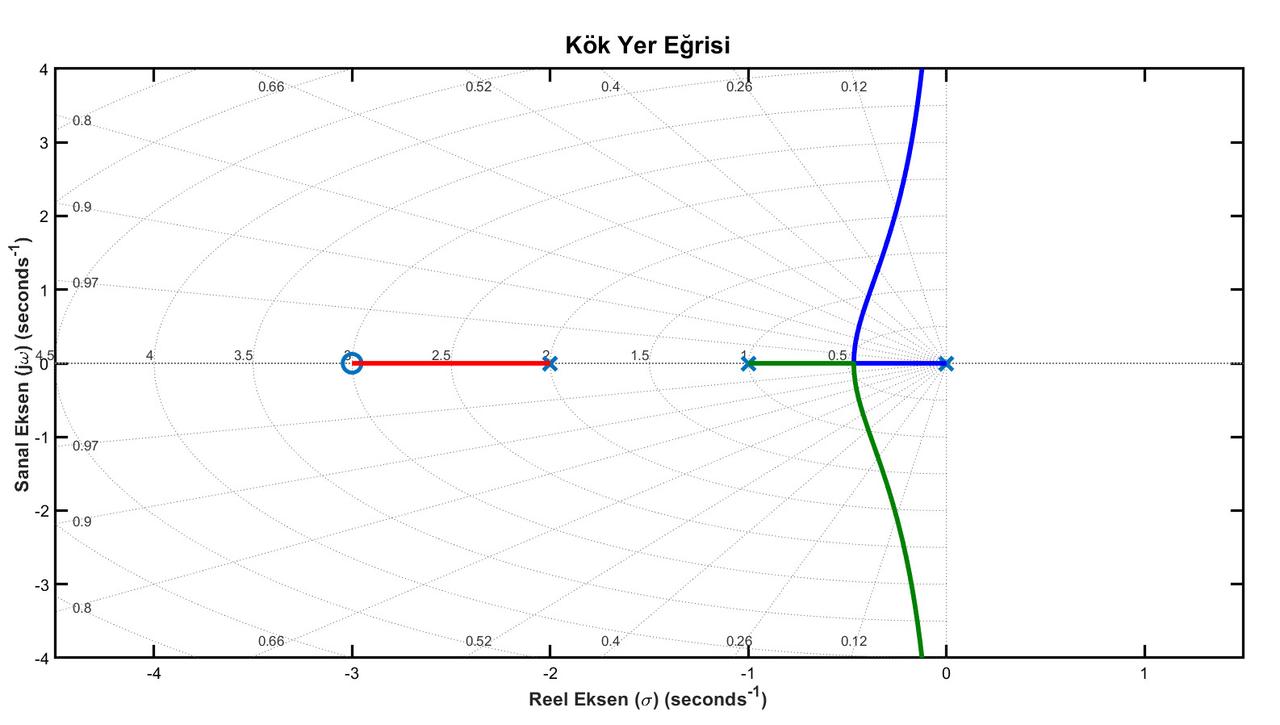
kendi matlab scriptim sonucu elde ettim
Root locus is a fundamental methodology used in the analysis and design of automatic control systems. It examines the geometric trajectories traced by closed-loop system poles in the s-plane as a specific system parameter (typically the open-loop gain, K) varies. By allowing the investigation of system dynamics based solely on open-loop poles and zeros, this method is considered the industry and academic standard for stability and transient response analysis in control engineering.
The root locus method was developed in 1948 by Walter R. Evans, an engineer working at North American Aviation. At the time, engineers working on flight control systems and rocket technologies relied on frequency-domain methods like Nyquist and Bode; however, these methods were often insufficient for establishing a direct correlation with time-domain performance criteria such as overshoot, settling time, and damping ratio. Instead of calculating the roots of complex polynomials individually for every gain value, Evans introduced this visual technique to predict the path of the roots based on the geometric arrangement of poles and zeros. In an era before widespread computing, Evans invented an analog tool called the "Spirule" (a portmanteau of "spiral" and "slide rule") to make his theory practical for manual calculation.
The mathematical framework of the method is based on the characteristic equation of Linear Time-Invariant (LTI) systems: 1+ KG(s)H(s). Two fundamental conditions are used to determine the trajectory of the closed-loop poles:
Specific geometric rules are followed to construct the general form of the root locus from the open-loop transfer function:
Root locus establishes a direct geometric link between time-domain responses (such as damping ratio and natural frequency) and the location of closed-loop poles in the complex plane. In analysis, high-order systems are often approximated as second-order models by focusing on the "dominant poles" closest to the origin. If the current trajectory does not meet the desired overshoot or settling time criteria, the root locus is reshaped through compensator design:
In contemporary control engineering, root loci are generated primarily using computer-aided design tools rather than manual sketches. Interactive design is possible using the rlocus command in MATLAB or the control.root_locus function in the Python ecosystem. For discrete-time (digital) systems, the analysis is mapped from the s-plane to the z-plane via the transformation z=eTs; in this case, the stability boundary becomes the unit circle instead of the imaginary axis.
The root locus method is applied in diverse fields, from the pitch control of F-104A fighter jets to DC motor position control in industrial production lines. By transforming the solution of differential equations into a geometric visualization, it allows for the intuitive interpretation of complex systems, positioning the root locus as an indispensable tool in control engineering.

kendi matlab scriptim sonucu elde ettim
Root Locus Analysis
Historical Development
Mathematical Foundations and Conditions
Geometric Construction Rules
System Design and Compensation
Modern Software and Application Areas
This article was created with the support of artificial intelligence.