


This article was automatically translated from the original Turkish version.
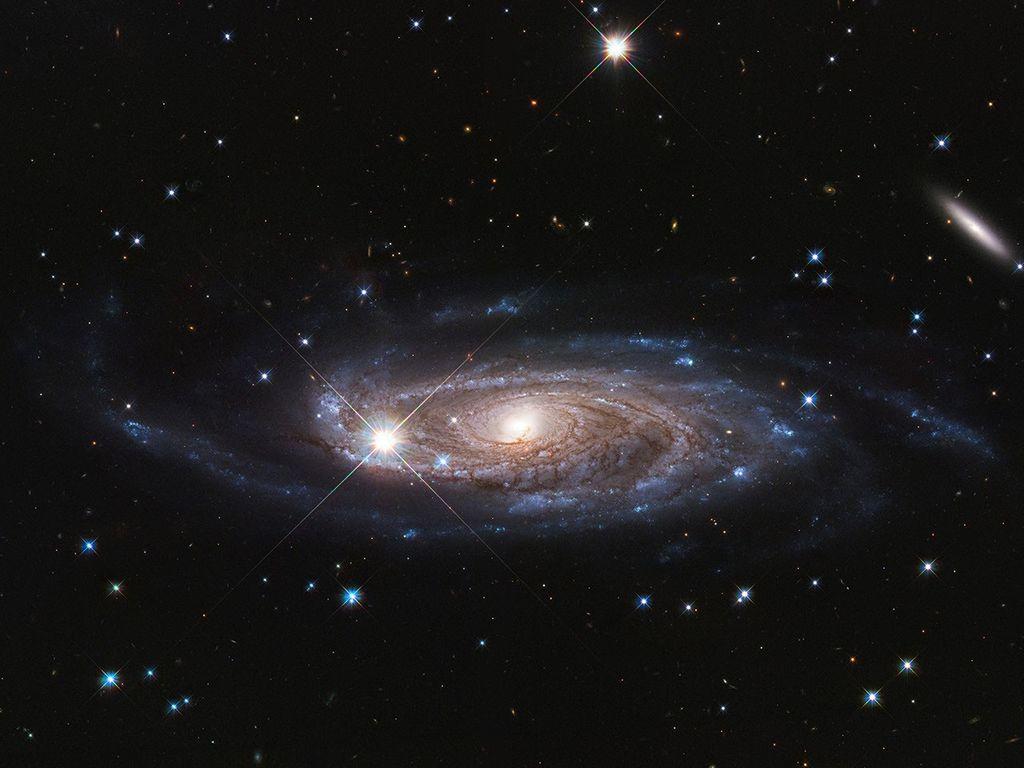
UGC 2885 (Rubin's Galaxy)
Constellation | Perseus | ||||||||
|---|---|---|---|---|---|---|---|---|---|
Distance(s) | Approximately 232 million light-years | ||||||||
Diameter | Approximately 500,000 light-years | ||||||||
Apparent Brightness | +11.7 magnitude | ||||||||
Mass | 1 trillion solar masses (10¹² M☉) | ||||||||
Rubin’s Galaxy (UGC 2885) is a classic spiral galaxy. It was first studied in detail by astronomer Vera Rubin, whose work revealed key properties of the galaxy. UGC 2885 is particularly notable for its size and structural characteristics.
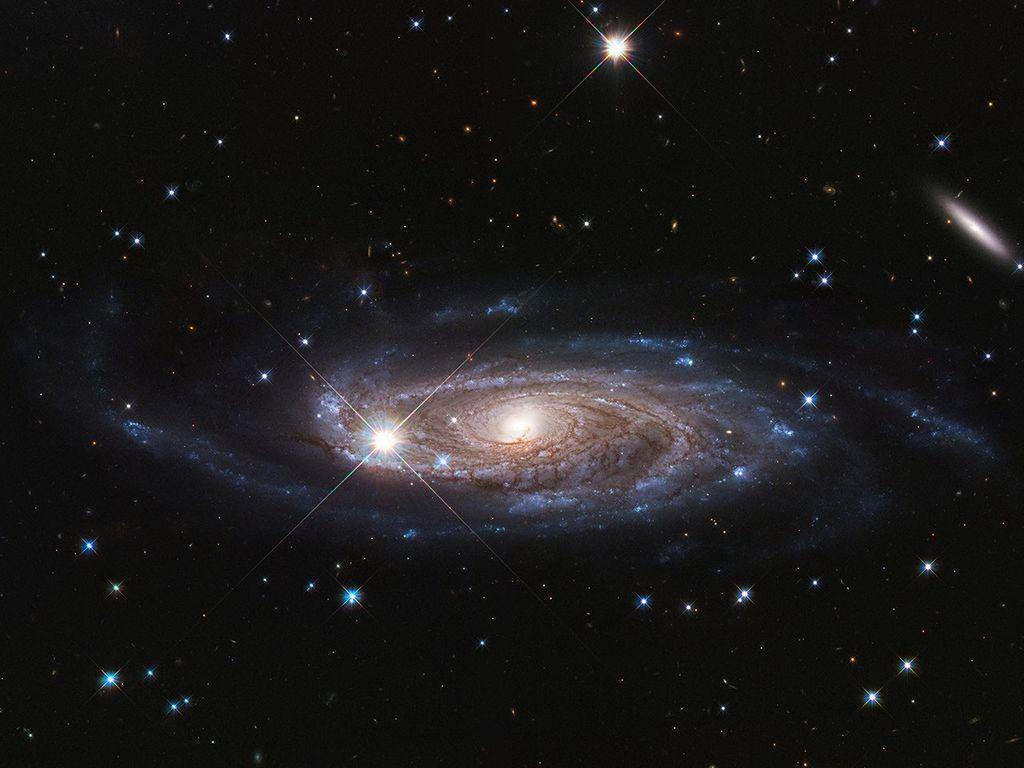
Rubin’s Galaxy – UGC 2885 (NASA)
UGC 2885 is a spiral galaxy located outside the Local Group at a distance of approximately 232 million light years. The galaxy has the typical form of a large spiral galaxy but is significantly larger in size and mass. Its diameter has been measured at about 500,000 light years, making it roughly five times larger than the Milky Way.
UGC 2885 possesses a prominent central nucleus and wide, highly symmetric spiral arms. The galactic disk is rich in dust and gas clouds, yet exhibits moderate levels of star formation activity. Analysis of the distribution of stars in the spiral arms and the gas content reveals a relatively homogeneous mass distribution. In the central region, dense stellar populations and potential signatures of a supermassive black hole have been observed.
Rubin’s Galaxy is scientifically significant due to its total mass of about one trillion solar masses (10¹² M☉). Estimates of its mass include contributions from stellar mass, gas, and dark matter components. Analysis of its rotation curves shows a clear influence of dark matter in the outer regions. Vera Rubin’s pioneering work provided crucial evidence for the existence of dark matter through observations of galactic rotation curves.
The rotation curves of UGC 2885 serve as fundamental data for understanding its mass distribution. These curves indicate that rotational velocities remain constant or even increase with distance from the galactic center, implying the presence of an additional mass component beyond visible matter. In this context, the galaxy’s dynamic structure has been used in modeling its dark matter halo.
UGC 2885 is considered an isolated galaxy, meaning it has not experienced significant interactions with nearby companion galaxies. This isolation has preserved its structural integrity and led to an evolutionary path distinct from that of galaxies in denser environments. Its position outside the Local Group renders it relatively independent of external environmental influences.
Although its current star formation activity is moderate, the galaxy has undergone significant growth and an increase in stellar population over its evolutionary history. Studies of metallicity and stellar age distributions indicate that UGC 2885 has undergone a long and continuous evolutionary process. Furthermore, its large size and structure are best explained by a model of isolated growth without major mergers or interactions.
The structure and motion of UGC 2885 have been studied using a variety of electromagnetic spectrum observations. Optical telescope imaging, hydrogen distribution mapping via radio telescopes, and spectral analyses have revealed detailed physical and chemical properties of the galaxy. Observational data have been compared with theoretical models to gain insights into its dynamics. Due to its structural size, rotation curves, and isolated location, UGC 2885 has become an important subject of study in astrophysics. Its investigation has provided key insights into the nature of dark matter and galactic evolution.
In conclusion, UGC 2885 serves as a critical example in dark matter research. Vera Rubin’s work on rotation curves played a pivotal role in shaping the scientific paradigm concerning galactic dynamics and the existence of dark matter. As a result, this galaxy is frequently cited in astrophysical literature.
NASA. "Galaxy UGC 2885 (Rubin’s Galaxy)." *NASA Science*. Accessed May 31, 2025. https://science.nasa.gov/wp-content/uploads/2023/06/hubble-litho-ugc-2885-rubins-galaxy.pdf.
NASA. "NASA’s Hubble Surveys Gigantic Galaxy." *NASA Science*. Accessed May 31, 2025. https://science.nasa.gov/missions/hubble/nasas-hubble-surveys-gigantic-galaxy/.
NASA. "Spiral Galaxy UGC 2885." *NASA Science*. Accessed May 31, 2025. https://science.nasa.gov/asset/hubble/spiral-galaxy-ugc-2885/.

UGC 2885 (Rubin's Galaxy)
Constellation | Perseus | ||||||||
|---|---|---|---|---|---|---|---|---|---|
Distance(s) | Approximately 232 million light-years | ||||||||
Diameter | Approximately 500,000 light-years | ||||||||
Apparent Brightness | +11.7 magnitude | ||||||||
Mass | 1 trillion solar masses (10¹² M☉) | ||||||||
No Discussion Added Yet
Start discussion for "Rubin's Galaxy (UGC 2885)" article
General Properties and Morphology
Mass Distribution and Rotation Curves
Location and Evolutionary History
Observational Techniques and Data