 Recently Added:
This article was automatically translated from the original Turkish version.
Russia’s recognition of the Taliban government is a diplomatic process that took place in July 2025 and marked the first official international recognition of the Islamic Emirate of Afghanistan. This recognition was completed following domestic legal reforms court rulings and diplomatic initiatives by the Russian Federation.

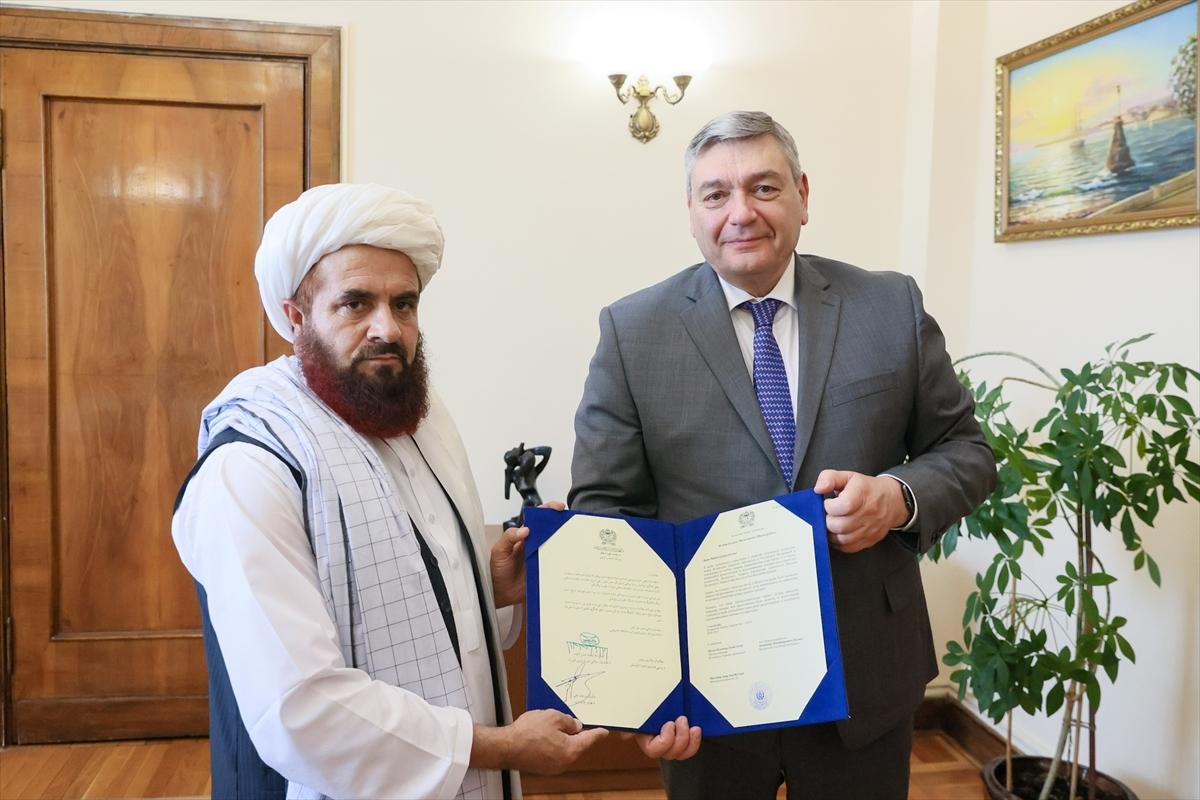
Russian Deputy Foreign Minister Andrey Rudenko (right) with newly appointed Afghan Ambassador to Moscow Gul Hasan (left) on 3 July 2025 — (Anadolu Agency)
The Taliban movement was designated as a terrorist organization by the Russian Supreme Court in 2003 and its activities were banned. In December 2024 Russian President Vladimir Putin approved a legislative amendment to remove the Taliban from the list of terrorist organizations. This revision was implemented under Federal Law No. 513-FZ which came into effect on 28 December 2024.
On 17 April 2025 the Russian Federation Supreme Court announced its decision to remove the terrorist status from the Taliban movement. This decision followed judicial proceedings conducted within the framework of Russia’s counterterrorism legislation.
In a statement by the Russian Ministry of Foreign Affairs it was clarified that the removal of the terrorist designation from the Taliban did not affect Russia’s obligations under the United Nations Security Council’s sanctions regime. Accordingly it was confirmed that international sanctions targeting individuals and entities linked to the Taliban would continue to be enforced.
The Russian Federation became the first country to officially recognize the Islamic Emirate of Afghanistan on 3 July 2025. The recognition decision was approved by Russian President Vladimir Putin on the recommendation of Foreign Minister Sergey Lavrov. The official statement on the matter was issued by Russia’s Special Representative to Afghanistan Zamir Kabulov. In an interview with the Russian news agency RIA Kabulov confirmed that Russia had formally recognized the Taliban administration.
Following the recognition decision the diplomatic mission of the Islamic Emirate of Afghanistan in Moscow was elevated to the rank of embassy. On the same day the Afghan flag used by the Taliban administration was hoisted on the embassy building in Moscow. This was the first time since the 2021 change of government that the flag had been publicly displayed in Moscow.
Additionally the newly appointed Afghan Ambassador to Moscow Gul Hasan met with Russian Deputy Foreign Minister Andrey Rudenko and submitted copies of his letter of credence. Simultaneously Russia’s Ambassador to Kabul Dmitriy Zhirnov presented his letter of credence to Acting Afghan Foreign Minister Amir Khan Muttaqi and conveyed Russia’s decision to recognize the Afghan administration.
Following the recognition decision the Russian Federation announced its intention to enhance cooperation with Afghanistan in economic commercial and infrastructure sectors. Particular emphasis was placed on the construction of energy transmission lines the development of transit trade routes and the assessment of Afghanistan as a potential investment destination. The Moscow administration anticipates that Afghanistan will play a pivotal role in regional economic integration in the coming period.
The Russian government plans to cooperate with the Taliban administration on counterterrorism efforts. Moscow has stated its support for Taliban operations against the Islamic State Khorasan Province operating on Afghan territory. In this context Russian President Vladimir Putin described the Taliban as a “partner” in counterterrorism in July 2024. The Moscow administration emphasized that stability in Afghanistan holds strategic importance for regional security in Central Asia.
Russia’s relations with the Taliban administration prior to official recognition were shaped by diplomatic engagement and participation in economic forums after 2021. Taliban delegations participated in international economic forums held in Saint Petersburg Russia in 2022 and 2024.
In October 2024 senior representatives of the Taliban administration held official talks in Moscow with Russian Foreign Minister Sergey Lavrov. Discussions covered the political and security situation in Afghanistan bilateral trade opportunities and regional counterterrorism cooperation.
In April 2025 Russian Foreign Minister Sergey Lavrov stated that the Taliban was the de facto authority governing Afghanistan and that Moscow must adopt a pragmatic foreign policy detached from ideological considerations. Lavrov described the Taliban administration as the “new reality of Afghanistan” and called for the normalization of diplomatic relations accordingly.
Al Jazeera. “Russia Becomes First Country to Recognise Afghanistan’s Taliban Government.” Accessed July 4, 2025. https://www.aljazeera.com/news/2025/7/3/russia-becomes-first-country-to-recognise-afghanistans-taliban-government
Anadolu Ajansı. "Rusya, Afganistan Yönetimini Resmen Tanıyan İlk Ülke Oldu." Accessed July 4, 2025. https://www.aa.com.tr/tr/dunya/rusya-afganistan-yonetimini-resmen-taniyan-ilk-ulke-oldu/3621260
Anadolu Ajansı. “МИД РФ: Москва Официально Признала Исламский Эмират Афганистан.” Anadolu Ajansı (Rusça). Accessed July 4, 2025. https://www.aa.com.tr/ru/%D0%BC%D0%B8%D1%80/%D0%BC%D0%B8%D0%B4-%D1%80%D1%84-%D0%BC%D0%BE%D1%81%D0%BA%D0%B2%D0%B0-%D0%BE%D1%84%D0%B8%D1%86%D0%B8%D0%B0%D0%BB%D1%8C%D0%BD%D0%BE-%D0%BF%D1%80%D0%B8%D0%B7%D0%BD%D0%B0%D0%BB%D0%B0-%D0%B8%D1%81%D0%BB%D0%B0%D0%BC%D1%81%D0%BA%D0%B8%D0%B9-%D1%8D%D0%BC%D0%B8%D1%80%D0%B0%D1%82-%D0%B0%D1%84%D0%B3%D0%B0%D0%BD%D0%B8%D1%81%D1%82%D0%B0%D0%BD/3621222
Russian Ministry of Foreign Affairs. “О приостановлении террористического статуса Движения талибов.” Ministry of Foreign Affairs of the Russian Federation. Accessed July 4, 2025. https://mid.ru/ru/foreign_policy/news/2009744/
The Moscow Times. “Россия нанесла удар по Киеву после разговора Путина с Трампом.” Accessed July 4, 2025. https://www.moscowtimes.ru/2025/07/03/rossiya-nanesla-udar-po-kievu-posle-razgovora-putina-s-trampom-a167903
Yeni Şafak. "Russia Recognizes Taliban Government in Afghanistan." Accessed July 4, 2025. https://www.yenisafak.com/en/news/russia-recognizes-taliban-government-in-afghanistan-3704396

Russia became the first state to officially recognize the Taliban administration in Afghanistan on 3 July 2025. The process began in 2024 with the removal of the Taliban from the list of terrorist organizations and was completed in April 2025 by a ruling of the Supreme Court. Following the recognition decision, the flag of the Taliban administration was raised at the Afghan Embassy in Moscow and mutual letters of confidence were exchanged.
No Discussion Added Yet
Start discussion for "Russia's Recognition of the Taliban Government" article
July 4, 2025
Process of Removing the Terrorist Status
July 4, 2025
Decision on Official Recognition
July 4, 2025
Development of Bilateral Relations
July 4, 2025
Diplomatic Process Prior to Recognition