

This article was automatically translated from the original Turkish version.
+1 More
Entry into Service | 1971 | ||||||||
|---|---|---|---|---|---|---|---|---|---|
Length(s) | 16.4 m | ||||||||
Engine(s) | Volvo RM8 | ||||||||
Manufacturer(s) | Saab AB | ||||||||
Height(s) | 5.9 m | ||||||||
Type(s) | Multirole combat aircraft | ||||||||
Maximum Speed | Mach 2.0 (approximately 2,100 km/h) | ||||||||
Empty Weight | Approximately 12,000 kg | ||||||||
Wing Area | 46 m² | ||||||||
Total Aircraft Produced | 329 | ||||||||
Country of Manufacture | Sweden | ||||||||
Range(s) | Approximately 2 000 km | ||||||||
Wingspan | 10.6 m | ||||||||
Retirement | 2005 | ||||||||
Saab 37 Viggen is a single-engine, multirole fighter aircraft developed by Sweden during the Cold War. The aircraft was designed by the Swedish aerospace and defense company Saab AB to meet the requirements of the Swedish Air Force. The program was initiated in the late 1950s under Sweden’s national defense doctrine with the goal of developing a fighter capable of operating from short runways and even highways, in addition to conventional air bases.

Saab 37 Viggen (José Luis Celada Euba)
Saab 37 Viggen project was launched in the late 1950s as a consequence of Sweden’s defense strategy during the Cold War. The Swedish Air Force identified a need for a new fighter capable of taking off and landing from short runways and highway strips, given the country’s geographic conditions and the vulnerability of its main air bases in the event of an attack. The resulting system was designed to be compatible with Sweden’s Bas 60 and later developed Bas 90 dispersed base concepts.
The responsibility for developing the aircraft was assigned to the Swedish aerospace company Saab AB. The project aimed to ensure the aircraft could perform high-speed interception missions, conduct strike missions against land and sea targets, and carry advanced navigation and targeting systems. Design efforts focused on achieving a balance between short takeoff and landing performance and high-speed capability, leading to the selection of an aerodynamic configuration combining a delta wing with canard surfaces.
Engine selection and flight performance were critical phases of the development process. The aircraft is powered by the Volvo RM8 turbofan engine, a licensed and military-optimized variant of the American Pratt & Whitney JT8D engine. This engine contributed significantly to the aircraft’s ability to operate from short runways through its high thrust output and reverse thrust system【1】.
Prototype production was completed in the mid-1960s, and the first flight took place on 8 February 1967. During test flights, various improvements were made to the aerodynamic structure, avionics systems, and weapons integration. Following the testing phase, the aircraft entered series production, and the first operational variant, the AJ 37, was introduced into the Swedish Air Force inventory in 1971.
Saab 37 Viggen was designed with an original aerodynamic configuration to meet the Swedish Air Force’s requirement for an aircraft capable of operating from short runways and dispersed locations. The aircraft’s airframe features a large-area delta wing planform combined with canard control surfaces located ahead of the main wings. This configuration provides aerodynamic stability at high speeds while enhancing lift at low speeds. The canards also facilitated control during takeoff and landing, playing a crucial role in improving short-field performance.

Saab 37 Viggen Technical Drawing (Generated by Artificial Intelligence)
The structural design of the aircraft was heavily influenced by Sweden’s requirement under its dispersed air base system (Bas system) to operate from highway strips. Consequently, several solutions were implemented to enable short takeoff and landing capabilities. The reverse thrust system fitted to the Viggen significantly reduced landing distances, allowing safe operations on runways as short as a few hundred meters.
The cockpit and mission systems were designed to be operated by a single pilot. The avionics suite was supported by an integrated computer system capable of automating mission planning and navigation tasks.
These systems were developed to reduce pilot workload and are regarded as among the earliest examples of digital mission computers in combat aircraft of that era.
The airframe incorporates metal alloys and robust structural components to support high-speed performance. Thanks to its aerodynamic configuration and engine setup, the Viggen achieved supersonic speeds and enabled the development of multiple variants tailored to different mission profiles.
The Saab 37 Viggen was designed as a single-engine, single-pilot fighter aircraft. Its airframe employs an aerodynamic configuration consisting of a delta wing and forward canard surfaces. This design aimed to provide aerodynamic stability at high speeds while simultaneously improving low-speed performance and short takeoff and landing capabilities.
The aircraft’s total length is approximately 16.4 meters, wingspan 10.6 meters, and height approximately 5.9 meters. The Viggen’s empty weight is approximately 12,000 kilograms, with a maximum takeoff weight of approximately 20,000 kilograms. These values vary depending on the variant and mission load【2】.
Saab 37 Viggen (Sonic Art Media)
The aircraft’s powerplant is the Volvo RM8 turbofan engine, a military-optimized variant of the American Pratt & Whitney JT8D engine. With an afterburner system, this engine enabled the aircraft to achieve supersonic speeds. The engine is also equipped with a reverse thrust system, which contributed to reducing landing distances.
The Viggen’s maximum speed reaches approximately Mach 2 (about 2,100 km/h). Its operational ceiling is approximately 18,000 meters. Its range varies depending on mission type and fuel load but can reach several thousand kilometers【3】.
In terms of armament, the Viggen was designed to carry a variety of munitions for both air-to-ground and air-to-air missions. The aircraft can carry different missile systems, guided and unguided bombs, and external fuel tanks. Some variants also feature an internal 30 mm automatic cannon.
The Saab 37 Viggen entered service in the early 1970s as one of the main fighter aircraft of the Swedish Air Force. The first operational variant, the AJ 37, began delivery in 1971 and was primarily deployed for strike missions against land and sea targets. In line with the multirole approach adopted during its development, the Viggen became a key component of Sweden’s air defense system through a series of variants tailored to different mission types【4】.

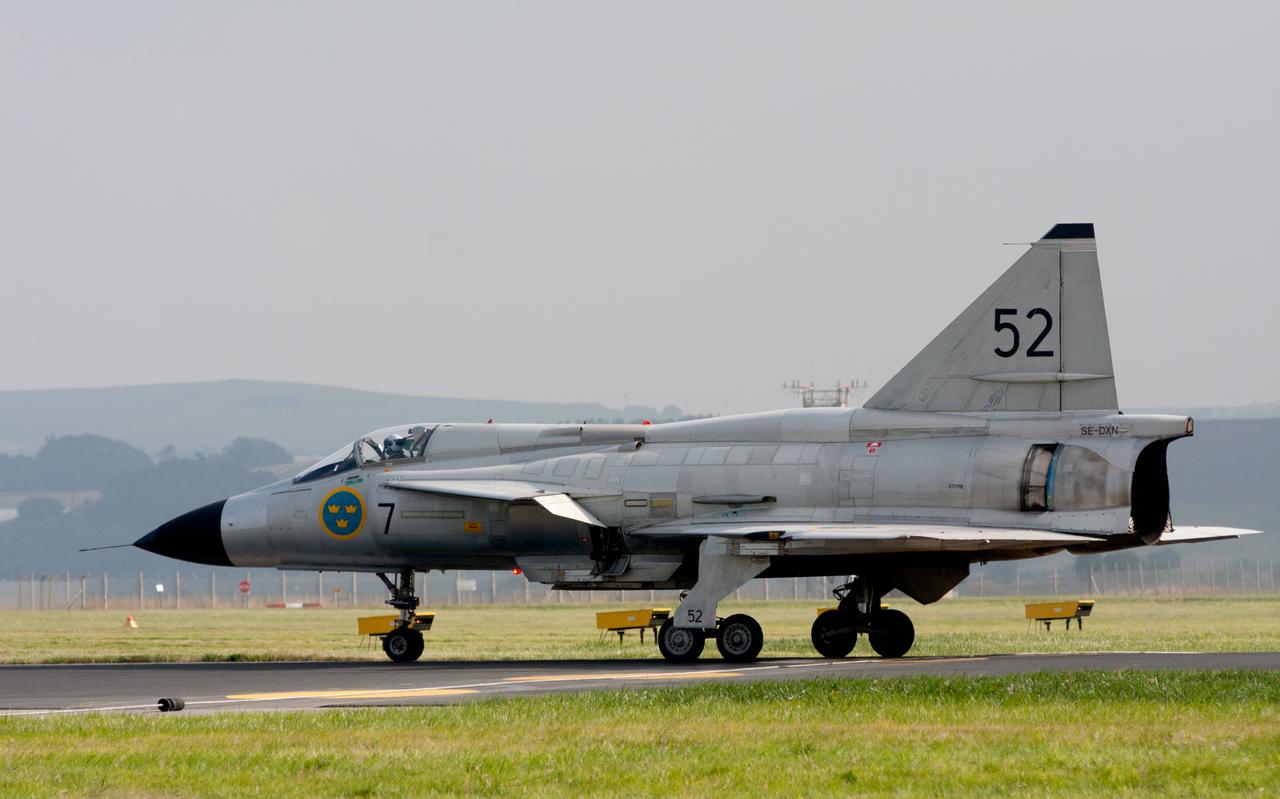
Saab AJS-37 Viggen (Alan Wilson)
During the Cold War, Sweden’s defense planning centered on rapid response and the ability to operate from dispersed bases. In this context, the Viggen was employed under Sweden’s Bas 60 and later Bas 90 air base systems to operate from highway strips and small airfields. This system aimed to reduce dependence on large, fixed air bases and preserve air force operational capability in the event of an attack.
The Viggen platform was adapted over time into multiple variants for different missions. The AJ 37 was used for strike missions, while the JA 37 variant was developed for interception and air defense roles. Additionally, the SF 37 and SH 37 models were employed for reconnaissance missions. These variants were equipped with specialized sensor systems and mission equipment to monitor and defend Sweden’s airspace.
The aircraft remained in active service with the Swedish Air Force from the 1970s until the early 2000s. With the introduction of the new-generation fighter aircraft, the Saab JAS 39 Gripen, developed by Sweden in the 1990s, the Viggen fleet was gradually phased out. The last Viggen aircraft were retired from operational service in 2005.
The Saab 37 Viggen platform was developed into a series of variants to meet the diverse operational needs of the Swedish Air Force. While sharing the same basic airframe and engine system, these variants differ in mission systems, sensors, and armament. The program produced models designed for strike, interception, reconnaissance, and training missions.
The first operational variant of the program, the AJ 37, was developed for strike missions against land and sea targets. This variant was specifically designed for anti-ship operations and low-altitude strike missions and entered service with the Swedish Air Force in the 1970s. The AJ 37 was equipped with a radar system and targeting equipment and configured to carry a variety of munitions.
The Viggen family’s air defense variant, the JA 37, was designed for interception missions. This model features an upgraded radar system, air-to-air missile capability, and enhanced avionics. The JA 37 variant was primarily used for defending Swedish airspace and is regarded as one of the most advanced versions of the Viggen family.

JA 37 Variant (Rob Schleiffert)
Two separate variants were developed for reconnaissance missions. The SF 37 variant was designed for photographic reconnaissance of land targets and equipped with various camera systems mounted under the fuselage. The SH 37 was developed for maritime reconnaissance and specifically used to monitor maritime traffic in the Baltic Sea.
The SK 37 model, developed for training, is a two-seat trainer aircraft. This variant was used to train pilots operating the Viggen and served in both basic flight training and operational mission training roles.
The design and production activities carried out under the Saab 37 Viggen program led to advancements in various technological fields within Sweden’s aerospace industry. Extensive engineering work was conducted in aerodynamic design, engine integration, avionics systems, and digital mission computer technology. These efforts contributed to expanding Sweden’s research and production capacity in military aviation.

Saab 37 Viggen (Johnny Comstedt)
The technical knowledge and production experience gained during the Viggen program were later applied to the design processes of subsequent Swedish fighter aircraft. Engineering data in areas such as aerodynamic configuration, avionics system integration, and aircraft system architecture served as references for later programs. In particular, certain technical experiences from the Viggen program were utilized in the development of the Saab JAS 39 Gripen.
After being retired from operational service, some Viggen aircraft have been preserved in aviation museums and collections. Additionally, certain aircraft have been maintained in flyable condition and are used in airshow demonstrations.
Aef.se. "Saab 37 Viggen AJ37 JA37 SH37 SK37 SF37 Notis 1". Accessed March 5, 2026. https://www.aef.se/Flygvapnet/Notiser/FPL37_Viggen.htm.
AerospaceWeb. "Saab AJ 37 Viggen Attack Fighter." AerospaceWeb. Accessed March 5, 2026. https://aerospaceweb.org/aircraft/attack/viggen/.
Aviodrome. "Saab 37 Viggen." Aviodrome. Accessed March 5, 2026. https://www.aviodrome.nl/en/discover/what-to-do/collection/saab-37-viggen.
Comstedt, Johnny. "Saab 1534 AJS 37 Viggen 37074 in Madrid." Flickr. October 13, 2019. Accessed March 5, 2026. https://www.flickr.com/photos/johnnyflight/49334689747/.
Euba, José Luis Celada. "SAAB 37 Viggen." Flickr, December 29, 2008. Accessed March 5, 2026. https://www.flickr.com/photos/joseluiscel/3147329805/
SKYbrary Aviation Safety. "SB37 – Saab Viggen." SKYbrary Aviation Safety. Accessed March 5, 2026. https://skybrary.aero/aircraft/sb37
Saab. "Saab 37 Viggen - ryggraden i det svenska flygvapnet under tre decennier | Saabs historia." Saab. Accessed March 5, 2026. https://www.saab.com/sv/markets/sweden/stories/2021/saab-37-viggen
Schleiffert, Rob. "JA-37 Sweden." Flickr, August 4, 2013. Accessed March 5, 2026. https://www.flickr.com/photos/109661044@N07/34374752873/
Schleiffert, Rob. "JA-37 Viggen." Flickr. August 9, 2020. Accessed March 5, 2026. https://www.flickr.com/photos/109661044@N07/50251429391/
Sonic Art Media. "Saab 37 Viggen." YouTube. Accessed March 5, 2026. https://www.youtube.com/watch?v=to_pebdtbmY
Wilson, Alan. "Saab AJS-37 Viggen “37098 / 52” (SE-DXN)." Flickr. July 6, 2013. Accessed March 5, 2026. https://www.flickr.com/photos/ajw1970/9223653017/
[1]
SKYbrary Aviation Safety. “SB37 – Saab Viggen" SKYbrary Aviation Safety. Access date: 5 March 2026.https://skybrary.aero/aircraft/sb37
[2]
Aviodrome. "Saab 37 Viggen" Aviodrome. Access date: 5 March 2026. https://www.aviodrome.nl/en/discover/what-to-do/collection/saab-37-viggen.
[3]
Aviodrome. "Saab 37 Viggen" Aviodrome. Access date: 5 March 2026. https://www.aviodrome.nl/en/discover/what-to-do/collection/saab-37-viggen.
[4]
AerospaceWeb. "Saab AJ 37 Viggen Attack Fighter" AerospaceWeb. Access date: 5 March 2026.https://aerospaceweb.org/aircraft/attack/viggen/.

Entry into Service | 1971 | ||||||||
|---|---|---|---|---|---|---|---|---|---|
Length(s) | 16.4 m | ||||||||
Engine(s) | Volvo RM8 | ||||||||
Manufacturer(s) | Saab AB | ||||||||
Height(s) | 5.9 m | ||||||||
Type(s) | Multirole combat aircraft | ||||||||
Maximum Speed | Mach 2.0 (approximately 2,100 km/h) | ||||||||
Empty Weight | Approximately 12,000 kg | ||||||||
Wing Area | 46 m² | ||||||||
Total Aircraft Produced | 329 | ||||||||
Country of Manufacture | Sweden | ||||||||
Range(s) | Approximately 2 000 km | ||||||||
Wingspan | 10.6 m | ||||||||
Retirement | 2005 | ||||||||
Development Process
Design and Technical Structure
Technical Specifications
Operational Use
Variants
Industrial Legacy