


This article was automatically translated from the original Turkish version.
+1 More
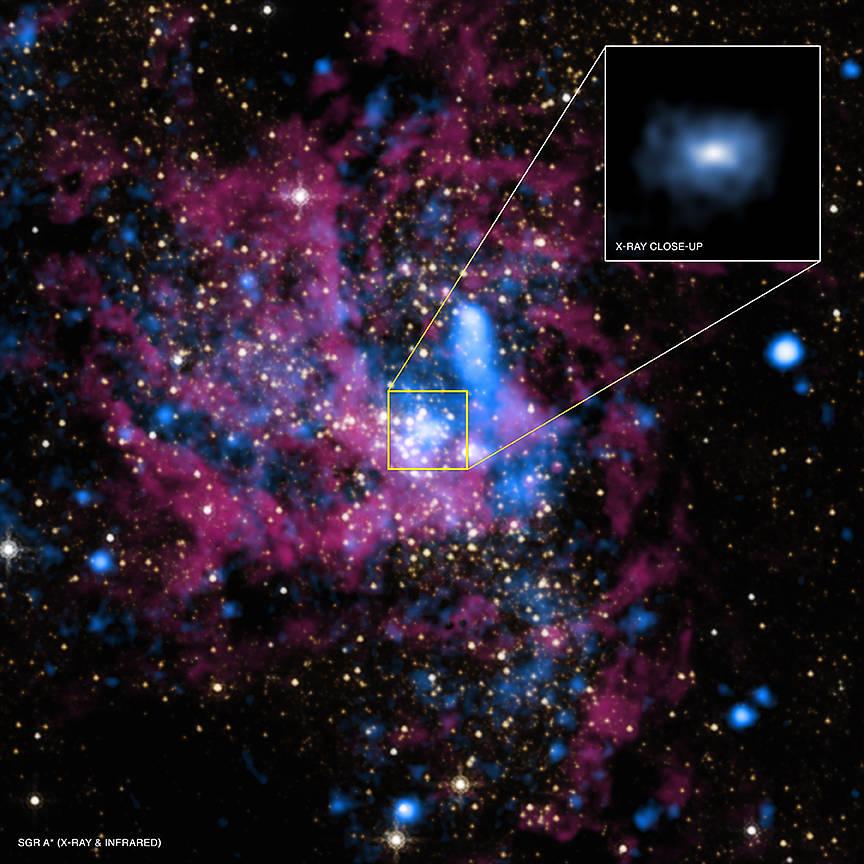
Sagittarius A* Black Hole
Black Hole | Sagittarius A* | ||||||||
|---|---|---|---|---|---|---|---|---|---|
Property | First Resolved Black Hole | ||||||||

The sharp image of the Sagittarius A* black hole
Black are cosmic structures with a gravitational field so strong that not even light can escape. Supermassive black holes can have masses of millions or even billions of Sun and are typically found at the centers of galaxies. At the center of the Milky Way, the region known as Sagittarius A* (Sgr A*) has a mass of approximately four million solar masses and is located about 26,000 light years from World. Black holes cannot be observed directly, but they can be studied indirectly through their interactions with surrounding matter and the radiation they create around their event horizon. In 2019, the Event Horizon Telescope (EHT) collaboration obtained the first direct image of the supermassive black hole M87* at the center of the M87 galaxy. Following this success, the EHT team focused on observing Sagittarius A* at the center of the Milky Way and succeeded in capturing its first direct image in 2022. This discovery has provided crucial insights into the physical properties of black holes and enabled new tests of Einstein’s General Theory of Relativity.
The fundamental physical properties of Sagittarius A* can be summarized as follows:

First image of the Sagittarius A* black hole – ESO
The Event Horizon Telescope (EHT) was used to image Sagittarius A*. The EHT is a global network of eight radio telescopes synchronized across different regions of Earth. This network operates using very long baseline interferometry (VLBI) to create a virtual telescope the size of the planet.
The telescopes used in this network include:
This telescope array detected radiation emitted by the superheated plasma surrounding the black hole, using radio waves with a wavelength of 1.3 mm. The collected data were processed using advanced algorithms to produce the first direct image of Sgr A*.
The image reveals a bright ring formed by the bending of radiation from hot gas around the black hole, with a dark region at its center corresponding to the black hole’s shadow.
This image largely agrees with the structure of the black hole shadow predicted by Einstein’s General Theory of Relativity.
The direct imaging of Sagittarius A* holds major scientific importance:
The obtained image matches precisely the structure of black holes predicted by Einstein’s General Theory of Relativity.
It provides a critical testing environment for understanding how black holes warp spacetime.
Sagittarius A* is in a interaction relationship with the Milky Way and can influence the galaxy’s structure and evolution. Its interactions with surrounding matter may alter star formation processes and galaxy dynamics.
The image provides new data on the nature of magnetic fields around Sagittarius A*. It will contribute to the development of new models explaining how supermassive black holes accrete matter and produce high-energy jets.
EHT Collaboration et al. “First Event Horizon Telescope Results for Sagittarius A*.” The Astrophysical Journal Letters 930, no. 2 (2022): L12. https://doi.org/10.3847/2041-8213/ac6674.
NASA Goddard Space Flight Center. “What We Know About Sagittarius A*.”
TÜBİTAK Bilim Genç. “Gök Adamızın Merkezindeki Kara Delik İlk Kez Görüntülendi.” Accessed [Date]. Accessed.

Sagittarius A* Black Hole
Black Hole | Sagittarius A* | ||||||||
|---|---|---|---|---|---|---|---|---|---|
Property | First Resolved Black Hole | ||||||||
No Discussion Added Yet
Start discussion for "Sagittarius A* Black Hole" article
Technical Characteristics of Sagittarius A*
First Image of Sagittarius A*
Event Horizon Telescope (EHT) and Techniques Used
Significance of the Sagittarius A* Image
Scientific Significance of the Discovery
Testing General Relativity
Impact on Galaxy Evolution
Magnetic Fields and Jets