This article was automatically translated from the original Turkish version.
+1 More
Location | Türkiye Kayseri Sahabiye Neighborhood | ||||||||
|---|---|---|---|---|---|---|---|---|---|
Construction Year | 1267 (H. 666) | ||||||||
Patron | Seljuk vizier Sahip Ata Fahreddin Ali | ||||||||
Period(s) | reign of III. Gıyaseddin Keyhüsrev Anatolian Seljuk State | ||||||||
Sahabiye Medrese is a stone medrese constructed in the 13th century during the Anatolian Seljuk period, notable for its open courtyard and four-iwan architectural layout, designed for religious and scientific education. Located in the Sahabiye neighborhood of central Kayseri, the structure is one of the exemplary monuments of Anatolian Seljuk cultural heritage, distinguished by its architectural ornamentation and its founder.

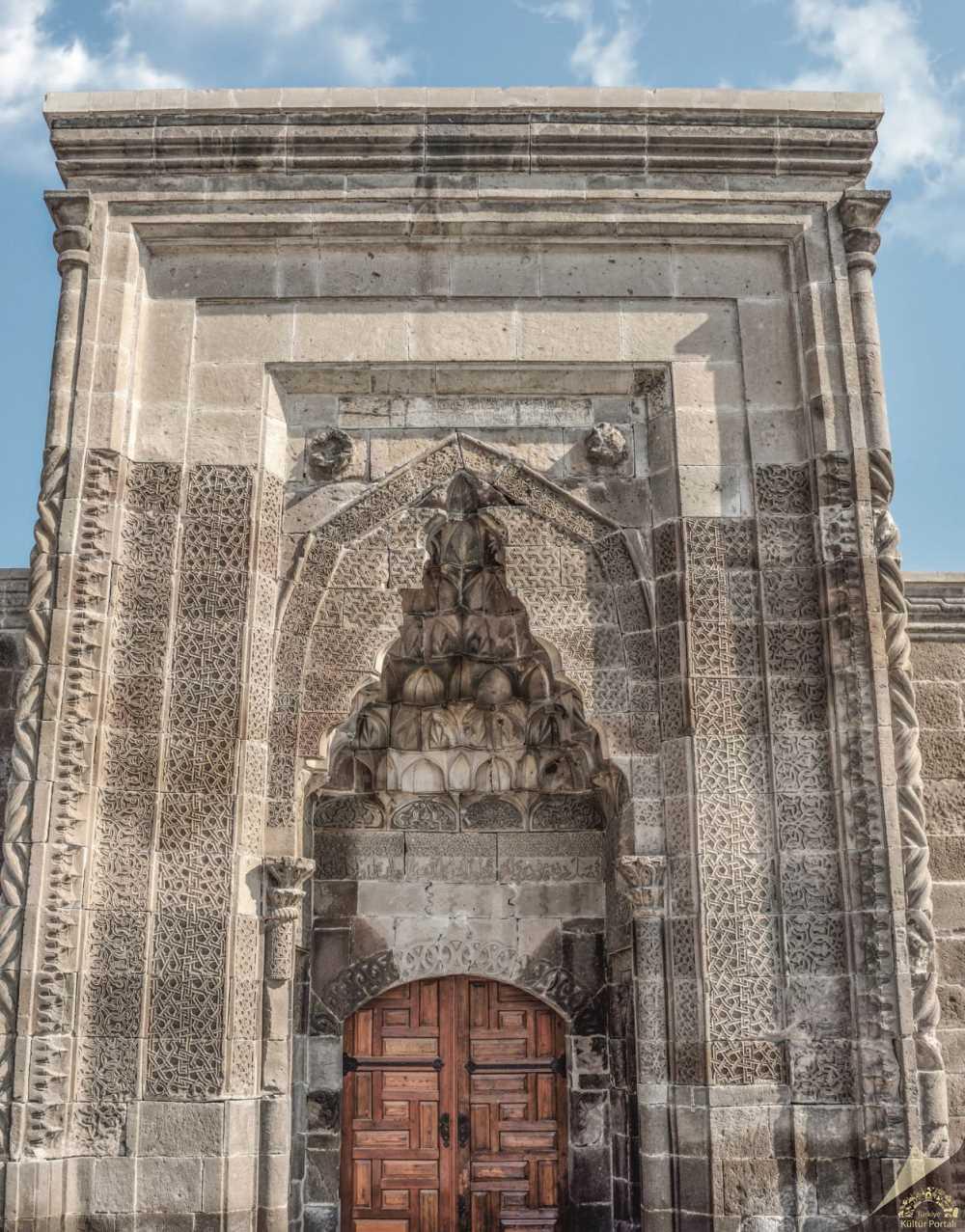
Sahabiye Church (Türkiye Culture Portal)
The medrese was commissioned in 1267 (AH 666) during the reign of Sultan III. Gıyaseddin Keyhüsrev by Sahip Ata Fahreddin Ali, one of the Seljuk viziers. An inscription in Naskh script on the portal clearly identifies the founder as Hüseyin’s son, Sahip Ata Fahreddin Ali, and confirms that construction took place under the rule of III. Gıyaseddin Keyhüsrev. Sahip Ata was a prominent statesman known not only for this medrese but also for other structures he commissioned across various cities of Anatolia, including the Sahip Ata Medrese in Konya and the Gök Medrese in Sivas.
The Sahabiye Medrese embodies the classical characteristics of Anatolian Seljuk architecture and is entirely constructed of cut stone. The building has a rectangular plan oriented north-south, featuring an open courtyard, four iwans, and a single story. The entrance facade resembles a medium-sized caravanserai in its architectural appearance. The monumental portal, projecting outward, draws attention through its geometric stone craftsmanship, zigzag edge decorations, and relief motifs.
Within the muqarnas-vaulted niche of the portal lies a depressed arch opening, surrounded by a pointed arch. The door borders feature stylized bird and plant motifs. Additionally, bull and lion figures are positioned on either side of the portal and on the spandrels.
The courtyard is surrounded on three sides by arcades, with a rectangular pool located at its center. Behind the arcades, student cells and classrooms are arranged under pointed barrel vaults.
A mosque and a fountain were constructed alongside the medrese. However, the mosque has not survived to the present day. The Sahabiye Fountain, one of the oldest known fountains in Kayseri, was relocated during urban roadworks to the eastern section of the medrese’s entrance facade. Over time, the surrounding streets were raised by approximately one meter, creating a level difference that left the base of the building below the current street level.
Today, the Sahabiye Medrese has been restored by the Kayseri Metropolitan Municipality and opened to the public. Although it no longer serves an educational function, it continues to be an important cultural monument in the city center, valued for its architectural and historical significance.
Kayseri Büyükşehir Municipality. "Sahabiye Medresesi ve Çeşmesi." kayseri.bel.tr. Accessed June 29, 2025. https://www.kayseri.bel.tr/kesfet-listeleme/sahabiye-medresesi-ve-cesmesi.
Mert, Yener Lütfü. “Sahabiye (Sahibiye) Medresesi.” Türkiye Turizm Ansiklopedisi. Accessed June 29, 2025. https://turkiyeturizmansiklopedisi.com/sahabiye-sahibiye-medresesi.
Ministry of Culture and Tourism. "Sahabiye Medresesi." *Kültür Portalı*. Accessed June 29, 2025. https://kulturportali.gov.tr/turkiye/kayseri/gezilecekyer/sahabiye-medresesi.
Location | Türkiye Kayseri Sahabiye Neighborhood | ||||||||
|---|---|---|---|---|---|---|---|---|---|
Construction Year | 1267 (H. 666) | ||||||||
Patron | Seljuk vizier Sahip Ata Fahreddin Ali | ||||||||
Period(s) | reign of III. Gıyaseddin Keyhüsrev Anatolian Seljuk State | ||||||||
Foundation and Founder
Architectural Structure and Plan Features
Building Complex and Later Modifications
Current Use