

This article was automatically translated from the original Turkish version.
+1 More
Registration Number | 835 | ||||||||
|---|---|---|---|---|---|---|---|---|---|
Registration Date | 09.08.2021 | ||||||||
Applicant/Registrant(s) | Haliliye Municipality | ||||||||
Geographical Boundary | Şanlıurfa Province | ||||||||
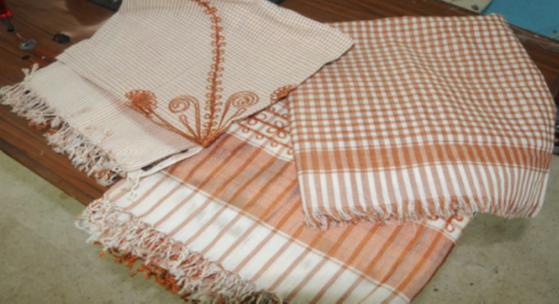
Şanlıurfa culha weaving is a traditional craft that has been practiced for centuries and represents the city’s deep-rooted textile heritage. This craft is based on the hand-weaving of cotton, wool, and silk yarns on traditional looms using plain weave or twill techniques, and over time it has produced fabrics tailored to the local population’s needs and aesthetic sensibilities. Registered as a geographical indication, culha weaving not only preserves a historical production tradition but also provides sustainable social and economic contributions, particularly through women’s employment.
Culha weaving has existed as a significant production activity in Şanlıurfa since the Ottoman period. Evliya Çelebi’s 17th-century account of sturdy cotton fabrics woven in Urfa, comparable in strength to doors and superior to Mosul cloth, attests to the craft’s historical roots. Nineteenth-century records from the Aleppo Vilayet annuals also mention the production of cloth and cotton abas in the city. Culhacılık has been mentioned alongside other traditional crafts of Şanlıurfa such as felt-making, coppersmithing, and blacksmithing, and has maintained its presence in markets and villages for many years.
Culha fabric is woven on traditional handlooms. The yarns used in production may be cotton, wool, silk, or artificial silk. The most common weave structure is plain weave, although twill weave is occasionally preferred. The warp and weft threads are mounted on the loom, and a frame (known locally as “kücü”) is used to open the shed, allowing the shuttle to carry the weft thread through. The weaving process is completed by tightening the fabric through the stability of the warp, the density of the weft, and the use of the reed.
Traditional looms are of the “pit loom” type, in which the weaver positions her feet in a depression beneath the loom. While the cotton yarn traditionally used is locally sourced, today synthetic yarns (floş) and artificial silk are also employed. Before weaving, the yarns are sized with a mixture of flour and water; this process enhances yarn durability and facilitates the weaving process.
Culha weaving appears in various product categories. Items such as the yamşah (cefiye), worn as head coverings by men and women; the red vala, favored for bridal veils; the ehram, a women’s shoulder wrap; the fıta, a half-veil worn by young girls; the kahke bezi, used in sesame bread ovens; and the izar, woven from cotton, are integral parts of the regional clothing culture. Patterned weaves such as hışvalı, şakkalı, puşu, and dümbüllü are typically used for shawls, tablecloths, television covers, and bedspreads. Additionally, embroidery techniques are applied to woven fabrics, as seen in examples such as the sarı ağabağı, a sash worn around men’s waists.
Culha weaving faced the threat of disappearance in the early 21st century. However, this traditional art was revitalized through the “Culha Weaving from Past to Present” project initiated by Haliliye Municipality. Supported by the GAP Regional Development Agency, the project established the Culha Workshop within the Haliliye GESEM (Center for Traditional Handicrafts), providing employment opportunities for women through ten weaving looms. Fabrics produced under the project were promoted nationwide through 18 designs by fashion designer Çiğdem Akın.
Şanlıurfa culha weaving was registered as a “geographical indication” on 09.08.2021 under the Industrial Property Law No. 6769. The registration was carried out by Haliliye Municipality, and all stages of production must occur within the boundaries of Şanlıurfa Province. Oversight is conducted by a monitoring body composed of representatives from Haliliye Municipality, Şanlıurfa Metropolitan Municipality, the Provincial Directorate of Culture and Tourism, and ŞURKAV.
Traditional culha weaving continues to be taught in educational workshops. Master artisans are transmitting the craft to new generations, enabling women to earn income while preserving a heritage on the verge of extinction. To ensure the sustainability of weaving, public-supported projects, local promotional activities, and modern design applications are being implemented in tandem.
Akpınarlı, Feriha. *Şanlıurfa Cülha Dokumacılığı*. Şanlıurfa: Şanlıurfa Büyükşehir Belediyesi Yayınları, Şanlıurfa Kültür Eğitim Sanat ve Araştırma Vakfı (SURKAV), 2022. Accessed July 15, 2025. https://www.sanliurfa.bel.tr/files/1/bsb_sonra/surkav_yayinlari/13_SANLIURFA_CULHA_DOKUMACILIGI.pdf.
Haliliye Municipality. “Haliliye Belediyesi ile Şanlıurfa’nın kültürü yaşatılıyor.” Date Published August 13, 2024. Accessed July 15, 2025. https://www.haliliye.bel.tr/icerik/7198/12/haliliye-belediyesi-ile-sanliurfanin-kulturu-yasatiliyor
Turk Patent ve Marka Kurumu. No: 835 – Mahreç İşareti Şanlıurfa Culha Dokuması. Date Published August 9, 2021. Accessed July 15, 2025. https://ci.turkpatent.gov.tr/Files/GeographicalSigns/d18d0a44-f8b8-4975-8ae0-1a86bc2e54aa.pdf
Registration Number | 835 | ||||||||
|---|---|---|---|---|---|---|---|---|---|
Registration Date | 09.08.2021 | ||||||||
Applicant/Registrant(s) | Haliliye Municipality | ||||||||
Geographical Boundary | Şanlıurfa Province | ||||||||
No Discussion Added Yet
Start discussion for "Şanlıurfa Culha Weaving" article
Historical Background and Cultural Significance
Production Method and Technical Features
Product Types and Uses
Modern Applications and Institutional Support
Geographical Indication Registration
Current Status and Promotion Efforts