This article was automatically translated from the original Turkish version.
+2 More
Location | Şanlıurfa / Türkiye | ||||||||
|---|---|---|---|---|---|---|---|---|---|
Founding Period | 1523 (Muhammed Salih Paşa) | ||||||||
Architectural Plan | Rectangular plan, three minarets | ||||||||
Architectural Type | Ottoman architecture | ||||||||
Important Elements | and a water source regarded as healing Structure integrated with the cave believed to be the birthplace of Prophet Ibrahim | ||||||||
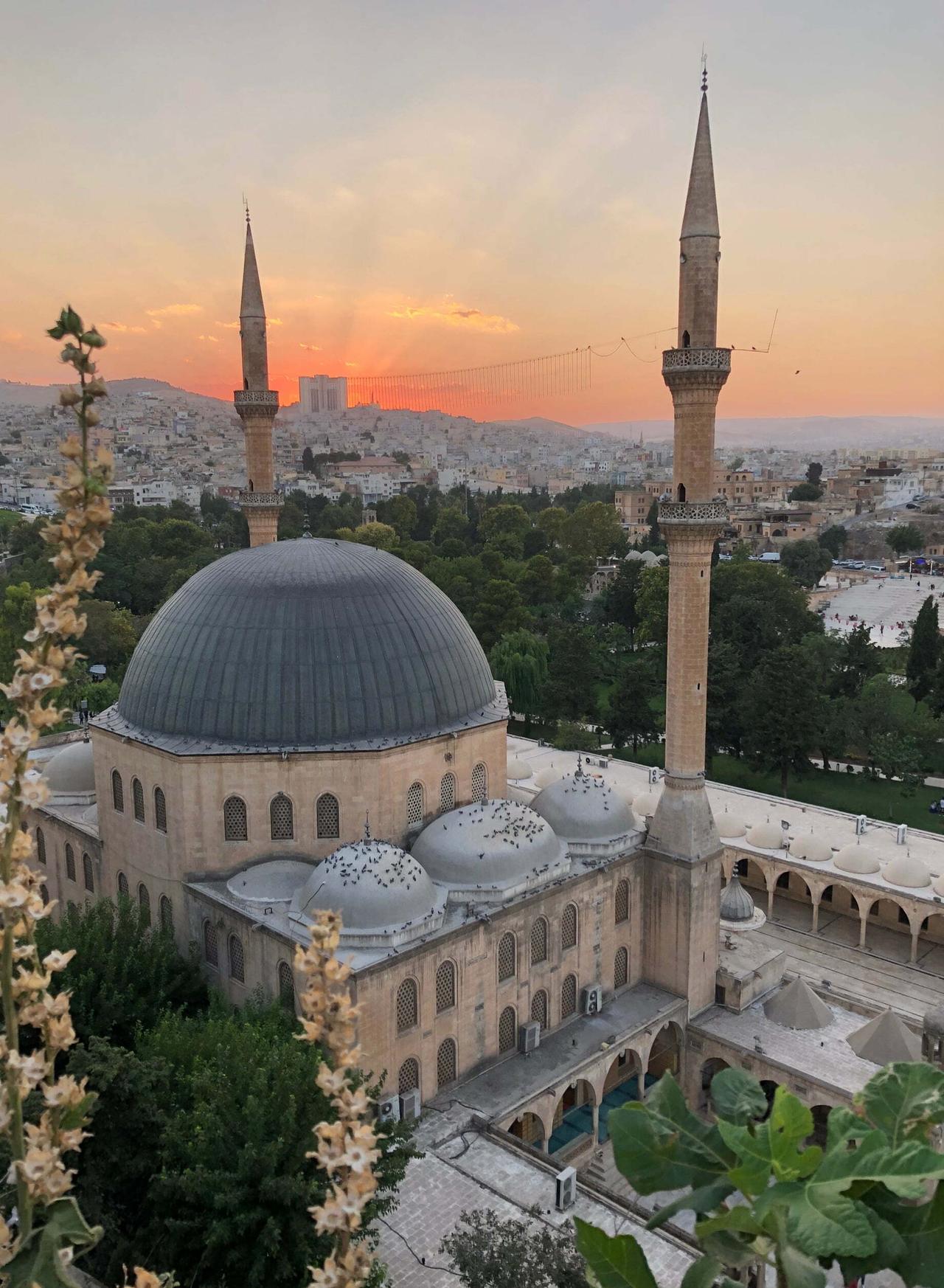
Mevlid-i Halil Camii is a rectangular place of worship located on the Dergâh Plateau around Balıklıgöl in Şanlıurfa, immediately next to the cave believed to be the birthplace of Prophet Ibrahim. It was constructed in 1523 during the Ottoman period by Muhammad Salih Pasha. Historically, this site has borne traces of multiple faiths and was later reconfigured within Islamic architectural traditions.
The mosque was built immediately beside the cave believed to be the birthplace of Prophet Ibrahim. The area has hosted numerous religious traditions throughout history. It is known that a pagan temple was constructed here in the 2nd century BCE by the Seleucids. Subsequently, the site was used as a synagogue by Jews and later as a church by Christians. After the first church was built around 150 CE, it was expanded during the Byzantine era under the name Hagia Sophia and became one of the major centers of Christian worship. In 1523, during the reign of Ottoman Sultan Selim I, the Ottoman governor Muhammad Salih Pasha commissioned the construction of a mosque on this sacred site, laying the foundations of the present-day Mevlid-i Halil Camii.

Mevlid-i Halil Camii (Türkiye Culture Portal)
The mosque is a rectangular structure reflecting the influences of Ottoman classical architecture. Its layout was carefully planned with consideration for the location of the cave believed to be the birthplace of Prophet Ibrahim, integrating the natural feature into the mosque complex without causing damage. During its initial construction, a wall was built between the cave and the mosque, ensuring the cave’s preservation while incorporating it as a sacred element enhancing the mosque’s sanctity. On the northeast side of the building stands a stone-carved portal that draws attention with its pointed arch and muqarnas decoration, characteristic of Ottoman architectural style.
The mosque has three minarets: one is positioned above the entrance to the cave, while the other two are located at the corners of the courtyard. The interior space is relatively simple in design, featuring a mihrab, minbar, and pulpit, but is adorned with fine stonework and calligraphy. The kalem-i işi decorations on the dome and walls have suffered deterioration over time but were restored during subsequent renovation efforts. Original lighting was provided by mazgal windows; in later periods, additional windows were added to improve natural illumination.

Mevlid-i Halil Camii (Türkiye Culture Portal)
The Mevlid-i Halil Cave, considered an integral part of the mosque complex, is one of its most striking features. According to tradition, the mother of Prophet Ibrahim, persecuted by the people of Nimrud, took refuge in this cave and gave birth to him here. As such, the cave holds great significance in Islamic belief. The spring within the cave is widely regarded by the public as having healing properties.
According to popular belief, this water source is the second most sacred after the Zamzam water in the Kaaba. Visitors come to the cave to pray and drink the water seeking healing. The spring is regularly cleaned and maintained by the foundation responsible for the mosque’s upkeep. The cave area can be visited independently from the mosque or courtyard, with separate entrances provided for men and women. The cave walls also feature inscriptions and religious plaques dating from the Ottoman period.
The cemetery located in the courtyard of Mevlid-i Halil Camii is another significant historical component of the structure. It contains over 200 tombstones dating from the 19th and 20th centuries. These tombstones represent important examples of Ottoman funerary art. They exhibit considerable diversity in ornamentation, headstone types, script styles, stone shapes, and materials used. Some of the stones belong to local sheikhs, madrasa teachers, and prominent regional figures. The stones bear inscriptions in Ottoman Turkish, including verses from the Quran, hadiths, and prayers. Some also mention professional titles. Tombstones from the early 20th century offer valuable insights into the artistic sensibilities and social structure of the period. The cemetery functions both as a burial ground and as an integrated historical memory space closely linked to the mosque.
Mevlid-i Halil Camii has undergone numerous repairs and restorations throughout its history. The first major restoration took place in 1816. Further significant repairs were carried out in 1852 and 1951 with community contributions. In the early 1990s, under a restoration project led by the General Directorate of Foundations, both the interior and exterior of the mosque were renovated, restoring it to its current appearance.
Following the 2023 earthquakes centered in Kahramanmaraş, minor damage occurred in this mosque, as in other historical structures in Şanlıurfa. Cracks were observed particularly in the minarets, prompting emergency teams to conduct structural analyses and implement reinforcement measures. During the restoration, traditional techniques were combined with modern conservation methods to preserve aesthetic integrity while enhancing the building’s resilience.
Mevlid-i Halil Camii is not merely a place of worship but also a symbol representing the cultural identity of the region. When considered together with the birth cave attributed to Prophet Ibrahim, Balıklıgöl, and Aynzeliha Lake, the site forms a complex of religious significance. The mosque welcomes hundreds of thousands of visitors annually, who come both to fulfill religious obligations and to experience the historical and cultural heritage firsthand. Additionally, events held at the mosque during religious holidays, kandil nights, and mevlit ceremonies play a central role in the religious life of Şanlıurfa.
Güler, Gül. "Urfa Mevlid-i Halil Camisi Haziresindeki Mezar Taşları." Vakıflar Dergisi 46, (2016): 145–162. Accessed July 24, 2025.
Ministry of Culture and Tourism of the Republic of Turkey. "Mevlid-i Halil (Dergâh) Camii ve Mağarası." Türkiye Kültür Portalı. Accessed July 24, 2025.
Soyluk, A., and Demircan, B. "Tarihi Yığma Minarelerin Deprem Yükü Altındaki Davranışlarının 6 Şubat Kahramanmaraş Depremlerinde Hasar Görmüş Cami Örnekleri Üzerinden Mimari Açıdan İncelenmesi." *Journal of Architectural Sciences and Applications* 8, special issue (2023): 329–354. Accessed July 24, 2025. https://dergipark.org.tr/en/pub/mbud/article/1318660

Location | Şanlıurfa / Türkiye | ||||||||
|---|---|---|---|---|---|---|---|---|---|
Founding Period | 1523 (Muhammed Salih Paşa) | ||||||||
Architectural Plan | Rectangular plan, three minarets | ||||||||
Architectural Type | Ottoman architecture | ||||||||
Important Elements | and a water source regarded as healing Structure integrated with the cave believed to be the birthplace of Prophet Ibrahim | ||||||||
No Discussion Added Yet
Start discussion for "Şanlıurfa Mevlid-i Halil Camii" article
Historical Background
Architectural Features
Mevlid-i Halil Cave and Healing Water
Cemetery and Tombstones
Restoration and Post-Earthquake Condition
Cultural and Pilgrimage Tourism