


This article was automatically translated from the original Turkish version.
Name(s) | Sapienza Naval Battles Firs Lepanto First Battle of Inebahri Burak Reis Island Naval Battles Zonchio Naval Battles | ||||||||
|---|---|---|---|---|---|---|---|---|---|
First Conflict | 12 August 1499 | ||||||||
Second Conflict | 20 August 1499 | ||||||||
Third Conflict | 22 August 1499 | ||||||||
Final Conflict | 25 August 1499 | ||||||||
Location | Gulf of Patras Zonchio Cape waters Sapienza Island (Porto Longo) Messenia coasts Peloponnese Peninsula | ||||||||
Parties | Republic of Venice Ottoman State | ||||||||
Ottoman Commanders | Kemal Reis Küçük Davud Pasha | ||||||||
Venetian Commanders | Admiral Antonio Grimani | ||||||||
Ottoman Forces | Heavy ships carrying large cannons Galleys | ||||||||
Venetian Forces | Reinforcements from Dalmatia and the Aegean Several heavy sailing ships Galleys | ||||||||
Outcome | The path was opened for the capture of Modon and Koron Ottoman Victory | ||||||||
Sapienza (Zonchio) Naval Battles refer to four separate naval engagements that took place intermittently on 12, 20, 22, and 25 August 1499, in the context of the Ottoman–Venetian War (1499–1503), near the island of Sapienza / Porto Longo on the Messenia coast of the Morea and off Cape Zonchio. The sequence of events appears in contemporary Venetian accounts as “Sopra el Zonchio” and “Porto Longo”; in modern literature, this phase of the 1499 conflict is most commonly referred to as the “Battle of Zonchio” or “First Lepanto (1499).”
During the battles, the Venetian fleet was commanded by Captain Antonio Grimani. The Ottoman fleet was assembled under the command of Kapudan Pasha Kütük Davud Pasha, with Kemal Reis emerging as one of the prominent captains in the engagement. Venetian sources particularly emphasize Grimani’s command and decisions, while Ottoman sources highlight Davud Pasha’s conduct and Kemal Reis’s role in the battle.

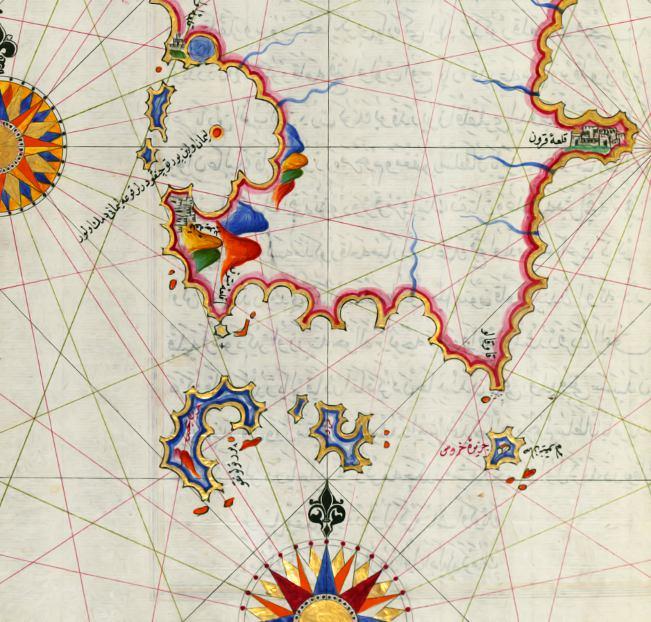
Map showing the coasts of the Morea and surrounding areas (Kitâb-ı Bahriye
The Sapienza/Zonchio battles are also regarded as a turning point in Mediterranean naval warfare due to the first significant use of ship-mounted cannons.【1】 The designation “first” remains debated in scholarly literature; however, contemporary accounts note the presence of an unusual Ottoman galley equipped with two exceptionally large cannons.
The losses suffered during the battles provoked a strong reaction in Venetian public opinion and led to the trial of Antonio Grimani in early 1500. This process laid the groundwork for major political debates within the Republic and is considered one of the critical turning points in the sequence of events leading to the loss of Modon and Koron (1500) and the eventual peace treaty of 1503.
By the late fifteenth century, competition between the Ottoman Empire and the Republic of Venice in the Mediterranean had intensified in both political and economic dimensions. Venice sought to maintain control over its fortresses and islands along the Morea coast to secure the Adriatic Sea and protect its Levantine trade routes; the Ottomans aimed to break this dominance and strengthen their naval supremacy along the Aegean and Ionian coasts.
Political developments on the Italian peninsula during this period directly influenced the balance of power. The Italian campaign of French King Charles VIII, which began in 1494, disrupted regional power dynamics, diverting Venice’s military and diplomatic resources significantly toward the Italian theater. From the Ottoman perspective, this situation presented a favorable opportunity to weaken Venice’s eastern defenses.
In the lead-up to the war, the Ottomans strengthened their navy by expanding their fleet and recruiting experienced captains known for piracy in the Mediterranean into state service. Kemal Reis’s incorporation into the imperial court’s patronage system in 1494, along with the equipping of his ships with shipyard facilities and heavy artillery, marked a significant professional transformation in Ottoman maritime capabilities. These moves were not merely aimed at defeating the Venetian fleet but also at isolating Venetian fortresses along the Morea coast and bringing their trade and supply routes under Ottoman control.

Map showing the fortress of Modon (Motun) (Kitâb-ı Bahriye
Venetian preparations, by contrast, were insufficient.【2】 Captain-General Antonio Grimani, though from a wealthy and influential family, possessed limited maritime experience. This led to serious weaknesses in fleet management and indecisiveness in command decisions. Although the Venetian Senate recognized the magnitude of the Ottoman threat, it was unable to mobilize its naval forces to full capacity due to the military and financial burdens imposed by the wars in Italy. Venice’s relations with the Papacy and Spain further hindered efforts to form a broad anti-Ottoman alliance.
The Ottoman fleet’s movement toward the Morea coast in the summer of 1499 revealed a shift in the balance of power. While the Ottomans deployed a powerful fleet, the Venetian navy failed to match them in numbers or discipline. The clashes off Zonchio and Sapienza exposed this imbalance and set the stage for the eventual loss of Modon and Koron in subsequent years.
The peace treaty signed in 1503 granted the Ottomans strategic superiority and significantly curtailed Venetian influence in the eastern Mediterranean. Thus, the political and strategic developments between 1494 and 1499 elevated the Sapienza (Zonchio) Naval Battles from mere military engagements to a pivotal turning point that reshaped the balance of power in the Mediterranean.
The battles occurred in the region surrounding the triangle formed by Modon (Methoni), Sapienza Island, and Navarino (Pylos), as well as near Cape Zonchio. This area was a strategic maritime zone characterized by sheltered bays and narrow straits, offering safe anchorage for fleets while also providing access to the open sea. The Ottoman fleet anchored in the Porto Longo harbor behind Sapienza Island during the summer months and launched its operations from there. The Venetian fleet positioned itself along the same axis, in the open waters between Modon and Sapienza, seeking to gain the wind advantage. This arrangement demonstrates that the region served as a central base for both sides throughout the conflict. Piri Reis’s Kitab-ı Bahriye describes the location of Sapienza Island as follows:
...Opposite the place mentioned are several uninhabited islets. One of these islets is called Kocular. These three islets are uninhabited. If a large ship intends to approach and anchor at these islets, the customary practice for ships arriving from the west is to pass them on the left side and find eight cubits of water with the lead line, then drop anchor. They moor to the islets on the side facing Palamar. The anchor is set against the north wind. This is how it is done. For large ships, this is a suitable anchorage. Thus it is known, peace be upon you.【3】
The three islets mentioned by Piri Reis are Schiza, Sapientza, and Agia Marina, located off the southern coast of the Morea Peninsula. A map showing their positions is provided below:

Map showing the area of the battle (Kitâb-ı Bahriye)
The most critical military factor in this region was wind and current patterns.【4】 The first major engagement on 12 August 1499 occurred as the Ottoman fleet exited Porto Longo, while the Venetian fleet waited for favorable winds to intercept them. Subsequent clashes during the following days took place along the same axis between Porto Longo and Zonchio, and by 25 August the battle line had extended as far as the Gulf of Patras. Thus, the four separate engagements unfolded along a maritime corridor stretching from Sapienza to Patras.
The positioning of the fleets was closely tied to the geographical features of the region. Ottoman ships were arranged several miles apart in the open sea, while Venetian heavy units maintained a line approximately ten miles off Sapienza. These deployments indicate that the battles followed a rhythm of approach and withdrawal between open waters and sheltered harbors. Changes in wind direction forced both sides to reorganize their battle formations multiple times within a single day.
Navarino also played a significant role in this campaign. After the initial clashes, the Ottoman fleet anchored at Navarino before reemerging to continue the battle. Thus, Navarino became an essential link in the Ottoman cycle of retreat, regrouping, and renewed advance, alongside Porto Longo. The name Zonchio was frequently used in sources to denote the battle site, and the surrounding waters were consistently described as the central theater of all engagements.
This geographical configuration was well suited to the operational requirements of Mediterranean oared fleets. The reliance of galleys on human-powered rowing and their limited provisions capacity necessitated frequent anchoring at small islands and coves. Consequently, natural harbors behind islands like Sapienza served not only as waiting and wind-watching points but also as vital centers for resupply and regrouping. This necessity explains why the control or denial of such anchorages remained a constant strategic objective in Ottoman–Venetian naval competition.
By 1499, the Ottoman and Venetian fleets represented the two largest naval powers in the Mediterranean. However, their preparations for the campaign unfolded under different conditions, directly influencing the course of the battles off Zonchio and Sapienza.
On the Ottoman side, with the support of Sultan Bayezid II, intensive shipbuilding activities were carried out at the Imperial Shipyard in Istanbul. Official command of the expedition was entrusted to Kapudan Pasha Kütük Davud Pasha, but operational leadership was effectively assumed by Kemal Reis. At this time, the core of the Ottoman fleet consisted of galleys; however, from the 1490s onward, large sailing vessels and artillery capabilities had been increasingly integrated into the fleet.

Map showing the islands of Crete and the Morea (Kitâb-ı Bahriye
Kemal Reis’s experience in Mediterranean piracy granted the Ottoman fleet not only numerical but also qualitative superiority through superior maneuverability.【5】 Other experienced captains serving in the campaign included Burak Reis and Sâlih Reis. This cadre became a crucial factor in enhancing the military effectiveness of the expedition.
Venetian preparations followed the Republic’s traditional naval organization. The Venetian Arsenal, one of the most advanced shipyards in the Mediterranean, possessed the capacity to equip numerous galleys. Nevertheless, the appointment of Captain-General Antonio Grimani sparked controversy within the fleet’s command structure. Although Grimani came from a wealthy and influential family, his limited maritime experience meant his appointment was widely perceived as a political choice rather than a professional one.
The main body of the Venetian fleet consisted of galleys, supported by several heavy sailing vessels. Additionally, Venice gathered auxiliary forces from the Dalmatian coast, the Aegean islands, and allied Italian city-states.
The most significant difference between the two fleets lay in artillery. The Ottoman fleet sailed with galleys armed with larger cannons and greater firepower, providing a decisive advantage during the battles. The Venetian fleet, by contrast, remained relatively limited in artillery capacity; despite efforts to enhance maneuverability, it lagged behind in fire support. This disparity created favorable conditions for Ottoman superiority during the four engagements of August 1499.

Map showing the Morea Island and surrounding islets (Kitâb-ı Bahriye
Both sides’ preparations also depended heavily on logistical considerations.【6】 The Ottoman fleet relied on islands in the Aegean and the Morea coast for resupply after departing from Istanbul, while the Venetian fleet drew support from bases along the Dalmatian coast and within the Adriatic. The short operational range of galleys made the selection of these bases decisive for the campaign’s progress. Under these conditions, the two fleets differed not only in organizational structure but also in the experience of their commanders. These differences provide a fundamental framework for understanding the outcome of the battle.
The Ottoman and Venetian fleets that confronted each other in 1499 embodied two distinct phases in the transition of Mediterranean naval warfare from the late Middle Ages to the early modern period. Both fleets were primarily composed of galleys, but each incorporated different elements around this core, particularly in terms of sailing vessels and artillery capabilities.
The Ottoman fleet had grown significantly in both numbers and equipment during the second half of the fifteenth century thanks to rapid shipyard production. Alongside galleys, larger vessels with broader hulls and higher bulwarks were added to the fleet, equipped with heavy cannons. Sources specifically mention two large-gun galleys, illustrating the Ottomans’ innovative efforts to enhance firepower. These ships integrated artillery into the traditional oared fleet structure without disrupting its core function, playing a decisive role in the Sapienza (Zonchio) battles.

Engraving depicting the Sapienza Naval Battles (British Museum)
The Venetian fleet, despite its long-standing dominance in the Mediterranean, lagged behind the Ottomans in artillery during this period. Although the Venetian Arsenal had the capacity to build numerous galleys, it adopted a more cautious approach to increasing firepower. While several large sailing vessels were present in the Venetian fleet, they could not match the concentrated firepower of the Ottoman ships. Venice’s advantage lay in its experienced crews and institutional naval traditions; however, weaknesses in command limited the effectiveness of these strengths on the battlefield.
In terms of doctrine, both sides prioritized the maneuverability of oared vessels. The traditional Mediterranean naval tactic aimed to board enemy ships and engage in close combat. However, the Ottomans’ effective use of artillery transformed this traditional approach, making long-range fire a more prominent feature of battle. The Venetians attempted to gain the wind advantage and encircle the Ottoman fleet, but this strategy failed in practice.
These differences were fundamental in determining the course of the battles off Sapienza and Zonchio. The Ottoman fleet’s superior firepower and diversity in ship types enabled it to gain the upper hand during the engagements; the Venetian fleet, by contrast, remained tied to traditional galley tactics and consequently lost its advantage. Thus, the battles of 1499 are regarded as the beginning of a new era in Mediterranean warfare, in which ship-mounted artillery gained decisive importance.
The first battle occurred as the Ottoman fleet exited the Porto Longo harbor behind Sapienza Island. The Venetian fleet under Antonio Grimani sought to gain the wind advantage but struggled to form a coordinated attack. Grimani’s cautious approach created uncertainty within the Venetian ranks. In contrast, the Ottoman fleet demonstrated rapid maneuverability, particularly through Kemal Reis’s leading galleys.
The heavy cannons on Ottoman galleys opened concentrated fire on Venetian ships at the outset, causing disruption in their formation. By the end of the day, the Venetian fleet had withdrawn, and the Ottoman fleet returned to Porto Longo to maintain its secure position. Although this first clash produced no decisive outcome, the Ottoman fleet’s superiority in firepower was clearly evident.
In the second encounter, both sides returned to the battlefield, with the Venetian fleet attempting to encircle the Ottoman fleet. However, variable wind conditions and internal command disunity prevented the Venetians from executing their plan. The Ottoman fleet effectively used its artillery to inflict heavy damage on several Venetian galleys.
During this engagement, discipline broke down among some Venetian vessels, leading to the disintegration of their formation. The Ottoman fleet capitalized on this disarray and enhanced its effectiveness on the battlefield. Although this battle also ended without a decisive result, morale and anxiety declined significantly within the Venetian ranks.
The third battle was one of the fiercest phases of the campaign. Both sides deployed larger forces. The Ottoman fleet, under Kemal Reis’s command, achieved overwhelming superiority through flanking maneuvers and intense artillery fire. Coordination among Venetian ships remained weak, and several galleys broke formation and fought alone.
This situation favored the Ottomans, allowing them to employ their firepower more effectively. Ottoman attempts to board enemy vessels were also recorded. By the end of the day, the Venetian fleet was forced to withdraw again, while the Ottoman fleet maintained its dominance on the battlefield.
The fourth and final battle was the largest in geographical scope, extending as far as the mouth of the Gulf of Patras. The Venetian fleet struggled to maintain its formation and moved in a disorganized manner. Antonio Grimani’s inadequate command became even more apparent at this stage. The Ottoman fleet intensified its artillery fire, inflicting heavy losses on Venetian ships.
Several Venetian galleys were sunk by cannon fire, while others caught fire and became unusable. The majority of Venetian vessels abandoned the battlefield, and the Ottoman fleet emerged as the undisputed master of the area. This outcome marked not only the conclusion of the August 1499 battles but also the beginning of a severe decline in the morale and reputation of the Venetian navy.
These four battles demonstrated the effectiveness of the Ottoman navy’s artillery-based approach to naval warfare and revealed that Venetian dominance through traditional galley tactics was no longer viable. The defeats of August 1499 laid the military groundwork for the loss of Modon and Koron a year later.
The four battles off Zonchio and Sapienza in August 1499 solidified the Ottoman navy’s strategic advantage. The Ottoman fleet not only forced the Venetian fleet to retreat but also intensified pressure on Venetian fortresses along the Morea coast. For Venice, the losses were not limited to ships and manpower; they also triggered a profound political and psychological collapse. Public opinion reacted strongly to the defeats, and blame was directly placed on Antonio Grimani.
A trial against Grimani was initiated in early 1500, sparking extensive debates in the Senate and among the public. Grimani was heavily criticized for his lack of maritime experience, and the decisions made during the proceedings were viewed as indecisive and inconclusive. As a result, Grimani was removed from command and briefly exiled. This process brought the competence of military commanders into public debate and prompted a reevaluation of Venice’s naval policy.

Map showing the Morea Vilayet (Kitâb-ı Bahriye
From the Ottoman perspective, the 1499 battles marked the beginning of operations along the Morea coast.【7】 These victories paved the way for the capture of Modon and Koron in 1500—fortresses regarded by Venice as its “two eyes.” The loss of these strongholds severely undermined Venetian naval supremacy in the Aegean and Ionian Seas. The Ottomans thus established control over the Morea coast and secured their supply lines.
The period between 1499 and 1500 was one of the decisive turning points in the Ottoman–Venetian War. Despite efforts to secure allies, Venice could not withstand the Ottomans alone and was compelled to recognize Ottoman gains in the peace treaty of 1503. These developments established the Ottoman navy as a foundational force in Mediterranean dominance throughout the sixteenth century and marked the beginning of a permanent decline in Venetian naval supremacy.
[1]
Pîrî Reis, Kitâb-ı Bahriye, s. 119.
[2]
Pîrî Reis, (a.g.e), s. 124.
[3]
Pîrî Reis, (a.g.e), s. 131.
[4]
Pîrî Reis, (a.g.e), s. 134. Ayrıca bknz. https://uskudar.biz/tarih/deniz-sava%C5%9Flar%C4%B1/burak-adas%C4%B1-deniz-sava%C5%9F%C4%B1.html.
Harita Transkripsiyonu şu şekildedir;
1- Haritanın en altında ve solunda yer alan siyah ok işaretleri kuzeyi gösterir.
2- Haritanın Kuzeydoğusundaki yazılar (Üstten Alta): İlk yazı "Cezire-i Mora"dır. Mora adası demektir. Hemen altında "Kal'a-i Koron yazar, Koron Kalesi demektir. Hemen altında adanın en uç kısmında Kavkalu yazar, liman kasabası ismidir. Kasabanın hemen karşısındaki adanın üzerinde "Santa Nikola" ve "Cezire-i Hurus" yazar, adanın isimleridir.
3- Haritanın Kuzey Çizgisindeki yazılar (Üstten Alta): İlk yazı "Kal'a-i Arkadya"dır, Mora için stratejik öneme sahiptir, kuzey çizgisinin çok az batısında yer alır, fark önemsenmemiştir. En alttaki kuzey çizgisinin hemen dibindeki adanın üzerinde "Karave" yazmaktadır, adanın ismidir.
4- Haritanın Kuzeybatısındaki yazılar (Üstten Alta): İlk yazı "Mezkûra Bark (Barak / Burak) Adası dahî dirler. Zîra Bark Barçası burada batmışdır." şeklinde bir açıklamadır. Burak Reis'in barçasının (topları bulunan savaş gemisi) battığı yeri ifade eder. Hemen altındaki adanın üzerinde "Cezîre-i Paradne" yazar, adanın asıl ismidir. Onun altında "Kal'a-i Avlin" yazısı bulunur, Mora'nın stratejik kalelerindendir. Onun Altında "Liman-ı Avlin, Porto Çenko (Zonchio'nun Osmanlıca okunuşu) dirler. Karga limanı dimek olur" yazar. Burası savaşın yaşandığı ana noktalardan birirdir. Hemen altında dağların arasında "Kal'a-i Cedid" yazar, stratejik bir liman kalesidir. Hemen altında "Kal'a-i Metrez (?)" yazar, liman kalelerinden biridir. En alt solda yer alan adanın üzerindeki isim net şekilde okunamamıştır, burası Sapienza Adası olmalıdır. hemen yanında "Porto Longo" yazar, adanın limanının ismidir.
[5]
Pîrî Reis, (a.g.e), s. 121.
[6]
Pîrî Reis, (a.g.e), s. 123.
[7]
Pîrî Reis, (a.g.e), s. 130.


Name(s) | Sapienza Naval Battles Firs Lepanto First Battle of Inebahri Burak Reis Island Naval Battles Zonchio Naval Battles | ||||||||
|---|---|---|---|---|---|---|---|---|---|
First Conflict | 12 August 1499 | ||||||||
Second Conflict | 20 August 1499 | ||||||||
Third Conflict | 22 August 1499 | ||||||||
Final Conflict | 25 August 1499 | ||||||||
Location | Gulf of Patras Zonchio Cape waters Sapienza Island (Porto Longo) Messenia coasts Peloponnese Peninsula | ||||||||
Parties | Republic of Venice Ottoman State | ||||||||
Ottoman Commanders | Kemal Reis Küçük Davud Pasha | ||||||||
Venetian Commanders | Admiral Antonio Grimani | ||||||||
Ottoman Forces | Heavy ships carrying large cannons Galleys | ||||||||
Venetian Forces | Reinforcements from Dalmatia and the Aegean Several heavy sailing ships Galleys | ||||||||
Outcome | The path was opened for the capture of Modon and Koron Ottoman Victory | ||||||||
No Discussion Added Yet
Start discussion for "Sapienza (Zonchio) Naval Battles" article
Political and Strategic Background (1494–1499)
Geographical Location and Battlefield
Preparations and Force Organization
Ship Types, Weapons, and Doctrine
Battle Chronology (August 1499)
12 August 1499 – First Engagement
20 August 1499 – Second Engagement
22 August 1499 – Third Engagement
25 August 1499 – Final Phase
Consequences and Subsequent Developments (1499–1500)