


This article was automatically translated from the original Turkish version.
+1 More
Sarıkaya Waterfall(Düzce Culture and Tourism Directorate)
Sarıkaya Falls
Location | Düzce Yığılca Sarıkaya Village | ||||||||
|---|---|---|---|---|---|---|---|---|---|
Distance(s) | 5 km from Yığılca | 38 km from Düzce center | ||||||||
Geological Structure | Limestone formation, semi-horizontal doline cave | ||||||||
Length(s) | Total length 717 m main gallery 510 m | ||||||||
Width / Height | ~80 m / 15–40 m | ||||||||
Protection Status | First-degree natural protected area (2001) + Strictly Protected Sensitive Area (2021) | ||||||||
Ecological Feature | Microclimatic environment, dripstone formations, high humidity | ||||||||
Sarıkaya Cave is located approximately 1.5 kilometers northeast of Sarıkaya Village, within the boundaries of Yığılca District in Düzce Province. It is situated 5 kilometers from Yığılca district center and approximately 38 kilometers from the city center of Düzce. Access to the cave is provided via stabilized roads originating from the district center, and the route also forms an extension of the Yığılca-Yedigöller ecotourism trail. The region holds a strategic position within Düzce’s nature-based tourism planning, and Sarıkaya Cave occupies a particularly significant role within this network.
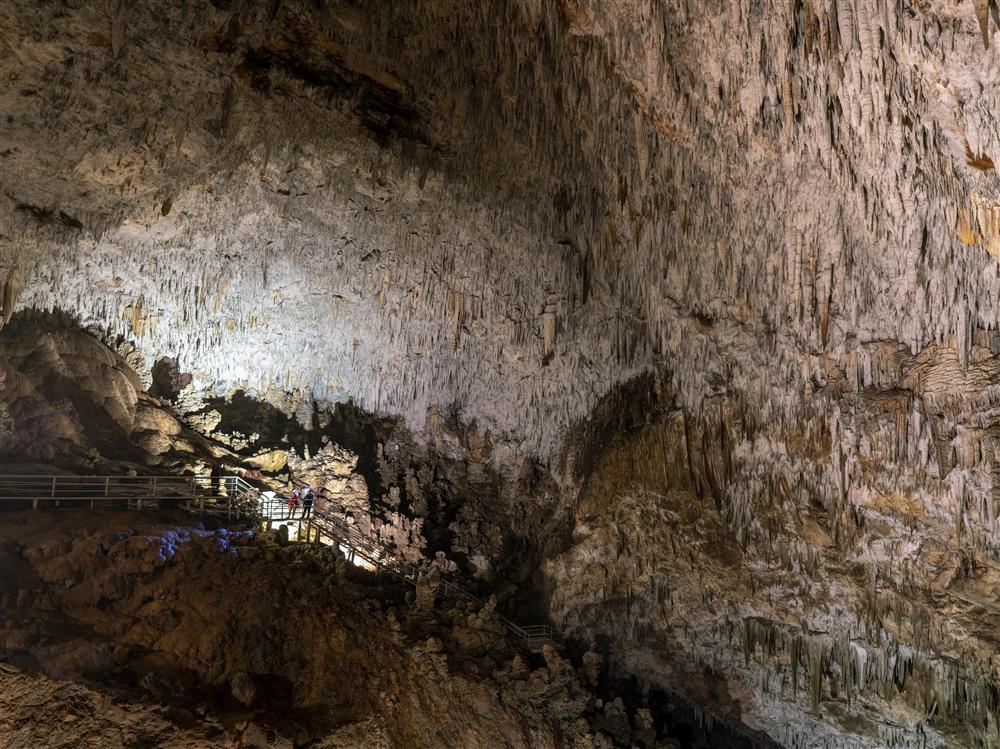
Sarıkaya Cave is situated on a geological zone characterized by dense deposits of limestone from the Paleocene–Lower Eocene periods and exhibits a phreatic-type semi-horizontal cave formation. Its total length is approximately 717 meters, of which 510 meters consist of the main gallery. The width reaches up to 80 meters, while the height varies locally between 15 and 40 meters. Within the cave, various stalactite forms (stalactites, stalagmites, columns) and fossil traces from two distinct geological developmental phases have been observed.
Additionally, the canyon-like valley structure within the cave and the small waterfall flowing through its center indicate that the cave remains hydrographically active. Particularly, erosion marks observed on the cave floor and narrow channel formations signify that karstic erosion processes are still ongoing.

Sarıkaya Cave (Düzce Culture and Tourism Directorate)
Sarıkaya Cave was officially registered as a Class I natural protected area by the Ministry of Culture and Tourism in 2001. However, subsequent scientific studies and ecological assessments led to its reclassification into a higher level of protection. On 20 March 2021, by Presidential Decree No. 3727, the cave was declared a “Strictly Protected Sensitive Area.” This designation confirms the national recognition of the cave’s geological, biological, and cultural values and its placement under absolute protection. This status means that any construction, excavation, or human activity may only be carried out with the explicit authorization of the relevant authority and in accordance with scientific principles.
Sarıkaya Cave has been opened to tourism under controlled visitation principles. Visitors are permitted access only to designated areas, and a safe experience is ensured through staircases, platforms, and directional signage installed within the cave. Guided tours provide visitors with information on the geological and ecological features of the site, enabling the cave to be recognized not merely as a natural phenomenon but also as an educational resource.
The lighting system installed inside the cave has been designed with both aesthetic and conservation objectives in mind. Given the potential damage that excessive light and humidity can cause to stalactite formations, low-intensity LED systems have been selected. Restricting visitor access to only 80 percent of the cave’s interior is crucial to preserving the remaining portion for scientific research and natural ecological processes.

Sarıkaya Cave (Düzce Culture and Tourism Directorate)
Sarıkaya Cave and its surrounding area constitute a microclimatic zone with high humidity levels influenced by the Black Sea transitional climate. This environment supports the growth of various fungi, algae, and microorganisms within the cave ecosystem, particularly facilitating the development of stalactites. Moreover, the vegetation cover surrounding the cave—characterized by mixed forest types including beech, hornbeam, and linden—provides a rich environmental corridor for fauna.
The development of continuous monitoring systems based on temperature and humidity measurements inside the cave is essential for studying microbial adaptation processes and stalactite formation. In this context, Sarıkaya Cave is not merely a natural tourist attraction but also functions as a potential interdisciplinary research laboratory.

Sarıkaya Cave (Düzce Culture and Tourism Directorate)
Joint promotional activities carried out by Yığılca Municipality and the Provincial Directorate of Culture and Tourism aim to enhance the cave’s contribution to the local economy. The strategy seeks to ensure that visitors experience not only the cave but also the village life, handicrafts, and local cuisine in its vicinity. This approach is grounded in the ecotourism principle of “community-integrated development.”
Sarıkaya Cave represents a significant example of how rural tourism can develop on sustainable foundations. It also holds a distinctive position among Düzce’s nature-based tourism destinations, distinguished by its integration of science, culture, and environmental awareness.
Ministry of Culture and Tourism of the Republic of Türkiye. "Sarıkaya Mağarası – Gezilecek Yerler." Accessed June 29, 2025. https://www.kulturportali.gov.tr/turkiye/duzce/gezilecekyer/yigilca-sarikaya-magarasi
T.C.Düzce İl Directorate of Culture and Tourism. "Sarıkaya Mağarası Registered as a 'Sensitive Area to Be Strictly Protected.'" Accessed June 29, 2025. https://duzce.ktb.gov.tr/TR-285125/sarikaya-magarasi-kesin-korunacak-hassas-alan-olarak-te-.html
T.C.Düzce İl Directorate of Culture and Tourism. "Sarıkaya Mağarası." Accessed June 29, 2025. https://duzce.ktb.gov.tr/TR-211208/sarikaya-magarasi.html

Sarıkaya Waterfall(Düzce Culture and Tourism Directorate)
Sarıkaya Falls
Location | Düzce Yığılca Sarıkaya Village | ||||||||
|---|---|---|---|---|---|---|---|---|---|
Distance(s) | 5 km from Yığılca | 38 km from Düzce center | ||||||||
Geological Structure | Limestone formation, semi-horizontal doline cave | ||||||||
Length(s) | Total length 717 m main gallery 510 m | ||||||||
Width / Height | ~80 m / 15–40 m | ||||||||
Protection Status | First-degree natural protected area (2001) + Strictly Protected Sensitive Area (2021) | ||||||||
Ecological Feature | Microclimatic environment, dripstone formations, high humidity | ||||||||
Geological Formation Process, Structural Morphology, and Interior Spatial Characteristics
Protection Status and Legal Recognition Process
Tourism Infrastructure, Guided Tour Practices, and Visitor Experience
Ecological Sensitivity, Biodiversity Potential, and Role as a Scientific Research Site
Contribution to Yığılca’s Rural Tourism Potential and Integration with the Local Economy