This article was automatically translated from the original Turkish version.
+2 More
Saros Gulf is a geographical formation of international significance, characterized by its high hydrodynamic activity which enables self-cleaning capacity, as well as rich biodiversity and sensitive ecosystems, shaped by the tectonic depression influenced by the North Anatolian Fault Line.

Saros Gulf (Keşan Chamber of Commerce and Industry)
Saros Gulf is a marine basin approximately 75 km long and 35 km wide, situated at the northeastern extremity of the Aegean Sea, bounded by the Thracian coastlines to the north (Enez and Keşan districts) and the Gelibolu Peninsula to the south. Geographically located between latitudes 40° 13' and 40° 38' N and longitudes 25° 58' and 27° 00' E, the gulf exhibits a "V"-shaped morphology that widens and deepens toward the west.【1】 The primary factor determining the gulf’s geomorphological character is its tectonically active structure and the resulting coastal forms. Along the northern coast, extensive lagoon systems and coastal dunes are observed along the Enez-Erikli line, while the southern coast displays a steeper, cliff-like structure.【2】
The formation and current structural configuration of Saros Gulf are directly linked to the northern branch of the North Anatolian Fault Line (NAFL), which drives the westward movement of the Anatolian Plate.【3】 The region experienced intense tectonic activity during the Neogene and Quaternary periods following the Alpine-Himalayan orogeny. The Saros Graben is a subsided basin formed under the influence of extensional and strike-slip forces generated by this active fault system.
Geological studies have identified five main structural elements in and around the gulf: Hisarlıdağ uplift, Enez Graben, Semadirek uplift, Saros Graben, and Gelibolu Block.【4】 Anticlinal structures formed prior to the Miocene were fragmented by subsequent graben-forming processes. The Saros Graben deepened significantly during the Miocene and Pliocene epochs, acquiring its present marine character; the passage of the North Anatolian Fault Line through the gulf has maintained continuous tectonic subsidence.【5】 Due to this active tectonism, the gulf floor descends steeply toward the west, forming one of the deepest points in the Aegean Sea.【6】
Three main sedimentary sequences, separated by unconformities, have been identified in the Saros Gulf area. These sequences reflect the region’s geological history of transgression (sea-level rise) and regression (sea-level fall):【7】

Saros Gulf Gökçetepe Nature Park (Keşan Chamber of Commerce and Industry)
Saros Gulf is one of the most hydrodynamically active regions of the Aegean Sea, and this dynamism directly influences its physical and chemical parameters. The most striking physical feature of the gulf is its self-cleaning capacity, enabled by complex current systems and high water circulation.
Water circulation in the gulf is primarily driven by wind effects and water exchange with the Aegean Sea. Three major water exchange events occur annually (typically in February, June, and October), causing cold, nutrient-rich bottom waters to rise to the surface while oxygen-rich surface waters sink to depth.【8】 These vertical and horizontal mixing processes allow pollutants to be transported into the open sea and ensure the continuous renewal of the marine ecosystem. Prevailing westerly and southwesterly winds along the northern coast trigger coastal currents that facilitate water exchange between the lagoons and the sea.
Water temperature and salinity in Saros Gulf vary seasonally and spatially. Sea surface temperatures drop to 10–12°C in winter and rise to 24–26°C in summer.【9】 Salinity values range between 35 and 38 ppt across the gulf. However, localized decreases in salinity are observed in the northwestern sector due to freshwater inputs from the Meriç River.【10】
Light penetration (Secchi depth) in the gulf is high, depending on water clarity. Particularly in open areas with strong currents and along the southern coast, high light penetration enables seagrass vegetation such as Posidonia oceanica to extend into deeper zones.

Saros Gulf Kaleyolu Bay (Keşan Chamber of Commerce and Industry)
Saros Gulf is one of the most biologically productive regions of the Aegean Sea, due to its diverse habitat types and unique species assemblages. Its position in the Northern Aegean and its hydrodynamic structure make it a transitional zone for species originating from both the Mediterranean and the Black Sea.
The foundation of Saros Gulf’s marine ecosystem is formed by extensive meadows of Posidonia oceanica, an endemic Mediterranean seagrass. This species forms vast underwater forests extending from shallow coastal zones to depths of approximately 30–40 meters. These meadows increase oxygen levels in seawater and provide essential breeding, feeding, and sheltering grounds for numerous fish and invertebrate species. Research indicates that in addition to P. oceanica, the gulf’s underwater flora is dominated by Cymodocea nodosa and various groups of green, brown, and red algae such as Cystoseira species.【11】
The marine fauna diversity of the gulf has been documented through micropaleontological and biological studies focused on benthic organisms. Systematic surveys have identified 36 species of Ostracoda (microscopic crustaceans) belonging to 12 families. Species such as Aurila convexa, Loxoconcha napoliana, and Cytheridea neapolitana are particularly abundant. The richness of the ostracod fauna is considered an indicator of the ecological health of the gulf’s sediment composition and water quality.【12】
The gulf is also rich in Mollusca, hosting protected species such as Pinna nobilis (noble pen shell), alongside various gastropod and bivalve species. In terms of fish populations, the gulf serves as a critical habitat for economically valuable species such as sea bass, gilthead seabream, red mullet, saddled seabream, and mackerel, as well as for endangered cartilaginous fish (sharks and rays).
The terrestrial component of the gulf is characterized by dune ecosystems and lagoon margins, especially along the northern coast. Saros coastal dunes host rare plant communities adapted to saline and sandy environments. Dominant dune plant species include Pancratium maritimum (sea daffodil), Euphorbia paralias (sea spurge), and Eryngium maritimum (sea holly).【13】 However, this sensitive flora is under serious pressure due primarily to secondary residential construction and uncontrolled tourism activities.
The terrestrial fauna is diverse due to the region’s biogeographic position. Mammalian species such as jackal, fox, wild boar, and badger are present, along with various reptile species including Testudo hermanni (Hermann’s tortoise, or Thracian tortoise).【14】 Dune areas and lagoon margins, due to their rich microhabitat diversity, support a diverse herpetofauna (amphibians and reptiles).

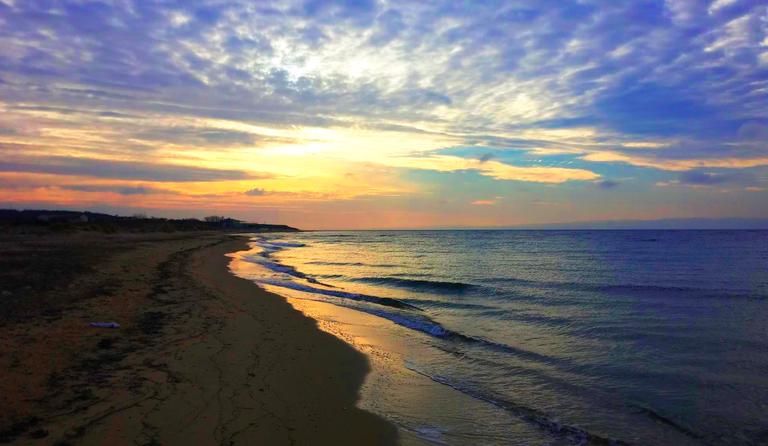
Saros Gulf Gökçetepe Beach (Keşan Chamber of Commerce and Industry)
Saros Gulf serves as a critical ecological corridor due to its sensitive habitats and internationally significant wetland systems. The region provides vital ecosystem services including water purification, carbon sequestration, and the continuity of biological diversity.
To protect its biological and geological values, an area of approximately 235 km² was designated as a Special Environmental Protection Area in 2010. This status aims to control urbanization pressures on marine biodiversity.
The northern shoreline of the gulf hosts dynamic lagoon systems separated from the sea by coastal dune barriers. The Enez and Erikli Lagoons, which include wetlands such as Dalyan, Işık, and Karagöl, play a vital role in sustaining traditional dalyan fishing and preserving the ecological balance of the coastal system. Another area of critical ecological importance is Gala Lake National Park, granted protected status in 2005; this ecosystem is recognized as one of Türkiye’s most strategic sites for stopover, feeding, and nesting by migratory waterbirds.【15】
The Meriç Delta and its surroundings are recognized as an internationally significant wetland under the criteria of the Ramsar Convention. Located on the Western Palearctic migratory flyway, the area serves as a critical stopover for tens of thousands of migratory birds annually (flamingos, swans, pelicans, etc.). Additionally, the seagrass meadows of Posidonia oceanica on the seafloor are listed among priority habitats requiring protection under the Bern Convention.【16】
The economic structure of Saros Gulf is shaped by its biological diversity, clean water resources, and strategic location. The primary economic activities are fishing and tourism. The gulf’s high hydrodynamic activity provides favorable conditions for both commercial fishing and alternative forms of tourism.
Saros Gulf is recognized as one of Türkiye’s most important diving centers due to its rich marine fauna and flora. The southern coast features steep and deep topography, while the northern coast is shallower and sandy, offering diverse dive routes for divers of all levels. To revitalize underwater tourism and enhance fish populations, the "World’s Largest Artificial Reef Project" has been implemented in Saros. Sunken aircraft (Airbus A330) and ships, along with various sculpture groups, have transformed the gulf into an international underwater museum. Minnet Island, Bebek Rocks, İbrice Harbor, and the Lundy Wreck are among the region’s most popular dive sites.【17】
The gulf is one of the most important spawning and feeding grounds in the Aegean Sea. The abundant oxygen and nutrients provided by current systems support dense populations of commercially valuable species.【18】 In addition to traditional coastal fishing, dalyan fishing conducted in the lagoons of Enez is economically critical. Major fish species caught in the gulf include sea bass, gilthead seabream, mackerel, red mullet, and flatfish. The region also holds potential for harvesting sea urchins and certain crustaceans.
Tourism in Saros Gulf is evolving beyond traditional "sea-sand-sun" models toward nature-based sports and eco-tourism. The beaches of Yayla, Erikli, and Enez experience heavy domestic tourist influx during summer months. However, a large portion of tourism activity in the region takes the form of secondary residences (summer homes), which exert pressure on coastal dunes.【19】 This leads to infrastructure deficits and environmental pollution risks due to seasonal population surges. In recent years, environmentally compatible tourism models such as camping, birdwatching, and windsurfing have been promoted to support a sustainable economy.

Saros Gulf Uzunkum Beach (Keşan Chamber of Commerce and Industry)
Despite its self-cleaning capacity, Saros Gulf faces various environmental threats due to increasing human activities (anthropogenic pressures) and unplanned development decisions over the past decade. These threats endanger both the marine ecosystem and the sensitive coastal dunes and lagoon structures.
The coastal dunes characterizing the northern shore of the gulf act as natural barriers against wind and wave action but are rapidly being destroyed due to uncontrolled use. Secondary residences, tourist facilities, and roads constructed on dune areas lead to the loss of dune vegetation. Without vegetation, dunes become vulnerable to wind erosion, lose stability, and contribute to shoreline retreat. Additionally, vehicle access and day-trip tourism pressure reduce the habitat range of endemic species unique to the area.【20】
Population surges during summer months in settlements around the gulf strain existing infrastructure. Inadequate sewage and wastewater treatment systems in tourist centers such as Erikli and Yayla result in leaks that threaten seawater quality. Additionally, fertilizers and pesticides from agricultural activities are transported into the gulf via the Meriç River and local streams, increasing nitrogen and phosphorus loads and creating eutrophication risks. In lagoon lakes, agricultural drainage waters cause shallowing and deterioration of water quality.【21】
One of the risks threatening the natural structure of the gulf is large-scale industrial projects. Such projects, if inadequately planned, risk damaging the Posidonia oceanica seagrass meadows on the seabed and pose potential pollution risks from shipping traffic, raising serious concerns among scientific institutions and environmental organizations.【22】
Due to the region’s high wind potential, some wind energy projects are located directly along bird migration routes, making them an ecological risk factor requiring careful management. In this narrow corridor, where tens of thousands of birds pass annually, collision risks with turbine blades and habitat fragmentation pose significant threats to wildlife.【23】
[1]
Okan Yaşar, "Underwater Diving Tourism on the Coasts of Saros Gulf," Zeitschrift für die Welt der Türken 3, no. 1 (2011): 35. Access date: 22 February 2026. https://www.dieweltdertuerken.org/index.php/ZfWT/article/view/204
[2]
Rüya Yılmaz and Derya Serbest, "Investigation of Environmental Impacts on Saros Gulf Coastal Dunes," Trakya Univ J Sci 6, no. 2 (2005): 84. Access date: 22 February 2026. https://dergipark.org.tr/en/download/article-file/213731
[3]
Salih Saner, "Sedimentary Sequences and Tectonic Setting of the Saros Gulf Area, Northeastern Aegean Sea, Türkiye," Bulletin of the Geological Society of Turkey 28 (February 1985): 1. Access date: 22 February 2026. https://www.jmo.org.tr/resimler/ekler/fee9cef84204f28_ek.pdf
[4]
Salih Saner, "Sedimentary Sequences and Tectonic Setting of the Saros Gulf Area, Northeastern Aegean Sea, Türkiye," Bulletin of the Geological Society of Turkey 28 (February 1985): 1. Access date: 22 February 2026. https://www.jmo.org.tr/resimler/ekler/fee9cef84204f28_ek.pdf
[5]
Salih Saner, "Sedimentary Sequences and Tectonic Setting of the Saros Gulf Area, Northeastern Aegean Sea, Türkiye," Bulletin of the Geological Society of Turkey 28 (February 1985): 9. Access date: 22 February 2026. https://www.jmo.org.tr/resimler/ekler/fee9cef84204f28_ek.pdf
[6]
Okan Yaşar, "Underwater Diving Tourism on the Coasts of Saros Gulf," Zeitschrift für die Welt der Türken 3, no. 1 (2011): 37. Access date: 22 February 2026. https://www.dieweltdertuerken.org/index.php/ZfWT/article/view/204
[7]
Salih Saner, "Sedimentary Sequences and Tectonic Setting of the Saros Gulf Area, Northeastern Aegean Sea, Türkiye," Bulletin of the Geological Society of Turkey 28 (February 1985): 4. Access date: 22 February 2026. https://www.jmo.org.tr/resimler/ekler/fee9cef84204f28_ek.pdf
[8]
Okan Yaşar, "Underwater Diving Tourism on the Coasts of Saros Gulf," Zeitschrift für die Welt der Türken 3, no. 1 (2011): 38. Access date: 22 February 2026. https://www.dieweltdertuerken.org/index.php/ZfWT/article/view/204
[9]
Ministry of Environment and Urbanization of Türkiye, Final Report of the Project for Identification of Terrestrial and Marine Biological Diversity in the Saros Gulf Special Environmental Protection Area (Ankara: Eko-Zon, 2014), 45. Access date: 22 February 2026. https://webdosya.csb.gov.tr/db/destek/icerikler/saros_b-yoces_sonuc_raporu_25.12.14-20191127153530.pdf
[10]
Okan Yaşar, "Environmental Threats Affecting the Lagoon Lakes on the Northern Coasts of Saros Gulf," Electronic Journal of Social Sciences 9, no. 33 (2010): 171. Access date: 22 February 2026. https://dergipark.org.tr/en/download/article-file/70207
[11]
Okan Yaşar, "Underwater Diving Tourism on the Coasts of Saros Gulf," Zeitschrift für die Welt der Türken 3, no. 1 (2011): 42. Access date: 22 February 2026. https://www.dieweltdertuerken.org/index.php/ZfWT/article/view/204
[12]
Nerdin Kubanç, "Ostracod (Crustacea) Fauna of Saros Gulf," Istanbul University Journal of Fisheries Sciences 20 (2006): 27–30. Access date: 22 January 2026. Link
[13]
Rüya Yılmaz and Derya Serbest, "Investigation of Environmental Impacts on Saros Gulf Coastal Dunes," Trakya Univ J Sci 6, no. 2 (2005): 87. Access date: 22 February 2026. https://dergipark.org.tr/en/download/article-file/213731
[14]
Ministry of Environment and Urbanization of Türkiye, Final Report of the Saros Gulf Special Environmental Protection Area, 156. Access date: 22 February 2026. https://webdosya.csb.gov.tr/db/destek/icerikler/saros_b-yoces_sonuc_raporu_25.12.14-20191127153530.pdf
[15]
Okan Yaşar, "Environmental Threats Affecting the Lagoon Lakes on the Northern Coasts of Saros Gulf," Electronic Journal of Social Sciences 9, no. 33 (2010): 172–174–186. Access date: 22 February 2026. https://dergipark.org.tr/en/download/article-file/70207
[16]
Ministry of Environment and Urbanization of Türkiye, Final Report of the Saros Gulf Special Environmental Protection Area, 108–142. Access date: 22 February 2026. https://webdosya.csb.gov.tr/db/destek/icerikler/saros_b-yoces_sonuc_raporu_25.12.14-20191127153530.pdf
[17]
Okan Yaşar, "Underwater Diving Tourism on the Coasts of Saros Gulf," Zeitschrift für die Welt der Türken 3, no. 1 (2011): 47–49. Access date: 22 February 2026. https://www.dieweltdertuerken.org/index.php/ZfWT/article/view/204
[18]
Ministry of Environment and Urbanization of Türkiye, Final Report of the Project for Identification of Terrestrial and Marine Biological Diversity in the Saros Gulf Special Environmental Protection Area (Ankara: Eko-Zon, 2014), 212. Access date: 22 January 2026. https://webdosya.csb.gov.tr/db/destek/icerikler/saros_b-yoces_sonuc_raporu_25.12.14-20191127153530.pdf
[19]
Rüya Yılmaz and Derya Serbest, "Investigation of Environmental Impacts on Saros Gulf Coastal Dunes," Trakya Univ J Sci 6, no. 2 (2005): 88. Access date: 22 January 2026. https://dergipark.org.tr/en/download/article-file/213731
[20]
Ministry of Environment and Urbanization of Türkiye, Final Report of the Project for Identification of Terrestrial and Marine Biological Diversity in the Saros Gulf Special Environmental Protection Area (Ankara: Eko-Zon, 2014), 260. Access date: 22 February 2026. https://webdosya.csb.gov.tr/db/destek/icerikler/saros_b-yoces_sonuc_raporu_25.12.14-20191127153530.pdf
[21]
Okan Yaşar, "Environmental Threats Affecting the Lagoon Lakes on the Northern Coasts of Saros Gulf," Electronic Journal of Social Sciences 9, no. 33 (2010): 180–182. Access date: 22 February 2026. https://dergipark.org.tr/en/download/article-file/70207
[22]
Chamber of Civil Engineers of Türkiye, "Assessment of the Proposed Pier in Saros Gulf," accessed 24 May 2024. Access date: 22 February 2026. https://www.imo.org.tr/TR,141121/saros-korfezi39nde-yapilmasi-planlanan-iskelenin-degerlendirilmesi.html
[23]
Ministry of Environment and Urbanization of Türkiye, Final Report of the Saros Gulf Special Environmental Protection Area, 270. Access date: 22 February 2026. https://webdosya.csb.gov.tr/db/destek/icerikler/saros_b-yoces_sonuc_raporu_25.12.14-20191127153530.pdf

Geographical Location and Geomorphological Structure
Tectonic Evolution and Formation of the Saros Graben
Coastal Sedimentary Sequences and Sedimentation Characteristics
Hydrological and Physical Characteristics
Self-Cleaning Mechanism and Current Systems
Water Temperature and Salinity Characteristics
Marine and Terrestrial Biodiversity
Marine Flora: Posidonia oceanica (Neptune Grass) Meadows
Marine Fauna and Benthic Structure: Ostracoda and Mollusca Species
Terrestrial Flora and Fauna: Dune Vegetation and Wildlife
Ecosystem Services and Protected Areas
Saros Gulf Special Environmental Protection Area (SEPA)
Wetlands and Lagoon Systems
International Protection Status and Migration Routes
Economic Activities and Tourism
Underwater Diving Tourism and Artificial Reef Projects
Fishing Potential and Economic Value
Sustainable Tourism and Secondary Residences
Environmental Issues and Anthropogenic Threats
Coastal Erosion and Degradation of Dune Ecosystems
Water Pollution and Infrastructure Deficiencies
Industrial Investments and Port Activities
Wind Energy Plants (WEPs) and Biodiversity