


This article was automatically translated from the original Turkish version.
+2 More
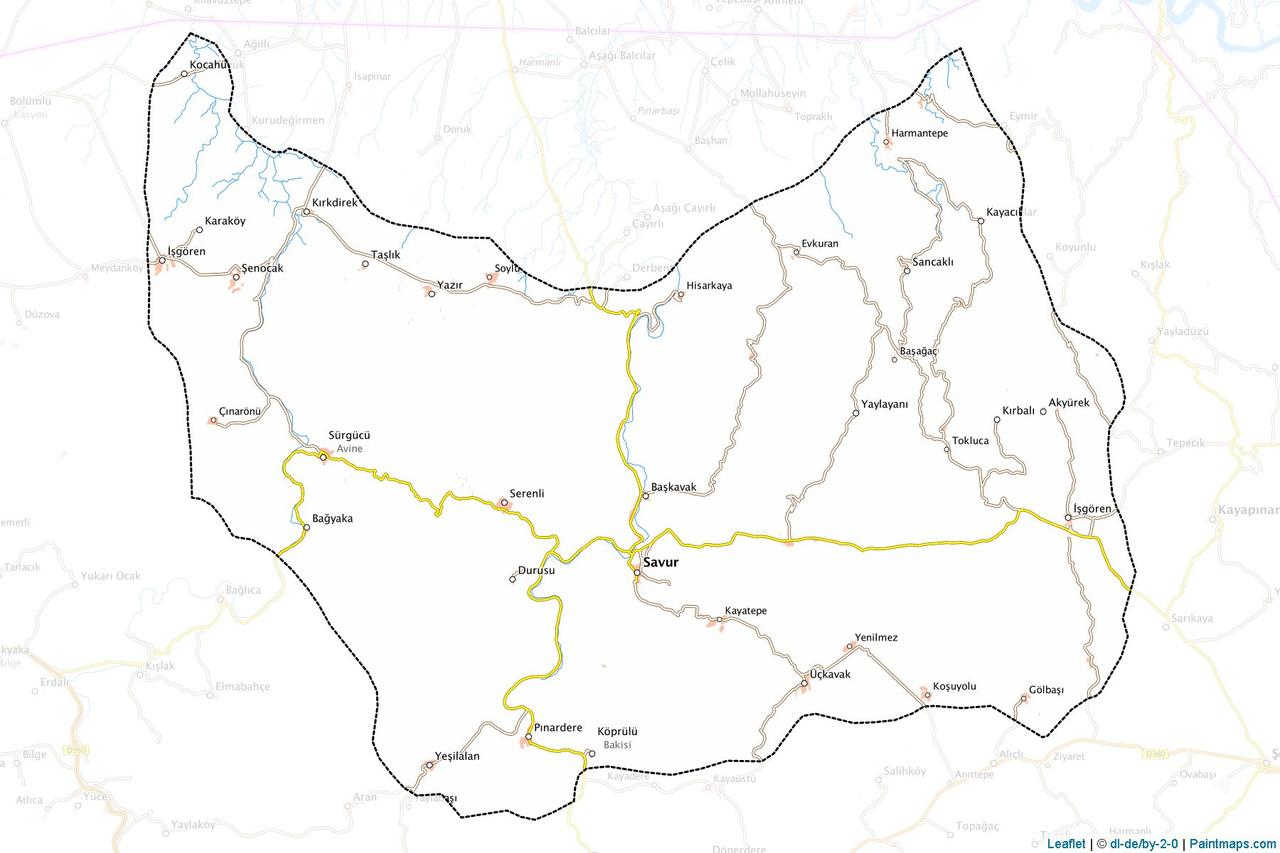
Savur (District)
Savur (District)
Location | Türkiye Mardin Province Southeastern Anatolia Region | ||||||||
|---|---|---|---|---|---|---|---|---|---|
Neighbors | East: Şırnak, West: Şanlıurfa, North: Diyarbakır, South: Mardin | ||||||||
Area(s) | 1049 km² | ||||||||
Elevation(s) | Average 900 metres | ||||||||
Distance(s) | 47 km from Mardin city center (connected by asphalt road) | ||||||||
Year of Establishment | 1884 (district status) | ||||||||
Savur is a district of Mardin Province in southeastern Türkiye. Located in northern Mesopotamia, this historic settlement attracts attention with its rich history, natural beauty and cultural fabric. The district covers an area of 1049 km² and is connected to the provincial center of Mardin by a 47 km road. Savur attained district status in 1884 and according to 2010 data had a population of 31817, of which 7170 resided in the district center. Administratively it comprises four towns (Savur, Pınardere, Sürgücü, Yeşilalan) and 35 villages.
Savur’s history extends back to the ancient past of Mesopotamia, reaching as far as the Hittites. Its earliest known inhabitants were the Hurrians, who in the 13th century BCE were mentioned in Assyrian records during the northern Syria campaign of King Adad-nirari I under the name “Šaru,” believed to be Savur. Assyrian sources note that during the reign of Shalmaneser III (883–859 BCE), a rebellion broke out in Šaru and spread to Habur. Under the Assyrians, Savur became known for its poplar trade; poplar logs were transported down the Tigris River on leather rafts, forming a significant source of income. This tradition continues to this day.
During the Persian period (7th century BCE), under Achaemenid rule, Savur became a refuge for populations driven into the mountainous regions due to pressure. In 247 BCE, the Parthian Empire under Mithridates I (160–139 BCE) conquered Mesopotamia including Savur. With the Roman Empire’s entry into the region, Savur changed hands frequently; during the Byzantine era it was known as “Sauras” and under the Sasanians as “Staor.” The Persian King Cyrus’s release of the Jews during the Roman-Sasanian conflicts influenced the demographic structure of the region.
With the spread of Islam, Muslim armies under Caliph Umar (634–644 CE) took Savur without resistance. In 990 CE, Savur came under the control of the Marwanids, then in the 11th century passed to the Mazyadids. In the 12th century it became part of the Artuqid dynasty’s three-century-long rule. Later, it came under the control of the Ayyubids and the Zengids. During the Ottoman period, Savur was incorporated into Ottoman territory in 1516 and officially gained district status in 1884. Ottoman records from 1526 list it as one of the significant settlements of the Mardin Sanjak.
Savur lies in the northern part of Mesopotamia, within the mountainous region of Mardin. It is bordered by Şırnak to the east, Şanlıurfa to the west, Diyarbakır to the north and Mardin to the south. The district is situated on a ridge shaped like a saddle between the last peak of the Mardin Mountains and the natural plateau to the north. Its average elevation is 900 meters. The Savur Creek flows through the area, feeding the valleys. The terrain is characterized by discontinuous ridges and remnants of extinct volcanoes. The extensive plains in the northwestern part are suitable for agriculture.
Savur experiences a hybrid climate combining Mediterranean and continental features. Winters are cold, summers are hot and dry, and precipitation is concentrated primarily in spring. The natural vegetation consists mainly of shrub oak woodlands. Spring rains are critical for the revival of agriculture and vegetation.
Savur’s social fabric has been shaped over centuries by the influence of various civilizations. According to 16th-century Ottoman records, 65.8 percent of the population was Muslim and 34.2 percent Christian; four of the villages under its administration were Christian and the rest Muslim. Although this diversity has diminished today, the district still preserves its cultural richness. The craftsmanship of stone masonry, the stone-built structures and the commanding position on the hillside reflect the accumulated social heritage of the area.
Savur’s economy is based on agriculture and animal husbandry. Grain cultivation is widespread in the northwestern plains; yields increase significantly when spring rains are abundant. Vegetables, grapes and poplar cultivation are practiced in irrigated valleys. In recent years, pomegranate orchards and cherry production have developed. Poplar trade, an important source of income since the Assyrian period, continues today. Although Savur is renowned for its vineyards and world-famous grapes, its winery remains inactive. Pomegranate and cherry cultivation are expected to grow in the future. Animal husbandry was once a primary livelihood, but rural depopulation due to the security situation has caused this sector to decline.
Savur possesses significant tourism potential due to its historical and natural attractions. Savur Castle, believed to have been built during the Roman period and situated on a mountain peak, has been illuminated by the municipality and now serves as a visual landmark. Rock houses, the Old Grand Mosque, the Romaniye and Yuhanna Churches (in Dereiçi Village), tombs and the Başkavak Bridge reflect the district’s historical character. With its charming architecture similar to Mardin, Savur presents the appearance of a “historical site crafted by a master hand.” Access to the district is easily provided by minivans from Mardin.
According to 2010 data, Savur’s total population is 31817, with 7170 residents in the district center (3516 males and 3654 females). There are 38 administrative units, including four municipalities: the district center and the towns of Pınardere, Sürgücü and Yeşilalan. Historically, Savur has housed diverse ethnic and religious groups; today the population is predominantly Muslim. Rural depopulation has affected the demographic structure.
Mardin Valiliği. “Savur.” Accessed April 8, 2025. http://www.mardin.gov.tr/savur.
Mardin İl Kültür ve Turizm Müdürlüğü. “Savur İlçesi.” Accessed April 8, 2025. https://mardin.ktb.gov.tr/TR-56493/savur-ilcesi.html.
Savur Belediyesi. "Tarihçe." Accessed April 8, 2025. https://www.savur.bel.tr/icerik/tarihce.
Savur Kaymakamlığı. "Savur Kalesi." Accessed April 8, 2025. http://www.savur.gov.tr/savur-kalesi.
Savur Kaymakamlığı. "Savur İlçemiz Genel Görünüm." Accessed April 8, 2025. http://www.savur.gov.tr/savur-ilcemiz-genel-gorunum.

Savur (District)
Savur (District)
Location | Türkiye Mardin Province Southeastern Anatolia Region | ||||||||
|---|---|---|---|---|---|---|---|---|---|
Neighbors | East: Şırnak, West: Şanlıurfa, North: Diyarbakır, South: Mardin | ||||||||
Area(s) | 1049 km² | ||||||||
Elevation(s) | Average 900 metres | ||||||||
Distance(s) | 47 km from Mardin city center (connected by asphalt road) | ||||||||
Year of Establishment | 1884 (district status) | ||||||||
History
Geographical Structure
Climate and Vegetation
Social Structure
Economic Structure
Tourism Potential
Demographic Structure