This article was automatically translated from the original Turkish version.
+1 More
Original Name(s) | Science: A Four Thousand Year History | ||||||||
|---|---|---|---|---|---|---|---|---|---|
Author(s) | Patricia Fara | ||||||||
Translation | Aysun Babacan | ||||||||
First Turkish Edition | October 2012 | ||||||||
Genre | History of Science / Critical Review | ||||||||
Publisher(s) | Metis Publications | ||||||||
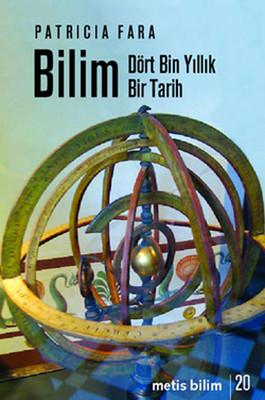
Science: A Four-Thousand-Year History is a comprehensive study by British science historian Patricia Fara that challenges prevailing narratives about the history of science and offers an alternative perspective. First translated into Turkish in 2012, this work does not present the history of science merely as a chronological sequence of developments; instead it examines how scientific knowledge is produced, who shapes it, and in what social and cultural contexts it gains meaning.
In the introduction, Fara emphasizes that historical writing is not simply a matter of listing events but a process of reconstruction shaped by choices about which events to include and which to exclude. Accordingly, she argues that the history of science has largely been written from a Eurocentric perspective, and that this framework does not objectively reflect scientific developments. For her, the history of science is not a story of flawless progress driven by “genius scientists,” but a complex process woven through errors, competition, and power relations.
The book is divided into seven main sections covering a time span from ancient Mesopotamia to the present: Origins, Interactions, Experiments, Institutions, Laws, Invisible Agents and Decisions. Under these headings, themes often treated as marginal in mainstream histories of science—such as alchemy, magic, religion, the role of women in scientific endeavors, and knowledge production systems across different civilizations—are brought to the center. For instance, the scientific contributions of China and the Islamic world are examined in detail, while a critical distance is established from the Western-centric narrative of scientific superiority.
Fara views the production of scientific knowledge not merely as a rational activity but as a human endeavor shaped by social, cultural, and even personal motivations. Within this framework, she seeks to uncover the ideological, political, and economic forces behind scientific advances. She asks not only “what” science is, but also “how” it operates.
Attention is drawn to the invisibility of women in the history of science, and critical assessments are made of these historical gaps. Additionally, the long-standing entanglement of practices such as magic and alchemy with science is emphasized, encouraging a reexamination of the sharp boundaries drawn by modern science.
Patricia Fara, a science historian with a background in physics, is known for her mastery of scientific concepts. She is recognized for her academic work on eighteenth-century England, representations of scientists, and the role of women in science, and serves as a faculty member at the University of Cambridge. Through works such as Newton: The Making of Genius (2002), Pandora’s Breeches: Women, Science and Power in the Enlightenment (2004), and Fatal Attraction: Magnetic Mysteries of the Enlightenment (2005), she has contributed significantly to the critical revision of the history of science.
Fara, Patricia. *Bilim: Dört Bin Yıllık Bir Tarih*. Translated by Aysun Babacan. Istanbul: Metis Yayınları, 2012. Accessed June 25, 2025. https://www.metiskitap.com/catalog/book/5487.

Original Name(s) | Science: A Four Thousand Year History | ||||||||
|---|---|---|---|---|---|---|---|---|---|
Author(s) | Patricia Fara | ||||||||
Translation | Aysun Babacan | ||||||||
First Turkish Edition | October 2012 | ||||||||
Genre | History of Science / Critical Review | ||||||||
Publisher(s) | Metis Publications | ||||||||
No Discussion Added Yet
Start discussion for "Science: A Four-Thousand-Year History (Book)" article
Historiography and the Selectivity of Scientific Narratives
Structure and Thematic Scope of the Book
The Social and Cultural Context of Scientific Knowledge
Tracing the Invisible and the Excluded
About the Author