


This article was automatically translated from the original Turkish version.
+2 More
Şehitkamil (District)
Location | The western part of the Southeastern Anatolia Region north of Alleben Creek in Gaziantep | ||||||||
|---|---|---|---|---|---|---|---|---|---|
Origin of the Name | Mehmet Kamil, who was martyred at the age of 14 during the Defense of Gaziantep | ||||||||
Foundation Date | 20 June 1987 (Law No. 3398), Entry into Force: 19 September 1988 | ||||||||
Area(s) | 1 268 km² (2015) | ||||||||
Elevation(s) | 850 m | ||||||||
Highest Point | Sofdağı (1,496 m) | ||||||||
Number of Neighborhoods | 146 | ||||||||
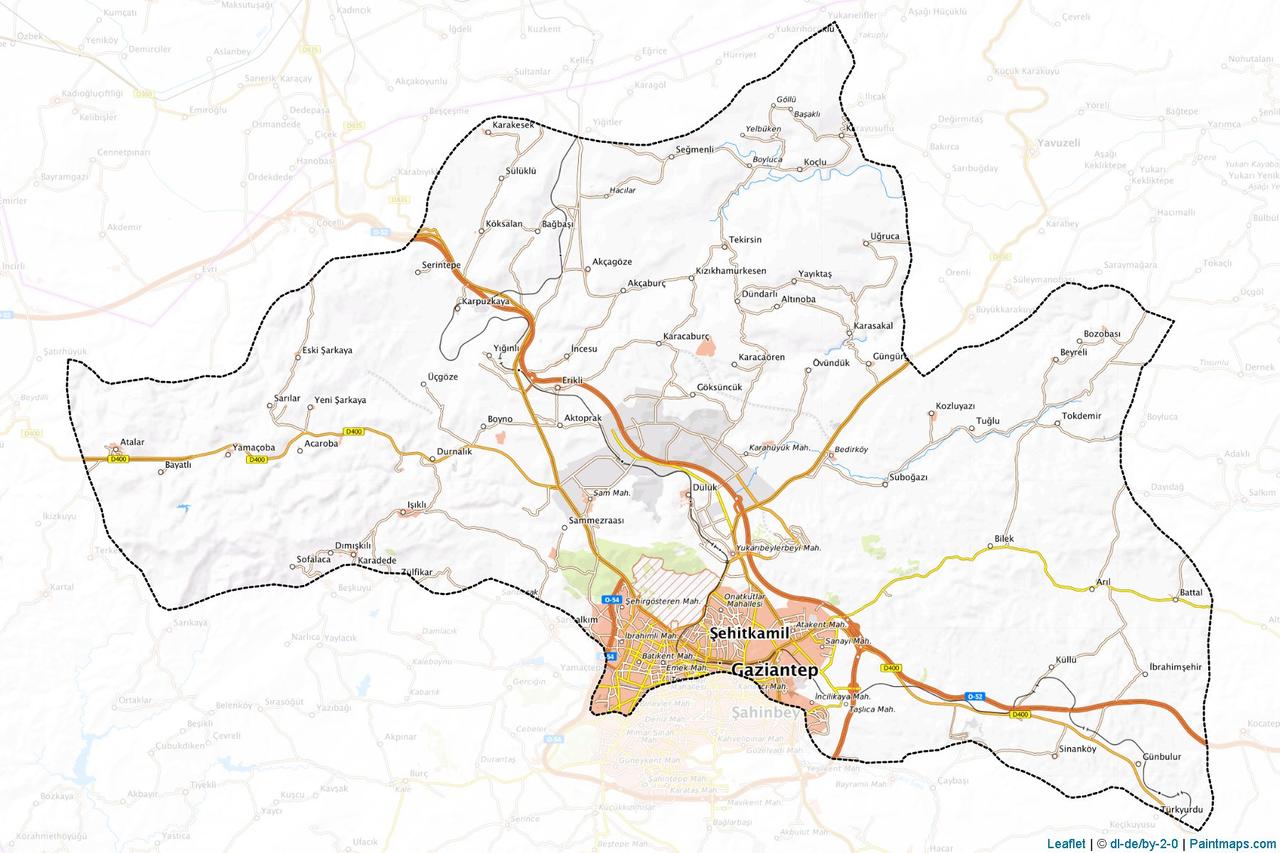
The area north of the Alleben Deresi and its natural extensions in the city of Gaziantep, center, constitutes the district of Şehitkamil, which was established by Law No. 3398 on 20 June 1987 and began operations on 19 September 1988. The district is named after Mehmet Kamil, who was martyred at the age of 14 during the Defense of Gaziantep. Covering an area of 1,268 km² (2015 data), the district is located in the western part of the Southeastern Anatolia Region, place. It is bordered by Pazarcık to the north, Yavuzeli to the northeast, Nizip to the east, Oğuzeli to the southeast, Şahinbey to the south, and Nurdağı to the west. The main elevations are Sofdağı (1,496 m), Dülükbaba (1,250 m), Güreniz (1,069 m), and the Sam Dağları (1,053 m). The main watercourse is Important, the Alleben Deresi. In 2015, the district had a population of 726,831 and contained 146 neighborhood.
The district of Şehitkamil was established on 20 June 1987 by Law No. 3398, centered on the area north of the Alleben Deresi in Gaziantep Province, and began operations on 19 September 1988. It derives its name from Mehmet Kamil, who was martyred at the age of 14 during the Defense of Gaziantep. On 21 January 1920, when French soldiers attacked his mother Hatice, Kamil struck one of them with a stone in an attempt to protect her but was subsequently speared and killed. This act stirred great public outrage; the French soldiers took refuge in a bakery, but the doors were broken down. Kamil’s funeral on 22 January was marked by a massive ceremony. French officer Colonel Saint Marie attempted to offer an apology and compensation, but Kamil’s father Ökkeş rejected it, declaring, “I demand blood for blood, life for life.” The Central Committee of Antep provided Ökkeş Ağa with 50 gold pieces as aid and granted him a pension. Mehmet Kamil’s name has been preserved through its use for the district, streets, schools, and cultural structures.
The District Governor’s Office began operations in 1988 in the annex building of the former Münifpaşa Primary School and continues to operate in the same building today.
Şehitkamil is named after Mehmet Kamil, aged 14. On 21 January 1920, when French soldiers attacked his mother Hatice, Kamil struck one of them with a stone but was speared and martyred. The incident provoked widespread public anger; the French soldiers fled into a bakery, but the doors were forced open. Kamil’s funeral on 22 January was held with great ceremony and served as a powerful warning to the French. French commander Saint Marie apologized and offered 200 gold pieces in compensation, but Kamil’s father Ökkeş Ağa refused it. The Central Committee provided Ökkeş Ağa with 50 gold pieces as aid and granted him a pension. Kamil’s name has been given to the district and various structures.
The district was established in 1987, and the District Governor’s Office began operations in 1988 in the annex building of the former Münifpaşa Primary School, where it continues to activity.
Şehitkamil is located at the intersection of the Southeastern Anatolia Region and the Mediterranean Region, covering an area of 1,268 km² (2015 data). The district, established north of the Alleben Deresi in Gaziantep, lies at an elevation of 850 meters. Its highest point is Sofdağı at 1,496 meters. Other significant elevations include Dülükbaba (1,250 m), Güreniz (1,069 m), and the Sam Dağları (1,053 m). The most important watercourse among the district’s rivers is Small, the Alleben Deresi. Şehitkamil is bordered by Pazarcık to the north, Yavuzeli to the northeast, Nizip to the east, Oğuzeli to the southeast, Şahinbey to the south, and Nurdağı to the west. The terrain structure is generally undulating and rugged.
Şehitkamil has a transitional climate between the Southeastern Anatolia and Mediterranean regions. Winters are cold and rainy, while summers are hot and dry. These climatic conditions have led to the dominance of steppe and maquis vegetation. The district produces Antep pistachios, olive, and grape as major agricultural products, like common. The Dülük Nature Park features pine trees and an arboretum containing 11,335 plants of 255 different species.
The social fabric of Şehitkamil is nourished by Gaziantep’s rich cultural heritage. The educational infrastructure is strong: the district has 4 preschools, 51 primary schools, 8 vocational and technical high schools, 1 science high school, and private schools, totaling 97,554 students and 2,998 teacher. The literacy rate is 97%. Health services are supported by two state hospitals (Şehitkamil State Hospital – 300 beds and 25 December State Hospital – 382 beds), 17 health centers, 25 health houses, 3 private hospitals, and 119 pharmacies. The district also hosts one Archaeology Museum and one Public Library under the Culture Ministry. Traditional Gaziantep customs, especially those related to marriage and sahre (picnic), are important elements of social life. The Gaziantep dialect, influenced by Arabic, stands out as a distinctive variant of Turkish.
Şehitkamil’s economy benefits from Gaziantep’s trade and industry strength. Pistachio production holds a significant place in the district’s agricultural economy. In addition, traditional crafts such as mother-of-pearl inlay, copper smithing, kutnuculuk, and yemenicilik, along with the gastronomy sector, support economic activity. The presence of 146 neighborhoods encourages the development of local trade and the service sector. The educational and health infrastructure also generates employment.
Şehitkamil possesses significant tourism potential due to its rich historical and cultural heritage. Zeugma Mosaic Museum, located on Hacı Sani Konukoğlu Boulevard, opened in 2011. This structure, the second-largest mosaic museum in the world, houses mosaics from the ancient city of Zeugma and the famous Mosaic of the Gypsy Girl. The ancient city of Dülük, located 10 km north of the district, has a 600,000-year history and occupies a strategic position along the Silk Road. The biological pond and arboretum within Dülük Nature Park also offer appeal for natural tourism. Gastronomy tourism is highlighted by Antep cuisine; baklava, kebabs, and sweet varieties domestic attract both domestic and foreign tourists. Festivals such as the Antep Pistachio Festival and the Gastronomy Festival stimulate tourism.
According to the 2015 Address-Based Population Registration System results, Şehitkamil’s total population is 726,831. The entire population is concentrated in the urban center (rural population is 0). Population growth over the years has been as follows: 411,186 in 2000, 558,821 in 2007, 649,596 in 2011, and 710,853 in 2014. The district has 146 neighborhoods. The population has a high level of education (97% literacy rate) and broad access to health services. Migration and urbanization have transformed the demographic structure into a dynamic form.
Şehitkamil Belediyesi. "Genel Bilgiler." Accessed April 8, 2025. https://www.sehitkamil.bel.tr/Sayfalar/detay/genel_bilgiler.
Şehitkamil Belediyesi. "Tarihçi." Accessed April 8, 2025. https://www.sehitkamil.bel.tr/Sayfalar/detay/tarihci.
Şehitkamil Kaymakamlığı. "Coğrafi Özellikler." Accessed April 8, 2025. http://sehitkamil.gov.tr/cografi-ozellikler.
Şehitkamil Kaymakamlığı. "Gastronomi." Accessed April 8, 2025. http://sehitkamil.gov.tr/gastronomi.
Şehitkamil Kaymakamlığı. "Kültürel Özellikler." Accessed April 8, 2025. http://sehitkamil.gov.tr/kulturel-ozellikler.
Şehitkamil Kaymakamlığı. "Sanat." Accessed April 8, 2025. http://sehitkamil.gov.tr/sanat.
Şehitkamil Kaymakamlığı. "Tarihçe." Accessed April 8, 2025. http://sehitkamil.gov.tr/tarihce.
Şehitkamil Kaymakamlığı. "Turizm." Accessed April 8, 2025. http://sehitkamil.gov.tr/turizm.
Şehitkamil (District)
Location | The western part of the Southeastern Anatolia Region north of Alleben Creek in Gaziantep | ||||||||
|---|---|---|---|---|---|---|---|---|---|
Origin of the Name | Mehmet Kamil, who was martyred at the age of 14 during the Defense of Gaziantep | ||||||||
Foundation Date | 20 June 1987 (Law No. 3398), Entry into Force: 19 September 1988 | ||||||||
Area(s) | 1 268 km² (2015) | ||||||||
Elevation(s) | 850 m | ||||||||
Highest Point | Sofdağı (1,496 m) | ||||||||
Number of Neighborhoods | 146 | ||||||||
No Discussion Added Yet
Start discussion for "Şehitkamil (District)" article
History
Who is Şehitkamil?
History of the Government Building
Geographical Structure
Climate and Vegetation
Social Structure
Economic Structure
Tourism Potential
Demographic Structure