


This article was automatically translated from the original Turkish version.
+2 More
Self-Actualizing Prophecy
Other Name | Self-fulfilling Prophecy | ||||||||
|---|---|---|---|---|---|---|---|---|---|
First Use | 1948, (Robert K. Merton) | ||||||||
Field | Philosophy Psychology Sociology | ||||||||
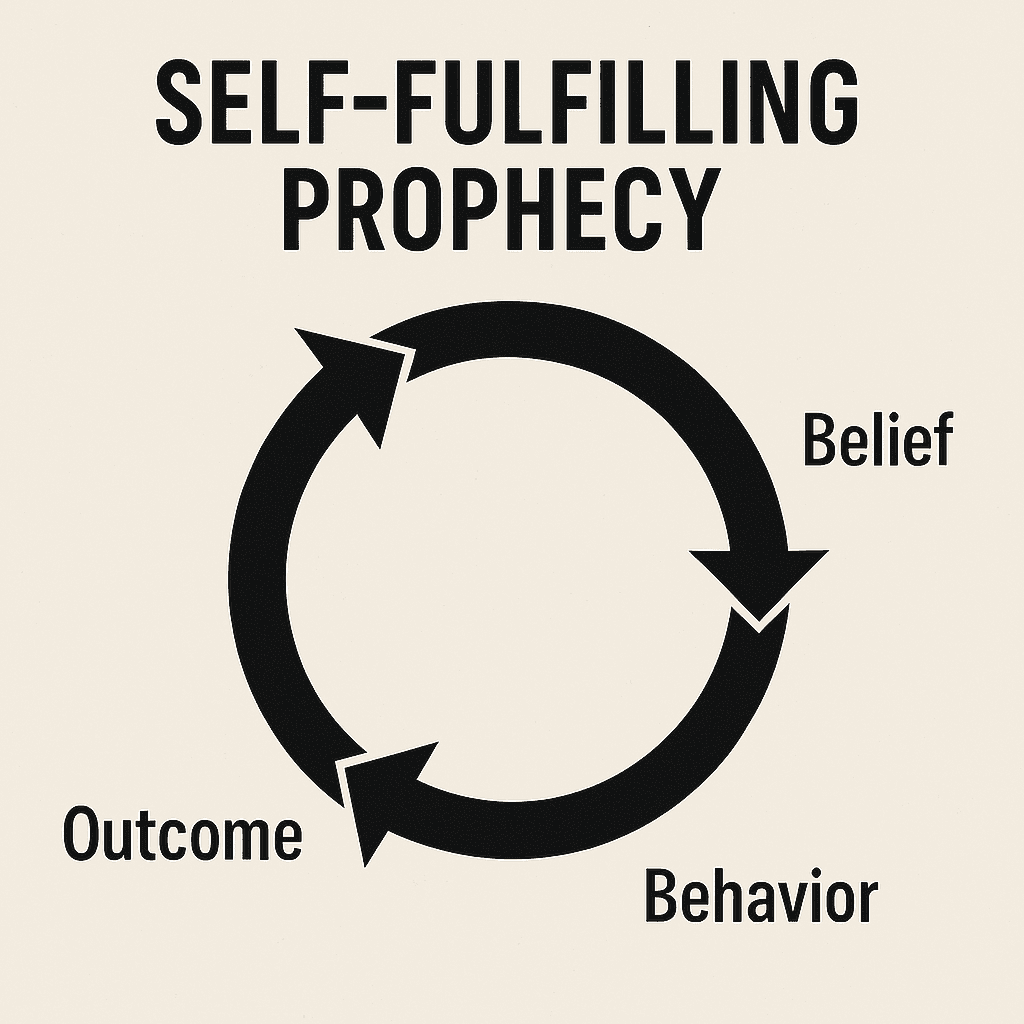
Self-fulfilling prophecy is a psychosocial phenomenon in which the expectations of individuals or societies regarding a particular event lead them to behave in ways that make the expected event actually occur. Concept was first introduced in the mid-20th century by American sociologist Robert K. Merton, who explained how the expectations of an individual or group can unconsciously alter their behavior, ultimately causing those expectations to become reality.
Self-fulfilling prophecy manifests in many areas, from daily life to academic studies, and from economic systems to educational processes. For example, a belief that a student will fail can reduce their work motivation and thereby lead to actual failure.

class=\
Similarly, an expectation of an economic crisis can cause individuals and companies to avoid investment, thereby causing an actual economic downturn.
This concept has been addressed not only in modern sciences but also throughout history within various thought systems. In Stoic philosophy, which extended from ancient Greece to Rome, the idea that events occur within a specific order and inevitably is central. According to the Stoics, human beliefs and attitudes can influence the course of events as part of a universal order. While this perspective does not directly align with modern scientific approaches, it offers an early understanding of how human thought and expectations shape the trajectory of events.
1. Prediction and Prophecy Principles
• Prophecy has been regarded as a field of science that enables prediction.
• According to the Stoics, prophecy is an art governed by specific principles, like medicine or navigation.
• According to Sextus, prophecy is sometimes defined as a science (epistēmē) based on observation and interpretation, and at other times as an art (tekhnē) based on definite outcomes.
2. Grounding in God, Fate, and Nature
• Stoics explain prophecy through three fundamental sources:
1. God (prophecy is the ability to interpret signs given to humans by the gods).
2. Fate (prophecy is part of the chain of causes and the universal order).
3. Nature (inductive conclusions are drawn from natural phenomena).
3. Sympathy and Universal Order
• Prophecy occupies a place within the functioning of the universal order.
• In Stoic thought, there is assumed to be a sympathy (harmony) between all things in nature.
• Prophecy attempts to foresee the likelihood of an event through these sympathetic relationships.
4. Scientificity and Methodological Issues
• Stoics argued that prophecy is grounded in a scientific basis.
• However, when expressed in Aristotelian terminology, the principles of prophecy are not certain but rather based on assumptions and inferences.
• It has been noted that prophecy contradicts modern scientific criteria regarding falsifiability and verifiability.
5. Deterministic and Chance-Based Approach
• For the Stoics, prophecy is based on specific cause-and-effect relationships.
• Nevertheless, some Stoics argued that prophecy need not be entirely dependent on fate and have proposed a non-deterministic foundation based on chance.
• If prophecy were viewed as entirely determined by fate, then acting upon it would lose any meaning.
These principles are valuable for understanding how self-fulfilling prophecy was shaped within Stoic philosophy and how it was evaluated as a field of knowledge.
The origins of self-fulfilling prophecy extend to ancient philosophical thought. The Stoics regarded prophecy as a methodological activity aimed at understanding the functioning of the universal order. To them, prophecy was treated as a “science” with specific principles and foundations. At the same time, prophecy was linked to fate, god, and the laws of nature.
The Stoics explained prophecy within a deterministic framework based on cause-and-effect relationships. According to them, every event in the universe has a specific cause, and this chain of causes is called fate. In Stoic physics, prophecy becomes possible precisely because of this tight connection between causes. However, this deterministic foundation of prophecy has been criticized by some philosophers. For instance, Cicero argued that if prophecy were merely a consequence of fate, then there would be no point in acting upon it.
Quintus attempted to weaken the link between prophecy and fate by defining prophecy as “the foretelling of events thought to occur by chance.” Cicero opposed this view, arguing that chance undermines wisdom and skill. According to him, if prophecy is to be a science or an art, it must be connected to causes.
At the root of the concept of self-fulfilling prophecy lies an important debate over whether prophecy is scientific. Cicero claimed that prophecy lacks a scientific basis because its rate of fulfillment is low and it offers only a form of knowledge based on coincidence. Cicero, who argued that science is responsible for explaining the causes of events, distinguished prophecy from science, asserting that it could only be regarded as a belief or an art.
This historical background helps us understand how self-fulfilling prophecy is approached today in psychology and sociology. The modern development of the concept was shaped especially by Robert K. Merton’s sociological work in the 20th century. However, the foundations of prophecy laid by the Stoics and other ancient philosophers remain highly significant for understanding its historical evolution.
Cicero. De Divinatione. Translated by W. A. Falconer. Loeb Classical Library. Cambridge, MA: Harvard University Press, 1923.
Merton, Robert K. Social Theory and Social Structure. New York: Free Press, 1949.
Sextus Empiricus. Against the Professors. Translated by R. G. Bury. Loeb Classical Library. Cambridge, MA: Harvard University Press, 1935.

Self-Actualizing Prophecy
Other Name | Self-fulfilling Prophecy | ||||||||
|---|---|---|---|---|---|---|---|---|---|
First Use | 1948, (Robert K. Merton) | ||||||||
Field | Philosophy Psychology Sociology | ||||||||
No Discussion Added Yet
Start discussion for "Self-Actualizing Prophecy" article
Fundamental Principles of Self-Fulfilling Prophecy
Historical Origins of Self-Fulfilling Prophecy
Deterministic Foundation: Chance, Fate, and Prophecy
Chance-Based Approach to Prophecy
Distinction Between Science and Prophecy