


This article was automatically translated from the original Turkish version.
+1 More
Location | Aksaray at the exit of Ihlara Valley. Selime Town Güzelyurt | ||||||||
|---|---|---|---|---|---|---|---|---|---|
Architecture(s) | Two-story the upper part designed as a castle. three-aisle basilica plan rock-carved | ||||||||
History | Constructed between the 8th and 11th centuries; frescoes date to the 10th and 11th centuries. | ||||||||
Usage | Worship, rest, caravan security; a center where religious figures were trained. | ||||||||
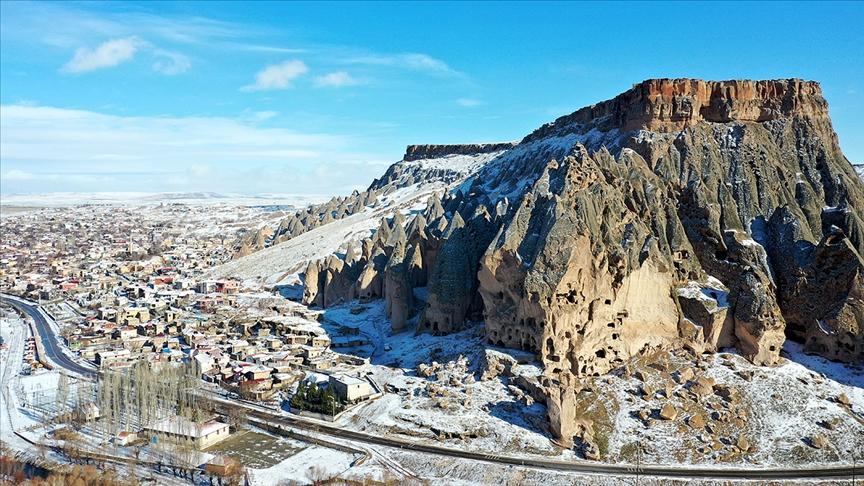
Selime Cathedral is a two-story monumental structure carved into the rock at the southern exit of the Ihlara Valley in Aksaray Province, Türkiye. It is regarded as the largest cathedral in the Cappadocia region. The cathedral and its adjacent monastery complex constitute an important example of the development of Christianity during the Byzantine period.

Selime Cathedral- Anadolu Agency
Selime Cathedral is situated at the southern end of the Ihlara Valley in the village of Selime, within the Güzelyurt district of Aksaray Province in Türkiye’s Central Anatolia Region. The structure, visible upon exiting the valley, is built on a natural platform surrounded by fairy chimneys and carved directly from the rock. Its geographical position provides both natural defensive advantages and strategic control over access routes. The cathedral is constructed in two levels and follows a basilical plan. Inside, two rows of columns divide the interior space into three naves, a layout unique in the region. The upper section of the structure was designed in the form of a fortress for defensive purposes, and remnants of walls and defensive positions have survived to the present day. The entrance to the cathedral features a high corridor, described in historical sources as a caravan route used by camels. The spatial organization of the building includes not only worship areas but also functional units such as a kitchen, courtyard, storage rooms, and side chambers.

Selime Cathedral- Anadolu Agency
Selime Cathedral and its adjacent monastery complex have served multiple functions throughout history. Construction of the structure dates back to the 8th century, while the figural frescoes are dated to the late 10th and early 11th centuries. This period corresponds to the height of Byzantine dominance in Anatolia and a time when Christian faith was expressed intensely through art and architecture. During the Byzantine era, the building functioned as a religious center, hosting worship and educational activities for Orthodox Christian communities.
Following the Edict of Milan in 313, which granted Orthodox Christians the right to worship openly, it is claimed that the first public liturgy in the region took place within this structure. Selime Cathedral became not only a religious center but also a hub for social and administrative decisions. In subsequent centuries, the building came under Seljuk control and during the Mongol invasions of Anatolia, it was repurposed as a defensive fortress. During this period, Selime Cathedral gained prominence as the site of the longest resistance against the Mongols. Due to its location at a crossroads of caravan routes, it also became associated with trade, providing worship and lodging facilities for merchants passing through the region.
The most striking artistic feature of Selime Cathedral is its interior fresco decoration. The frescoes were created between the late 10th and early 11th centuries and represent significant examples of early Christian iconography in the region. They depict scenes from the New Testament as well as sacred figures such as the Virgin Mary and various saints. Particularly notable scenes include the Ascension of Christ, the Annunciation, the Presentation of the Virgin in the Temple, the Seven Steps of the Virgin, the Nativity, the Adoration of the Magi, the Massacre of the Innocents, the Flight into Egypt, the Baptism, the Koimesis, and the Visitation of Elizabeth. These frescoes reflect the iconographic traditions of Byzantine art both technically and thematically while also showing influences from local artistic practices. Additionally, depictions of bishops indicate that the structure also served as an educational and administrative center.

Selime Cathedral- Anadolu Agency
Selime Cathedral and its associated monastery complex were constructed as a multifunctional unit. The main worship space, the cathedral, follows a three-nave basilical plan and was used for religious ceremonies. In addition, the pyramid-shaped kitchen within the complex is one of its original architectural features. Around this kitchen, candle niches are arranged and connected to side chambers. The kitchen served both daily needs and the hospitality of guests. The high corridor at the front of the building is historically identified as the caravan route along which camels passed and were led into the central part of the cathedral. This demonstrates that Selime was not merely a religious center but also an active hub for trade and transportation.
The monastery structure is built in two stories and features a courtyard layout. This section was used not only for religious instruction but also for military and regional meetings. The fortress-like upper section of the cathedral was particularly utilized for defense during the Mongol invasions. This multi-layered structure has made Selime Cathedral one of the largest and most comprehensive monastery complexes in Cappadocia.
Aksaray İl Directorate of Culture and Tourism. "Kiliseler." Accessed June 13, 2025. https://aksaray.ktb.gov.tr/TR-63659/kiliseler.html.
Anadolu Ajansı. *Ihlara Vadisi ve Selime'ye Ukraynalı Turist Akını*. Accessed June 13, 2025. https://www.aa.com.tr/tr/pg/foto-galeri/ihlara-vadisi-ve-selimeye-ukraynali-turist-akini/0.
Anadolu Ajansı. *Ihlara'nın Giriş Kapısı Selime Kışın Tüm Güzelliklerini Yansıtıyor*. Accessed June 13, 2025. https://www.aa.com.tr/tr/yasam/ihlaranin-giris-kapisi-selime-kisin-tum-guzelliklerini-yansitiyor/2150177.
Anadolu Ajansı. *Ihlara'nın Giriş Kapısı Selime, Tarihi ve Doğallığıyla Büyülüyor*. Accessed June 13, 2025. https://www.aa.com.tr/tr/yasam/ihlaranin-giris-kapisi-selime-tarihi-ve-dogalligiyla-buyuluyor/2016214.
T.C.Güzelyurt Kaymakamlığı Governorship. *Selime Katedrali and Fairy Chimneys*. Accessed June 13, 2025. http://www.guzelyurt.gov.tr/selime-katedrali-ve-peribacalari.
Türkiye Kültür Portalı. *Selime Katedrali ve Peribacaları - Aksaray*. Accessed June 13, 2025. https://www.kulturportali.gov.tr/turkiye/aksaray/gezilecekyer/selime-katedrali-ve-peribacalari.


Location | Aksaray at the exit of Ihlara Valley. Selime Town Güzelyurt | ||||||||
|---|---|---|---|---|---|---|---|---|---|
Architecture(s) | Two-story the upper part designed as a castle. three-aisle basilica plan rock-carved | ||||||||
History | Constructed between the 8th and 11th centuries; frescoes date to the 10th and 11th centuries. | ||||||||
Usage | Worship, rest, caravan security; a center where religious figures were trained. | ||||||||
Location and Architectural Plan
Historical Development and Use
Artistic Features and Frescoes
Functional Units