


This article was automatically translated from the original Turkish version.
+2 More
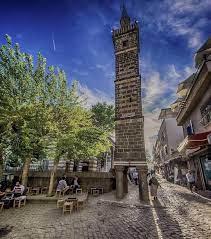
Sheikh Matar (Four-Legged Minaret) Camii
Name(s) | Şeyh Matar Camii | ||||||||
|---|---|---|---|---|---|---|---|---|---|
Popular Name | Dört Ayaklı Minareli Camii | ||||||||
Location | Sur district near Hz. Süleyman Camii Diyarbakır – east of İçkale | ||||||||
Construction Date(s) | 16th century | ||||||||
Şeyh Matar Camii, also known among the public as the Four-Legged Minaret Mosque, is located in the Sur district of Diyarbakır, Türkiye, east of the historic İçkale and near Hz. Süleyman Camii. The mosque stands within the Suriçi region, one of Diyarbakır’s oldest settlement areas. During its construction, basalt stone consistent with other historical structures in the area was used.

Şeyh MatarAnadolu Agency
The mosque was built on the site of a former zawiya and türbe from the Akkoyunlu period in the 16th century. Although no construction inscription has been found, various sources indicate that it was constructed during the reign of Sultan Kasım Bey of the Akkoyunlu in the early 1500s. It is recorded that Şeyh Matar, also known as Şeyh Mutahhar, lived in this area and was active in Islamic religious activities.
Şeyh Matar Camii is a structure with a near-square rectangular plan. The mosque extends in a north-south direction, with the final prayer area located on the northern side. The mihrab is a niche with muqarnas and a pointed arch. The most distinctive feature of the mosque is its minaret.
The minaret is situated in the northeast corner of the mosque and rests on four pillars. Each of the four pillars is made from a single piece of basalt stone and supports the body of the minaret. This unique architectural feature has led to the minaret being commonly referred to by the public as the “Four-Legged Minaret.” The base of the minaret is square in plan, while its body is octagonal. Decorative elements include geometric and vegetal motifs, as well as inscriptions written in Arabic script.

Şeyh MatarAnadolu Agency
Şeyh Matar Camii has served not only as a place of worship but also as a social gathering and educational center throughout its historical development. It is believed that the cemetery located in the mosque’s courtyard contains the tomb of Şeyh Matar.
The structure is an important component of Diyarbakır’s cultural and architectural heritage. Various restoration efforts have been undertaken to preserve the mosque and its minaret. The building continues to attract visitors and is used for both tourist and religious purposes.
Anadolu Ajansı. “Dört Ayaklı Minare’ye Vatandaş İlgisi.” AA. Accessed June 19, 2025. https://www.aa.com.tr/tr/yasam/dort-ayakli-minareye-vatandas-ilgisi-/1081301
Anadolu Ajansı. “Sur’daki Kiliseler 15 Milyon Lira Kaynakla Onarılacak.” Anadolu Ajansı, February 28, 2019. Accessed June 19, 2025. https://www.aa.com.tr/tr/turkiye/surdaki-kiliseler-15-milyon-lira-kaynakla-onarilacak/1416632.
T.C. Ministry of Culture and Tourism. “Şeyh Mutahhar Camii (Dört Ayaklı Minare).” Kültür Portalı. Accessed June 19, 2025. https://www.kulturportali.gov.tr/turkiye/diyarbakir/gezilecekyer/seyh-mutahhar-cam-dort-ayakli-mnare
T.C.Diyarbakır Valiliği. "Şeyh Matar (Dört Ayaklı Minare) Camii." Accessed June 19, 2025. http://www.diyarbakir.gov.tr/seyh-matar-dort-ayakli-minare-camii
Türkiye Yazarlar Birliği. "Dört Ayaklı Minare ve Kimi Ayrıntılar." Accessed June 19, 2025. https://www.tyb.org.tr/dort-ayakli-minare-ve-kimi-ayrintilar-12027yy.htm
Uğurlu, Murat Arda, Sultan Erdemli Günaslan, and Abdulhalim Karaşin. “Dört Ayaklı Minare’nin Modellenmesi ve Yapısal Analizi.” *Dicle Üniversitesi Mühendislik Fakültesi Dergisi* 8, special issue (May 2017): 3–9. Accessed June 19, 2025. https://dergipark.org.tr/tr/download/article-file/432224.
Sheikh Matar (Four-Legged Minaret) Camii
Name(s) | Şeyh Matar Camii | ||||||||
|---|---|---|---|---|---|---|---|---|---|
Popular Name | Dört Ayaklı Minareli Camii | ||||||||
Location | Sur district near Hz. Süleyman Camii Diyarbakır – east of İçkale | ||||||||
Construction Date(s) | 16th century | ||||||||
No Discussion Added Yet
Start discussion for "Sheikh Matar (Four-Legged Minaret) Camii" article
Historical and Construction Information
Architectural Features
Four-Legged Minaret
Religious and Social Function
Conservation and Current Status