

This article was automatically translated from the original Turkish version.
+2 More
Place of Residence | Kemerovo Oblast, Russian Federation | ||||||||
|---|---|---|---|---|---|---|---|---|---|
Language(s) | Shor Russian | ||||||||
Ethnic Name | Mountain Tatar, Shor | ||||||||
Belief | Shamanism, Orthodox Christianity | ||||||||
Among the Turkic peoples, the Shors constitute a small community in terms of population but are exceptionally rich in cultural heritage. They hold a unique position within the ethnic and folkloric mosaic of Southern Siberia. Throughout history, this community has been referred to by various names; today, it continues to live primarily in Southern Siberia, especially in the Kemerovo Oblast of the Russian Federation. The Shors occupy an original place in the Turkic mythological world through their language, oral narrative traditions, heroic epics, and folktales, while simultaneously facing challenges related to identity and culture in the modern era.
Child Performing the Shor Dastan (Tiblok1)
Although etymological data regarding the origin of the name “Shor” is limited, it is known that the designation has been used in various forms throughout history. From the 19th century onward, Russian sources commonly referred to this community as “Mountain Tatars” or simply “Tatars.” During the Soviet period, the name “Shor” was officially recognized and became firmly established in ethnographic literature.
In their own language, the ethnonym is also “Shor,” and the region where they live is known as “Shorya.” This geographical designation is directly linked to the ethnonym. Radloff’s dictionary studies confirm that the term “Shor” was used in this manner and that the linguistic affiliation of the group was systematically documented.
The ethnic origins of the Shor Turks are traced back to proto-Turkic communities that inhabited the Altai-Sayan mountain region since prehistoric times. This area, considered the historical homeland of the Turkic peoples, lies in the Altai region, and the Shors are regarded as one of the indigenous groups of this territory. The Shors are classified among the Western Siberian Turkic peoples alongside the Altaians, Khakas, and Dolgans.
Anthropologically, the Shors are a people formed by a mixture of Turkic and indigenous Siberian elements. Thus, they possess a composite structure shaped by regional interactions. This is particularly evident in their language and rituals.
The Shor Turks are described within the Turkic peoples as a minority group with a culturally unique identity. The Shors possess a strong oral culture but have historically been subjected to political and cultural pressures from dominant neighboring groups. Especially during the Soviet period, assimilation policies led to severe cultural and demographic erosion among the Shors. In this context, the Shor Turks represent a cultural heritage that is both little known and in need of preservation within the Turkic world. Their ethnographic classification is based not only on ethnic affiliation but also on their language, narrative traditions, and the cultural influences of their geographic environment.
Today, the Shor Turks live in the Kemerovo Oblast of the Russian Federation, within Southern Siberia, particularly around the Tom, Mras, and Kondom rivers. This region is known locally as “Shorya” and is regarded as the historical homeland of the Shors. The area borders the Altai-Sayan mountain system and is notable for its rich natural resources, dense forested areas, and favorable river systems.
Settlements are generally rural and mountainous, consisting of small village-type communities. Throughout history, the Shors have inhabited river valleys and sustained their livelihoods through activities based on natural resources such as hunting and ironworking. In this sense, geography has been a decisive factor in shaping both their economic life and their rituals.
The Shor Turks are among the smallest communities in the Turkic world, and their population has declined rapidly since the end of the 20th century. It is known that the Shors have become largely assimilated into Russian society, with their ethnic identity weakening and the number of native speakers of the Shor language decreasing daily.
Among the Siberian Turkic peoples, the Shors are considered a minority alongside the Khakas and Altaians, and their numbers constitute a very small proportion of the total Siberian Turkic population, estimated at 1.5 to 1.9 million.
This rapid population decline has been influenced by factors such as forced migration, cultural pressures, educational policies, and industrial urbanization during the Soviet era. The disruption in intergenerational transmission of the Shor language has increasingly made it difficult for future generations to preserve their ethnic and cultural identity.
In the modern era, the Shor population continues to exist primarily in rural areas and regions where traditional ways of life are still maintained, in contrast to those living in cities. However, urbanization, youth migration to urban centers, and cultural assimilation processes pose a threat to their ethnic identity.
Shor Turkish is generally regarded as a dialect of Khakas Turkish but possesses unique phonetic features, vocabulary, and narrative patterns that qualify it as a distinct linguistic variety.
The Shor language belongs to the group of Southern Siberian Turkic languages and shares many features with historical Khakas, Altai, and Tuvan Turkish. Radloff, in his four-volume dictionary “Opıt Slovarya Tyurkskih Nareçiy” compiled in the late 19th century, collected Shor vocabulary.
Today, Shor Turkish is classified as an endangered language. The majority of the population uses Russian in daily life, while Shor is spoken only sparingly by the elderly. It is known that the Shor language is now artificially sustained only by specific organizations and academic initiatives, and intergenerational transmission has been largely interrupted.
Historically, Shor Turkish did not develop significantly as a written language and remained primarily oral for a long time. Until the mid-20th century, no standardized written form existed. During the Soviet period, a short-lived writing system based on the Cyrillic alphabet was developed but was used only marginally and never widely adopted by the general population.
Today, there are virtually no media outlets publishing in Shor. Beyond materials produced by some cultural associations and academic circles, written Shor culture remains extremely limited.
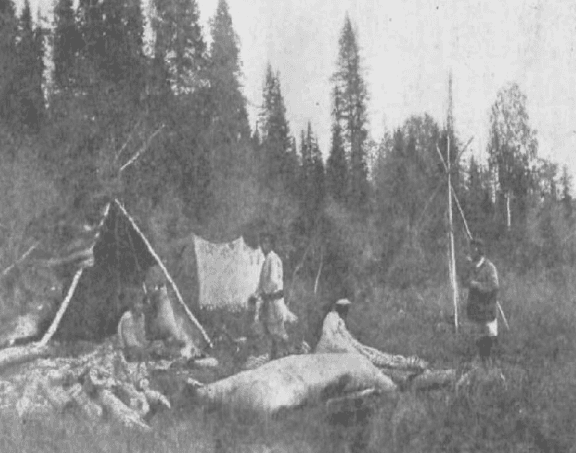
The traditional lifestyle of the Shor Turks has been directly shaped by their geographic environment. Due to their residence in mountainous and forested areas, their primary means of subsistence throughout history have included ironworking, hunting, fishing, and gathering.
Ironworking, in particular, was not merely a profession among the Shors but also a socially defining craft. It is known that figures of blacksmiths appear even in Shor folk literature and folktales, indicating the strong cultural representation of this craft in their collective memory. The Shors processed local mineral resources to produce weapons, tools, and jewelry.
The taiga and mountainous regions inhabited by the Shors provided favorable environments for hunting and fishing due to their rich forest ecosystems and water sources. For centuries, this people hunted forest animals such as bear, deer, squirrel, and hare, and consumed fish such as trout and lenok from their rivers. In addition, they supplemented their diet by gathering wild fruits, roots, mushrooms, and herbs from the forests.
These activities were not only economic but also carried ritualistic and cultural functions. Ceremonies related to hunting, reverence for hunted animals, and harmonious coexistence with nature are closely linked to the Shors’ cosmological belief systems.
In traditional Shor life, agriculture and animal husbandry held secondary importance. Due to the unsuitability of mountainous terrain for farming, agriculture was practiced on a small scale only in narrow valleys and along riverbanks. The most common crops included barley, oats, and potatoes.
Animal husbandry involved raising sheep, goats, and cattle. However, neither agriculture nor animal husbandry ever held the same defining role among the Shors as hunting and ironworking.
The industrialization policies implemented during the Soviet Union brought fundamental changes to the Shors’ way of life. Compulsory employment in sectors such as mining, timber processing, and industrial production led to the decline of traditional livelihoods. Today, many Shor families sustain their livelihoods by migrating to cities or working seasonal jobs.
This economic transformation is directly linked to the weakening of cultural identity and social disintegration. The failure to transmit traditional crafts to younger generations is among the primary threats to cultural continuity.
Although the Shor Turks’ belief system has been influenced by many factors throughout history, its core retains traces of the ancient Turkic belief system. At the apex of this system stands the Sky God (Kök Tengri), regarded as a sacred power responsible for cosmic order and human destiny. Reverence for earth and water spirits (Yer-Su) reflects a worldview centered on harmony with nature.
This cosmological understanding is clearly evident in Shor oral narratives, especially in epics and folktales. The balance between humans, nature, and sacred forces forms the central framework of these stories.
The Bayram Celebration of the Shor Turks (TRT Avaz)
One of the most prominent pillars of the traditional Shor belief system is Shamanism. The shaman is regarded as both a spiritual leader and a social advisor. Shamans are seen as sacred individuals capable of communicating with spirits, healing illnesses, and making prophecies. They also represent the earliest examples of epic narrators (kaychis). These narrators, known as kaychis, are “chosen” after encountering the Kay Iyesi through dreams. This process parallels shamanic initiation.
From the 19th century onward, Russian missionaries introduced Orthodox Christianity among the Shors. Due to forced baptism policies and the Russian education system, Christianity gradually replaced indigenous beliefs. However, many elements of Shamanism were preserved secretly and continued to persist within the community.
Today, while some Shors publicly identify as Christians, traditional belief elements are still maintained in syncretic form, especially in rural areas. For example, during religious holidays, both church rituals and shamanic ceremonies are performed together.
The family structure among the Shor Turks resembles the patriarchal model common in traditional Turkic societies, yet certain kinship relations exhibit more horizontal and egalitarian characteristics. The family is not merely an economic unit but also the fundamental social structure through which cultural transmission and narrative traditions are sustained.
Strong bonds based on respect and solidarity exist among family members. Women have played active roles both in domestic responsibilities and in cultural production, such as storytelling, folk tale collection, and folk performances.
Traditional Shor dwellings are small, functional structures built from natural materials such as clay, wood, and stone. Due to the cold climate, thermal insulation is a primary concern. Houses are typically positioned according to principles of respect for nature; certain trees are not cut to avoid harming forest spirits, and building orientations follow traditional rules.
The Şıra Saçma Tradition of the Şor Turks (TRT Avaz)
Traditional clothing is made from local materials such as animal hides, wool, and linen, with functionality prioritized, especially in winter garments. Men wear leather boots, wide trousers, and thick jackets, while women wear embroidered skirts, head coverings, and fur coats.
Diet is based on the resources available in the environment. Meat, dairy, fish, and wild plants form the foundation of Shor cuisine. The meat of hunted animals, as well as forest fruits and mushrooms, appear on both daily and ceremonial tables. Fermentation, salting, and drying are common preservation methods.
A key component of Shor cultural structure is the oral narrative tradition. The written language developed very late; therefore, for a long time, knowledge and culture were transmitted exclusively through oral means. Epics, folktales, and oral stories have served as the primary carriers of Shor identity and historical consciousness.
In the 20th century, efforts were made to establish a written Shor language, with brief experiments using the Cyrillic alphabet, but written culture never became widespread among the population. Today, written production remains largely confined to the efforts of academic circles and cultural associations.
At the center of the Shors’ cultural memory lies storytelling (kaychilik). This tradition is not merely for entertainment but also serves educational and cultural transmission purposes. Storytellers, who pass on knowledge from generation to generation within the oral tradition, are held in high esteem. Storytelling among the Shors is associated not only with narrative skill but also with moral integrity and symbolic wisdom. Storytellers function as the living memory of the community, preserving and transmitting traditional norms.
Bağcı, Atilla. *Şor Destancılık Geleneği ve Şor Kahramanlık Destanı “Künnü Körçen Kün-Köök” Üzerinde Mukayeseli Bir Çalışma.* Master's thesis, Hacettepe University Institute of Social Sciences, 2011. https://tez.yok.gov.tr/UlusalTezMerkezi/TezGoster?key=zD1B0cW7zVr3VcnZjitVXs8-xOEfNHIm2E8EjigV16iPuu8pmFFmqNJyXejaKclk.
Derman, Giray Saynur. “Sibirya Türkleri Üzerine Genel Bir Değerlendirme.” *Siberian Studies (SAD)* 4, no. 9 (2016): 15–40. https://www.academia.edu/37811361/S%C4%B0B%C4%B0RYA_T%C3%9CRKLER%C4%B0_%C3%9CZER%C4%B0NE_GENEL_B%C4%B0R_DE%C4%9EERLEND%C4%B0RME_Yazar_Giray_Saynur_DERMAN.
Kaya, Mehmet. *W. Radloff’un “Opıt Slovarya Tyurkskih Nareçiy” Adlı Eserinde Geçen Şor Türkçesine Ait Kelimeler ve Bu Kelimelerin Çağdaş Şor Türkçesi ile Mukayesesi.* Master's thesis, Selçuk University Institute of Social Sciences, 2018. https://tez.yok.gov.tr/UlusalTezMerkezi/TezGoster?key=hcgrYffRbz0Z44UJEuLtwUNi9oIogKpInKBI4_zFFpFqXniAw7FCO_JIQ698EPl8.
Sönmez, Seniha. *Türklerde Dağ Kültü İnancı ve Altay, Tıva ve Şor Destanlarında Dağ.* Master's thesis, Balıkesir University Institute of Social Sciences, 2008. https://tez.yok.gov.tr/UlusalTezMerkezi/TezGoster?key=UPP_Zu9isEmWGFXFCBYasdRwCiaYUd8PMNLFcXB6oTC0XS6X_1DSqpOHWKmSJwte.
TRT Avaz. “Şor Türkleri Mıltık Bayramı'nı Böyle Kutluyor - Sibirya'dan - TRT Avaz.” YouTube, Accessed August 5, 2025. https://www.youtube.com/watch?v=pwqyYq9Oego.
TRT Avaz. “Şor Türkleri Yemeklerde Neden Kolba Kullanıyor? Şıra Saçma Geleneği Nedir? - Sibirya'dan - TRT Avaz.” YouTube, Accessed August 5, 2025. https://www.youtube.com/watch?v=b30zhiFyk-o.
Tiblok1. “Fragment of the Shor Epic.” YouTube, Accessed August 5, 2025. https://www.youtube.com/watch?v=7VZ_Ms2qdo8.
Uğurcan, Fatma Zehra. *Şor Masalları (İnceleme–Metin).* PhD thesis, Yıldız Teknik Üniversitesi Sosyal Bilimler Enstitüsü, 2023. https://tez.yok.gov.tr/UlusalTezMerkezi/TezGoster?key=a0OMTmEd_3mfOBxT8SiBTC6WhhElFV422sSy5foxdaA15DSsTFMGSBd7ednI6LvM.

Place of Residence | Kemerovo Oblast, Russian Federation | ||||||||
|---|---|---|---|---|---|---|---|---|---|
Language(s) | Shor Russian | ||||||||
Ethnic Name | Mountain Tatar, Shor | ||||||||
Belief | Shamanism, Orthodox Christianity | ||||||||
The Meaning and Historical Use of the Name “Shor”
Ethnic Origins and Anthropological Characteristics
Classification and Academic Positioning
Geographical Settlement and Demographics
Areas of Residence
Population and Demographic Data
Language and Alphabet
Current Status of the Language
Alphabet and Written Language
Livelihood and Economic Structure
Hunting, Fishing, and Gathering
Agriculture and Animal Husbandry
Economic Changes in the Modern Era
Belief System
Ancient Turkic Belief and the Cult of the Sky God
Shamanism
Christianity
Cultural Structure
Family and Social Life
Housing, Clothing, and Diet
Oral and Written Culture