This article was automatically translated from the original Turkish version.
Geographical Location(s) | Khakass Autonomous Republic a federal subject of the Russian Federation | ||||||||
|---|---|---|---|---|---|---|---|---|---|
Origin(s) | Continuation of the Yenisei Kyrgyz | ||||||||
Body Structure | Sagay, Kach, Kizyl, Koybal, Beltir, Shor | ||||||||
Language(s) | Khakas Turkish | ||||||||
Dialects | Sagay, Kach, Kizyl and Shor dialects | ||||||||
Belief | Shamanism (Kamlık), Burhanism and Christian Orthodoxy | ||||||||
Hakas Turks are an ancient Turkic community originating from southern Siberia, known throughout history by various names. Today, this people live within the boundaries of the Republic of Khakassia, an autonomous republic of the Russian Federation, and trace their ethnic and cultural origins to the Yenisei Kyrgyz.
In historical sources, they are also referred to by various subtribal and regional names such as “Abakan Tatars,” “Minusinsk Tatars,” “Yenisei Turks,” “Sagay,” “Kach,” “Kyzyl,” “Koybal,” and “Beltir.”
The name “Hakas” was officially adopted by the Soviet administration in 1923, but it is believed to be related to the form “Heges” found in Chinese sources from the 9th and 10th centuries, and thus regarded by the people as a variant of the name Kyrgyz.
Today, the Hakas Turks live in an area of approximately 61,900 square kilometers around the Yenisei River and its tributaries in southern Siberia, with Abakan as the capital. The total population of the Republic of Khakassia is about 585,000, of which ethnic Hakas constitute only 11%. This situation is the result of long-term Russification policies and migration movements. The Hakas are a community actively striving to preserve their ethnic identity and cultural heritage.
National Anthem of the Hakas Turks (Khakassia Khanate)
The Hakas Turks have existed since very early periods in history and were among the ancient Turkic communities of southern Siberia. Their name first appears in the 2nd century BCE during the Xiongnu period, among the groups living north of them. Later, during the Göktürk Khaganate, this people living along the lower reaches of the Yenisei River established contact with the Göktürks via the Kem River. It is known that during this period they maintained political and cultural ties with other Turkic groups.
Following the Göktürks, during the Uyghur dominance in Ötüken, the Hakas joined an alliance opposed to the Uyghurs and showed the strongest resistance against them. In 840, the Hakas overthrew the Uyghur Khaganate and briefly dominated the region. However, this dominance did not last long; by 924 the Kitan people and in the 13th century the Mongols took control of the area.
In the 14th century, as Mongol dominance weakened, the Hakas formed a semi-independent political structure known as the Hongoray (Hooray) Chieftaincy, which lasted until the end of the 17th century. However, from the 16th century onward, Russian expansionist policies gradually brought the Hakas under Russian influence. In 1727, with the signing of the Treaty of Kyakhta between China and Russia, Khakassia was formally incorporated into the Russian Empire.
After coming under Russian rule, the Turkic peoples of the region were generally classified under the label “Tatars.” The Hakas identity was long described by external and regional names such as “Abakan Tatars” or “Minusinsk Tatars.”
After the Russian Revolution of 1917, the use of the name “Hakas” for this people was proposed and officially adopted in 1923.
During the Soviet period, the Hakas faced repressive policies regarding language and culture; as a result of collectivization, assimilation, and Russification, their population declined and their ethnic identity eroded. Nevertheless, traditional beliefs, shamanism, oral culture, and ancestor worship were partially preserved in various areas.
Hakas Kopuz and Takpak (Song) Singing Tradition (Tengiz Türk)
Hakas Turkish is a dialect within the Siberian Turkic language group and one of the more recently institutionalized in terms of developing a written form. Rooted in oral culture, Hakas Turkish has been formalized in the modern era and established itself as a young written language among contemporary Turkic dialects.
The first scholarly studies on the Hakas language were initiated in the 18th century by Russian and Western researchers. During the Tsarist Russian period, travelers and linguists sent to the region commonly referred to the Hakas language as “Abakan Tatar” or “Minusinsk Tatar.”
In pre-Soviet studies, the Hakas were classified into six main subtribes: Koybal (Hoyballs), Beltir (Piltir), Sagay (Sagay), Shor (Sor), Kach (Haastar), and Kyzyl (Hyzyl).
Over time, the dialectal features of these subtribes merged, and the modern written Hakas language developed based on four primary dialects: Sagay, Kach, Kyzyl, and Shor.
Documentary on the Hakas Turks (TVNET X)
The modern written Hakas language began to be developed from the 1920s onward. Although the Cyrillic alphabet was initially adopted, the development of the written language occurred in several distinct phases:
Today, Hakas is primarily spoken by the older generation, while its use among the youth has significantly diminished. The adoption of Russian as the primary language of education after the Soviet era, along with migration and urbanization, have been key factors in the decline of Hakas Turkish. Nevertheless, dictionaries, grammar books, and literary works in Hakas still exist. State-supported programs continue efforts to revitalize the language.
The Hakas Turks have historically possessed a complex social structure composed of multiple subtribes, forming the foundation of both linguistic and cultural diversity. Historically, the Hakas people consisted of six main subtribes: Sagay, Kach, Kyzyl, Koybal, Beltir, and Shor.
Over time, these subtribes intermingled, yet each retained certain cultural and dialectal characteristics into the present day.
Traditionally, the Hakas Turks had a patriarchal family structure. Elders and shamans (kam) are respected in society and participate in decision-making mechanisms. Life transitions such as marriage, birth, and death are surrounded by rituals and taboos.
Today, the number of Hakas living within the Republic of Khakassia constitutes only about 11% of the total population (approximately 60,000–70,000 people). This minority status poses a serious threat to cultural continuity. Traditional social structures are dissolving under the influence of Russification policies and modern lifestyles. Nevertheless, the Hakas community continues to resist this erosion through cultural institutions, folklore associations, and academic initiatives aimed at preserving their subtribal historical memory and traditional identity.
Throughout their history, the Hakas Turks have encountered various belief systems, yet the most defining element in their collective memory is the tradition of Shamanism (Kamlık). This belief system is not merely religious but also serves as a foundational pillar of social and cultural life. Even today in Khakassia, rituals based on shamanism are practiced, and individuals known as “kam” fulfill various spiritual and communal roles.
Hakas Shamanism is based on a worldview centered on nature spirits, ancestors, and cosmic order. It embraces a three-tiered universe (sky – earth – underworld) in which spirits are believed to exist. Shamans mediate between these realms, healing illnesses, guiding souls, and resolving social crises.
Kams are individuals selected by special birth signs and trained through a lengthy initiation process. In rituals, they use drums (tägï), incense, colorful garments, and various objects to communicate with spirits. Shamanic ceremonies are performed not only during life transitions such as birth, marriage, and death, but also during illness, drought, and periods of abundance.
During the Soviet era, Shamanism was largely suppressed; kams were stigmatized as symbols of backwardness and sometimes punished. However, after the collapse of the Soviet Union, traditional identity reconstruction led to a revival of shamanic practices under the label of Neo-Shamanism. In this process, female kams—such as Ludmila Vasilyevna Kobecikova—have emerged prominently, engaging in both medical and ritualistic practices.
Throughout history, alongside Shamanism, other belief systems have influenced the Hakas, including Burhanism (Ak Din) and Christianity. Burhanism is based on a nature-centered moral order and spiritual purification, while Christianity spread primarily through missionary activities of the Russian Orthodox Church. However, the adoption of these religions did not eliminate Shamanic traditions; instead, they often coexisted in a syncretic form.
Hakas Turks Performing Rituals (TRT Avaz)
Ancestor worship holds a central place in the Hakas belief system. Offerings are made to the spirits of deceased ancestors, prayers are recited for them, and their graves are regularly visited. In some cases, family prosperity is directly linked to the ancestors’ satisfaction. Sacred spirits known as “Tañrı atalar” are believed to continue existing in nature.
This devotion to ancestors extends beyond rituals; natural elements such as mountains, trees, stones, and rock idols are associated with ancestral spirits. For example, rock idols such as Ulug Hurtuyah are regarded as ancestral sites and transformed into sacred ceremonial spaces.
Post-death practices among the Hakas are shaped by their shamanic worldview. Immediately after death, a series of layered rituals are performed, including delaying the burial, preparations for the soul’s journey, the funeral feast (ölü aşı), and annual commemorative ceremonies.
The belief in reincarnation is present in Hakas mythology and oral narratives. Stories persist in popular memory that a person’s soul may be reborn within the same family, even that deceased children return to the same household.
In Khakassia, rock idols, ancient graves, mountain peaks, and natural formations are regarded as sacred due to their connection with ancestors. Offerings are made, prayers are recited, and communal ceremonies are held at these sites. These places serve as vital elements in sustaining collective memory and ethnic identity.
Hakas cuisine has developed according to the region’s geographical resources and nomadic traditions. The diet centers on meat, dairy products, and grains. Meat dishes, especially those made from sheep and cattle, form the basis of Hakas meals. Dried meats, soups based on bone broth, fatty pastry dishes, and fermented dairy products are the main elements of traditional cuisine.
Some notable traditional foods include:
Among beverages, kumys, ayran, and fermented drinks made from fruit herbs are prominent. Certain foods and drinks are considered sacred and consumed during ceremonial occasions.
The Hakas possess a strong oral tradition. Genres such as epics, legends, laments, riddles, and lullabies have been passed down through generations. Epics such as Alp Han, Hara Dayan, and Altın Arığ are considered foundational texts of Hakas mythology.
These narratives are not merely for entertainment; they also convey teachings on history, ethics, heroism, and the understanding of nature. Oral culture also plays a critical role in transmitting shamanic rituals.
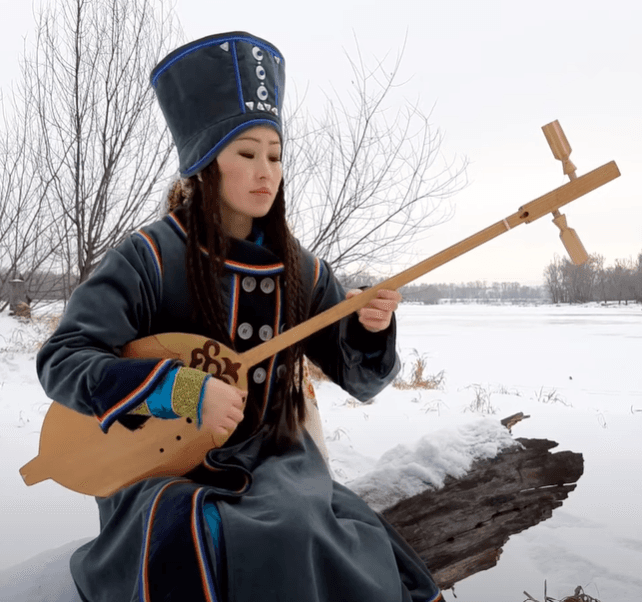
Hakas folk music is dominated by steppe lyricism. The most commonly used instruments are the komus (stringed instrument) and the tägï (shaman drum). Additionally, throat singing (höömey) is a distinctive vocal technique unique to the Hakas. During ceremonies and celebrations, dances and folk games are performed to the accompaniment of this music.
Traditional Hakas attire consists of long tunics, headgear, and boots made from wool, leather, and felt. Women’s clothing features embroidery and beadwork. Traditional handicrafts prominently include weaving, felt-making, and stone carving.
Particularly, traditional jewelry carries both aesthetic and protective/spiritual meanings. Amulets and talismanic objects reflect influences of Shamanism.
Arvas, Abdulselam. “Hakas Bir ‘Kam’ ve Düzenlediği Ritüeller.” Çukurova Üniversitesi Sosyal Bilimler Enstitüsü Dergisi 30, no. 2 (2021): 79–90. Accessed August 6, 2025. https://dergipark.org.tr/tr/pub/cusosbil/issue/67691/942201
Davletov, Nükhet. "Hakas Şamanizminde Ölüm." PhD thesis, Hacettepe Üniversitesi, 2020. Accessed August 6, 2025. https://tez.yok.gov.tr/UlusalTezMerkezi/TezGoster?key=Eb5EkakJlp3olBdo_wNEGfRV_ZFXN7P5_5K31jNsncHWGEvMeqQzy5iSOna8PyXT
Davletov, Timur. "Hakasya ile Türkiye Arasında Sosyokültürel Devamlılık Unsuru Olarak Şamanlık." PhD thesis, Hacettepe Üniversitesi, 2019. Accessed August 6, 2025. https://tez.yok.gov.tr/UlusalTezMerkezi/TezGoster?key=as2oTjW5jfr9IKSvmCdJYtuOD1gTOIrtjVnL52rzzYwXcp0Bq8gn5ak2v15L8S1c
Güneş, Nuray. "Hakaslarda Mutfak Kültürü: Tematik Söz Varlığı İncelemesi." Master's thesis, Marmara Üniversitesi, 2022. Accessed August 6, 2025. https://tez.yok.gov.tr/UlusalTezMerkezi/TezGoster?key=kScA8XnrRb0WogX-qPGFkpaC_FEiR2lkm9fYxb5pkGvnKB3vOXTZOdSwwjup_6cr
Güven, Emine. Hakas Yazı Dilinin Oluşturulma Süreci. PhD thesis, Ankara Hacı Bayram Veli Üniversitesi, 2023. Accessed August 6, 2025. https://tez.yok.gov.tr/UlusalTezMerkezi/TezGoster?key=r4I1HnmXxFQovUpyAyUmxBcZbJK5zb3TyL9u8oh-LZEfBl6J74R5Ms5HNmwAm83X
Khakassia Khanate Youtube Kanalı. "Hakasya Cumhuriyeti Milli Marşı - "Гимн Хакасии" | Türkçe Çeviri İle Birlikte." Accessed August 6, 2025. https://www.youtube.com/watch?v=Tv84XL1SnU0&list=RDTv84XL1SnU0&start_radio=1
Kirişçioğlu, M. Fatih. “Sibirya’daki Türkler ve Dilleri.” Türk Dili 70, no. 839 (2021): 20–35. Accessed August 6, 2025. https://www.tdk.gov.tr/wp-content/uploads/2021/11/M.-Fatih-Kiri%C5%9F%C3%A7io%C4%9Flu-_-S%C4%B0B%C4%B0RYA%E2%80%99DAK%C4%B0-T%C3%9CRKLER-VE-D%C4%B0LLER%C4%B0_-12.pdf
Okutan, Nükhet. *Hakaslarda Atalar Kültü ve Günümüz Hakas Kültürüne Etkileri*. Master's thesis, Hacettepe Üniversitesi, 2016. Accessed August 6, 2025. https://tez.yok.gov.tr/UlusalTezMerkezi/TezGoster?key=Br_XTptK8CZ70f0JGX9xElyN3jcWxsAu3jA093kNajwV4zA5mbpTQyMFc52qCcA5
TRT Avaz YouTube Channel. "Hakasya - Türk Dünyasında Kadın - TRT Avaz." Accessed August 6, 2025. https://www.youtube.com/watch?v=zk1D0HjpXWk
TRT Avaz YouTube Channel. "Totemin Etrafında 3 Kere Dönülür - Şaman Âdetleri ile Hakas Halkı - TRT Avaz." Accessed August 6, 2025.
TVNET X Youtube Kanalı. "En savaşkan Türkler: Hakaslar nasıl ayakta kaldı? Nazgül Kenzhetay anlattı | Bir Tugan: Hakaslar." Accessed August 6, 2025. https://www.youtube.com/watch?v=g4rOYuVwYQ4
Tengiz Türk Youtube Kanalı. "Hakas Kopuzu & Takpak Söyleme Geleneği." Accessed August 6, 2025. https://www.youtube.com/watch?v=6byhppmR_tQ&list=RD6byhppmR_tQ&start_radio=1
Çavdar, Esra. Hakasya Türkleri Siyasi ve Kültürel Tarihi. Master's thesis, Trakya Üniversitesi, 2010. Accessed August 6, 2025. https://tez.yok.gov.tr/UlusalTezMerkezi/TezGoster?key=EEdeQgIdFRxX5NbvVau-AprSOX2v1Em5ojWr1vMHhkmvUDW149ljh6Xypg1y_cXs

Geographical Location(s) | Khakass Autonomous Republic a federal subject of the Russian Federation | ||||||||
|---|---|---|---|---|---|---|---|---|---|
Origin(s) | Continuation of the Yenisei Kyrgyz | ||||||||
Body Structure | Sagay, Kach, Kizyl, Koybal, Beltir, Shor | ||||||||
Language(s) | Khakas Turkish | ||||||||
Dialects | Sagay, Kach, Kizyl and Shor dialects | ||||||||
Belief | Shamanism (Kamlık), Burhanism and Christian Orthodoxy | ||||||||
History
Language and Written Culture
Historical Process
Establishment of the Written Language
Current Status of the Language
Social Structure and Subgroups
Main Subtribes
Social and Demographic Structure
Belief System
Core Elements of Shamanism
Shamanism and the Modern Era: Neo-Shamanism
Other Beliefs in Khakassia
Ancestor Worship
Death and Posthumous Practices
Key Death Rituals
Belief in Reincarnation and Soul Migration
Sacred Sites
Culinary Culture
Oral Culture and Folk Literature
Music and Instruments
Clothing and Handicrafts