


This article was automatically translated from the original Turkish version.
+2 More
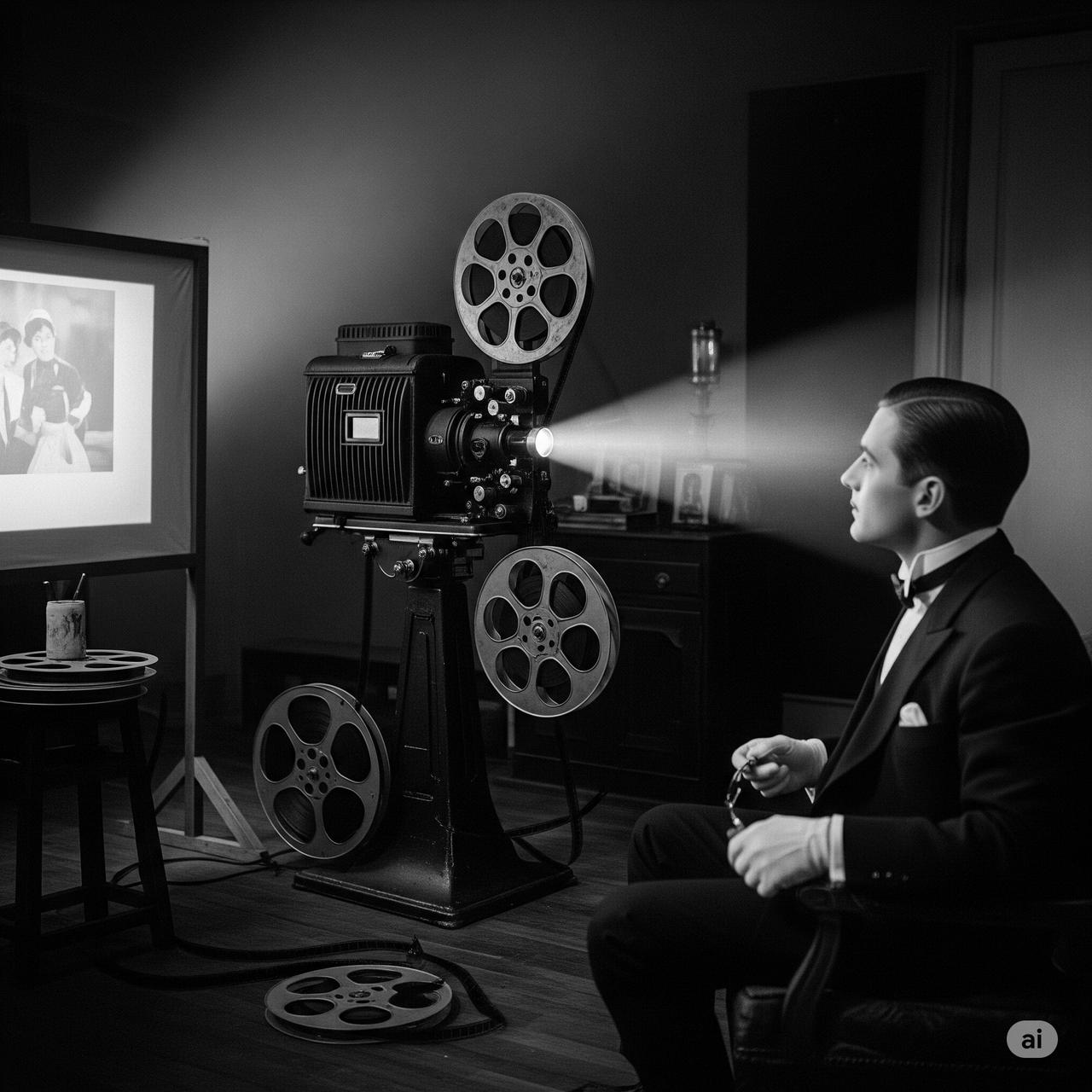
Silent Film Era (Generated by Artificial Intelligence)
Time Period | 1895–1929 | ||||||||
|---|---|---|---|---|---|---|---|---|---|
Currents in Europe | German Expressionism, Neorealism, Soviet Montage Theory | ||||||||
Pioneers of Silent Comedy | Charlie Chaplin, Buster Keaton, Harold Lloyd, Harry Langdon | ||||||||
Pioneers of the First Genre | The Watered Gardener (Comedy), The Wall's Collapse (Effect), A Trip to the Moon (Science Fiction) | ||||||||
End of Silence | 1927 Jazz Singer (First sound film) | ||||||||
The Silent Film Era is the period in cinema history spanning from the late 1890s to the late 1920s during which films lacked synchronized dialogue and recorded sound effects. Narrative during this era relied on actors’ gestures and facial expressions visual composition and intertitles that conveyed the story or dialogue. Screenings were typically accompanied by live music performed by a pianist or orchestra to enhance the film’s atmosphere. This era, born out of technological limitations, is regarded as a formative period in which cinema developed its own unique visual language and established foundational genres and storytelling techniques.
The birth of cinema is dated to 1895 with the invention of the Cinematograph by Louis and Auguste Lumière brothers a device that functioned as both camera and projector. The short films shot by the Lumière brothers although documentary in nature constitute the earliest examples of cinema. Among these pioneering works The Waterer Watered (L'Arroseur Arrosé) is recognized as the first comedy film while The Demolition of a Wall (Démolition d'un Mur) shown in reverse is recorded as the first film to use special effects. Inspired by these screenings the magician George Méliès perceived cinema’s potential as a narrative medium and in 1902 produced A Trip to the Moon (Le Voyage dans la Lune) the first scripted film and the first science fiction film in cinema history. Méliès created comic and fantastical scenes using cinematic tricks such as accelerated motion and single-frame techniques.
At the beginning of the era films were typically single-reel productions lasting about ten minutes. However increasing competition and audience interest led producers to create longer multi-reel films. In 1906 the Australian 70-minute film The Story of the Kelly Gang became the longest film made up to that point. Starting in 1905 the first movie theaters known as nickelodeons opened in the United States and cinema became a popular form of mass entertainment. During this period American director David Wark Griffith emerged as the most important figure in transforming cinematic storytelling into an art form. Griffith laid the foundations of modern cinematic language by developing techniques such as continuity editing and establishing the director’s central role in the filmmaking process. His epic films such as The Birth of a Nation (1915) and Intolerance (1916) featuring massive sets and large casts expanded the narrative possibilities of cinema.
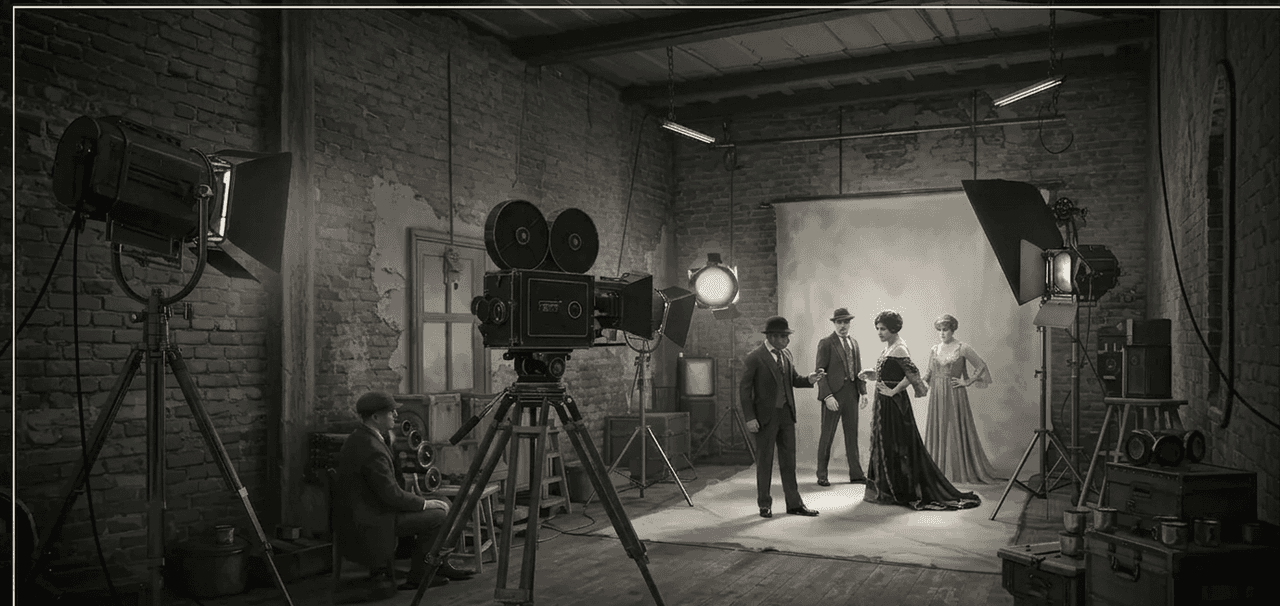
A Visual Representing the Silent Film Era (Generated by AI)
Before World War I French and Italian cinema dominated Europe. In France Ferdinand Zecca developed the chase comedy (course comique) genre which would deeply influence American comedians. Louis Feuillade advanced the genres of crime and horror through productions such as Fantômas and Les Vampires and initiated the serial film format. Italian cinema attracted attention with historical epics such as Quo Vadis? (1912) and Cabiria (1914) which featured large casts and monumental sets. These Italian productions served as major sources of inspiration for American directors such as D.W. Griffith.
After the war one of cinema’s most significant developments emerged from defeated Germany. Under the leadership of the company UFA (Universum-Film AG) during the Weimar Republic (1919–1933) German cinema experienced its golden age. The defining artistic movement of this period was German Expressionism which began with Robert Wiene’s 1920 film The Cabinet of Dr. Caligari (Das Cabinet des Dr. Caligari). In this movement architectural set design and lighting were exaggerated and distorted to reflect characters’ inner psychological states. Masters such as F.W. Murnau (Nosferatu The Last Man Faust) and Fritz Lang (Metropolis) became iconic figures in world cinema history through their work in this movement. In the second half of the 1920s German cinema shifted toward a more realistic style known as New Objectivity (Neue Sachlichkeit) which sought to portray life as it was influenced by the social collapse following the war.
The most important representative of this movement was G.W. Pabst. At the same time in the Soviet Union cinema was viewed as one of the primary tools of revolutionary propaganda. The State Film Institute (VGIK) the world’s first film school was established. Limited resources compelled filmmakers to reinterpret existing footage to generate new meanings. This necessity led to the development of editing theories. Lev Kuleshov conducted the experiment known as the Kuleshov Effect demonstrating that the emotional impact on viewers changed depending on the sequence of images. Kuleshov’s students Sergei Eisenstein and Vsevolod Pudovkin developed approaches that regarded editing as cinema’s fundamental element. Eisenstein applied a montage theory based on Marxist dialectics and centered on conflict in films such as Battleship Potemkin (Bronenosets Potemkin). Dziga Vertov rejected fictional cinema and proposed the theory of “Cinema-Eye” (Kino-Glaz) based on documentary imagery.
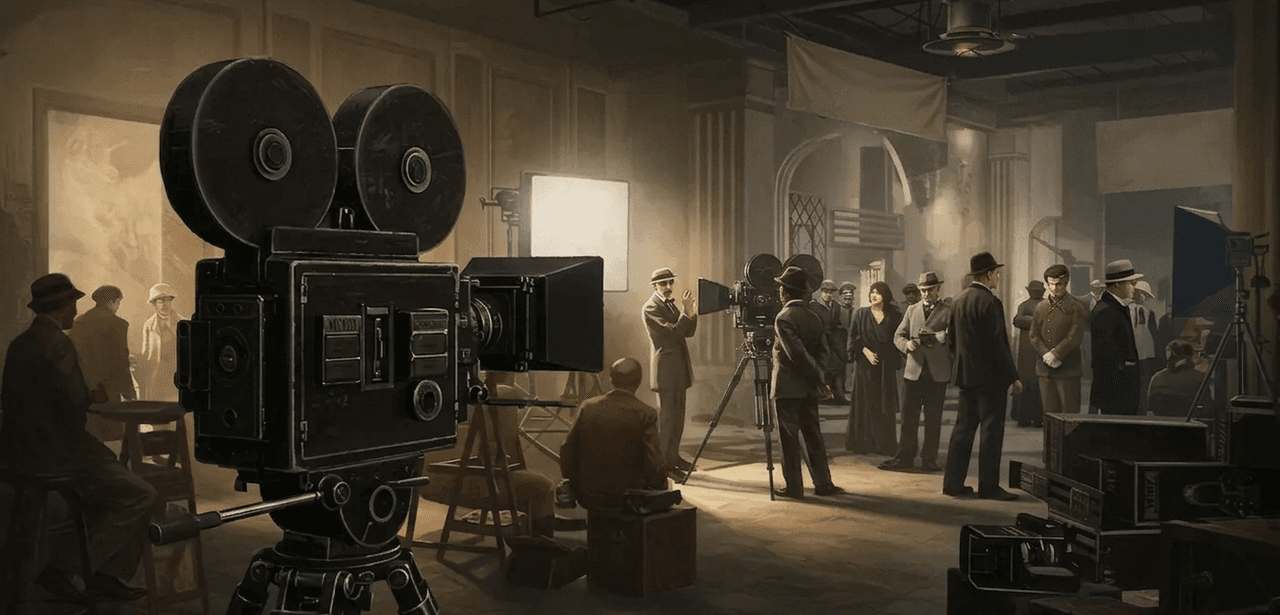
A Visual of the Film Industry and the Silent Film Era (Generated by AI)
During the silent era the film industry in the United States experienced massive growth and Hollywood became the center of film production. The 1913 film The Squaw Man is considered the first feature-length film shot in Hollywood. One of the most popular genres of this period was comedy. Mack Sennett’s Keystone Studios founded in 1912 became the epicenter of slapstick comedy. Keystone comedies had an anarchic and parodic structure that mocked authority and social norms. This studio served as a training ground for the biggest stars of silent cinema.
The “Big Four” of American silent comedy Charlie Chaplin Buster Keaton Harold Lloyd and Harry Langdon reached the peak of their careers during this period. Charlie Chaplin who was raised in British music halls achieved worldwide fame with his character “The Tramp” created at Keystone. He later moved to studios such as Essanay and Mutual to gain creative control over his films and produced masterpieces such as The Kid The Gold Rush and Modern Times. Buster Keaton known as “The Great Stone Face” stood out for his acrobatic skills and impeccable timing. He became renowned for performing dangerous stunts without stunt doubles in films such as The General and Sherlock Jr. Harold Lloyd portrayed the adventures of the ordinary man through his bespectacled and optimistic character while Harry Langdon created a distinct comedic style with his childlike and naive persona.
Important figures also emerged outside the comedy genre. Douglas Fairbanks became the most popular star of adventure films through works such as The Thief of Bagdad. Cecil B. DeMille was known for his lavish historical and modern dramas while Austrian director Erich von Stroheim challenged Hollywood’s established moral codes with his realistic and pessimistic films. The growing influence of cinema and themes such as sexual freedom in films provoked public backlash. To avoid government intervention producers established a self-regulation body in 1922 known as the Hays Office.
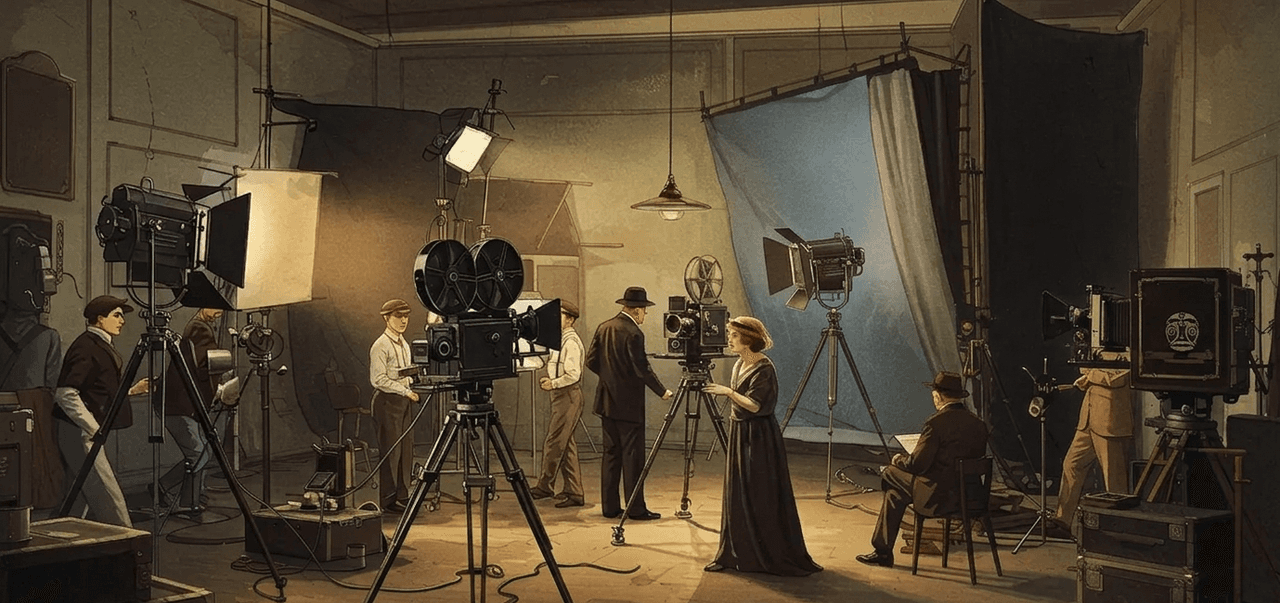
A Visual on the Development of the Film Industry and the Silent Film Era (Generated by AI)
The end of the silent film era came with the technological advancement that allowed sound to be synchronized with film. The most significant milestone in this transition was the 1927 film The Jazz Singer which premiered on October 6 and featured synchronized dialogue and songs in some scenes. This film is recognized as the first feature-length sound film. The 1928 film Lights of New York was the first all-talking film and achieved major box office success.
Although the arrival of sound was initially met with concern by some directors and critics who feared it would weaken cinema’s visual language the usefulness of sound as a complementary narrative element was quickly accepted. By the 1930s silent film production had largely ceased. However the visual storytelling techniques editing approaches and acting styles developed during the silent era continue to form the foundation of contemporary cinema.
Anadolu Ajansı. “Dünden Bugüne Sinemanın Yolculuğu.” Accessed [insert date]. https://www.aa.com.tr/tr/kultur-sanat/dunden-bugune-sinemanin-yolculugu/1603789.
Bilgin, Tayfun. Filmde Ses Kuşağının Tarihsel Evrimi. Duvar Yayınları, [year].
Charlie Chaplin Klasikleri. IMDb. Accessed July 21, 2025. https://www.imdb.com/title/tt31613470/.
Çelik, Fırat. "Sinemanın Sessiz Hali: Konuşmayan Filmlerin Hikâyesi." *Genç Gazete.* June 29, 2024. https://www.gencgazete.net/sinemanin-sessiz-hali-konusmayan-filmlerin-hikayesi.
İhtiyar, Ali. *Sessiz Sinemada Anlatım Yöntemleri Lâl.* Master's thesis, Marmara Üniversitesi, 2010. https://www.proquest.com/openview/18b450e4483b9581bff421f4d142ea41/1?pq-origsite=gscholar&cbl=2026366&diss=y.
Şavk, Serkan. “Sessiz Dönem Türk Sinema Tarihi (1895–1922).” *Sinecine: Sinema Araştırmaları Dergisi* 1, no. 2 (2006): 17–34. https://dergipark.org.tr/tr/pub/sinecine/issue/43728/536693.


Silent Film Era (Generated by Artificial Intelligence)
Time Period | 1895–1929 | ||||||||
|---|---|---|---|---|---|---|---|---|---|
Currents in Europe | German Expressionism, Neorealism, Soviet Montage Theory | ||||||||
Pioneers of Silent Comedy | Charlie Chaplin, Buster Keaton, Harold Lloyd, Harry Langdon | ||||||||
Pioneers of the First Genre | The Watered Gardener (Comedy), The Wall's Collapse (Effect), A Trip to the Moon (Science Fiction) | ||||||||
End of Silence | 1927 Jazz Singer (First sound film) | ||||||||
Technological Development and Early Years
Movements in European Cinema
American Cinema and the Rise of Hollywood
The End of Silent Cinema