


This article was automatically translated from the original Turkish version.
+6 More
Smart Building Technologies
Main Objective | Energy Efficiency, Safety, Comfort, and Cost Savings | ||||||||
|---|---|---|---|---|---|---|---|---|---|
Core Technologies | Building Automation Systems (BAS), Internet of Things (IoT), Central Control Systems | ||||||||
Controlled Systems | Heating, Ventilation, and Air Conditioning (HVAC), Lighting, Security, Elevators, Communication | ||||||||
Key Benefits | Low Operating Costs, Reduced Environmental Impact, Increased User Efficiency and Comfort | ||||||||
Application Area(s) | Offices Healthcare Facilities Residential Buildings Industrial Facilities Hotels | ||||||||
Smart buildings are structures equipped with sensors, control units and software that enable their internal systems to operate in an integrated manner, responding to environmental conditions and user needs. In these buildings, core systems such as heating, ventilation, air conditioning (HVAC), lighting, security and communication are centrally monitored and managed through automation technologies. Thanks to an infrastructure capable of collecting and analyzing data, a smart building enhances user comfort and safety while optimizing energy consumption.
The primary objective of these structures is to maximize energy efficiency, comfort, security and functionality. With technological advancement, particularly through developments such as the Internet of Things (IoT), smart buildings have evolved beyond mere collections of automated systems to become dynamic, data-driven and sustainable ecosystems. Their fundamental purpose is to achieve maximum performance and comfort with minimal energy consumption, reduce operational costs and minimize environmental impact.

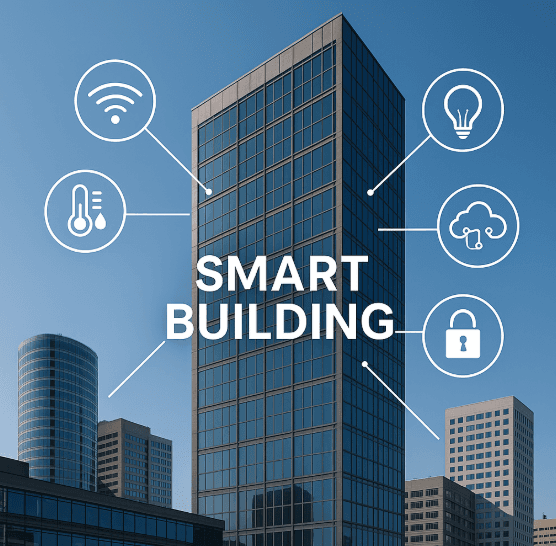
Smart Buildings (Generated with Artificial Intelligence.)
Smart buildings are formed by the integration of a range of technological components. These technologies ensure the building operates efficiently, safely and comfortably. The main features and the technologies enabling them are detailed below.
Building Automation Systems (BAS) can be regarded as the central nervous system of a smart building. BAS is a combination of software and hardware that enables the centralized monitoring, control and management of mechanical, electrical and electronic systems within the building. These systems integrate critical infrastructure such as heating, ventilation and air conditioning (HVAC), lighting, elevators, fire detection and suppression. Thanks to centralized control and monitoring, building managers can track the performance of all systems in real time, respond rapidly to faults and make necessary adjustments to optimize energy consumption. BAS has evolved in parallel with Industry 4.0 and lean manufacturing principles, enabling buildings to be managed more efficiently and systematically.
The most fundamental feature distinguishing smart buildings from conventional structures is their emphasis on energy efficiency. The goal is to achieve maximum performance with minimum energy consumption. Various strategies are employed to reach this objective. For example, lighting systems operate in integration with daylight sensors and occupancy sensors, providing illumination only when needed and at the required level. Heating and cooling systems automatically adjust based on outdoor temperature, indoor occupancy and time of day. Additionally, some smart buildings generate and store their own energy using renewable sources such as solar power. These systems significantly reduce energy costs while also lowering the building’s carbon footprint.
Security is another critical component of smart buildings. Advanced security systems are designed to protect both occupants and property. These systems include card-based access systems, biometric identification systems, closed-circuit television (CCTV) systems and motion detectors. All these devices are connected to a centralized security network and immediately alert security personnel or authorities in case of any anomaly, such as an unauthorized access attempt. In emergency situations such as fire, fire detection sensors automatically activate suppression systems, manage ventilation and illuminate emergency exit routes to facilitate safe evacuation.
Seamless communication, required by modern work and living environments, is a key feature of smart buildings. These buildings are equipped with advanced communication infrastructure including high-speed wireless internet (Wi-Fi), PBX telephone systems, teleconferencing and video conferencing systems. Radio or wireless headset systems may also be used to facilitate communication among staff within the building. Particularly in office buildings, information technology systems such as centralized data storage servers, remote backup services and computer-aided systems support operational efficiency and continuity.
The Internet of Things (IoT) is a revolutionary technology that elevates the concept of smart buildings to a higher level. IoT adds an additional layer of intelligence to building automation systems by collecting and sharing data through a network of sensors, devices and other objects. While traditional BAS systems typically operate within their own closed networks, IoT enables their integration with cloud computing platforms, offering more advanced analysis and control capabilities.

Smart Apartment (Generated with Artificial Intelligence.)
IoT technology is utilized in various ways to enhance efficiency and operational effectiveness in buildings. Thousands of sensors collecting real-time data provide detailed information about every corner of the building. These data are analyzed on cloud-based platforms to deliver valuable insights for building management.
Smart building technologies are flexible and adaptable to the unique requirements of each building type. These solutions can be customized according to the needs of different building categories.
"Smart Building Applications." DergiPark. Accessed July 23, 2025. https://dergipark.org.tr/en/download/article-file/3119201.
Cormind. “Akıllı Bina Nedir? Akıllı Bina Otomasyon Sistemleri Cormind.” Accessed October 17, 2023. https://cormind.com.tr/akilli-bina-nedir.
“Akıllı Binalar ve Enerji Verimliliği.” İstanbul Teknik Üniversitesi - POLEN. Accessed July 23, 2025. https://polen.itu.edu.tr/items/ffd4511d-8dbb-49da-a203-20991361da2e.
“Akıllı Yapılar.” *akillisehirler.gov.tr.* Accessed July 23, 2025. https://www.akillisehirler.gov.tr/wp-content/uploads/KapasiteGelistirme/Egitim_Sunum/PDF/Akilli_Yapilar.pdf.
“Smart Buildings.” Paessler. Accessed July 23, 2025. https://www.paessler.com/it-explained/smart-buildings.

Smart Building Technologies
Main Objective | Energy Efficiency, Safety, Comfort, and Cost Savings | ||||||||
|---|---|---|---|---|---|---|---|---|---|
Core Technologies | Building Automation Systems (BAS), Internet of Things (IoT), Central Control Systems | ||||||||
Controlled Systems | Heating, Ventilation, and Air Conditioning (HVAC), Lighting, Security, Elevators, Communication | ||||||||
Key Benefits | Low Operating Costs, Reduced Environmental Impact, Increased User Efficiency and Comfort | ||||||||
Application Area(s) | Offices Healthcare Facilities Residential Buildings Industrial Facilities Hotels | ||||||||
Core Features and Technologies of Smart Buildings
Building Automation Systems (BAS)
Energy Management and Efficiency
Security Systems
Communication Infrastructure
Integration of the Internet of Things (IoT)
The Role of IoT in Smart Buildings
Applications for Different Building Types