


This article was automatically translated from the original Turkish version.
Space Security is a defense domain encompassing activities aimed at developing the capacity to monitor protect and if necessary intervene to safeguard space-based systems in support of states’ military economic and strategic interests. This concept includes not only military platforms but also the security of civilian and commercial satellites infrastructure. Historical developments regarding the militarization and armament of space the formation of the international legal framework and the emergence of modern space forces have been decisive in shaping this field.
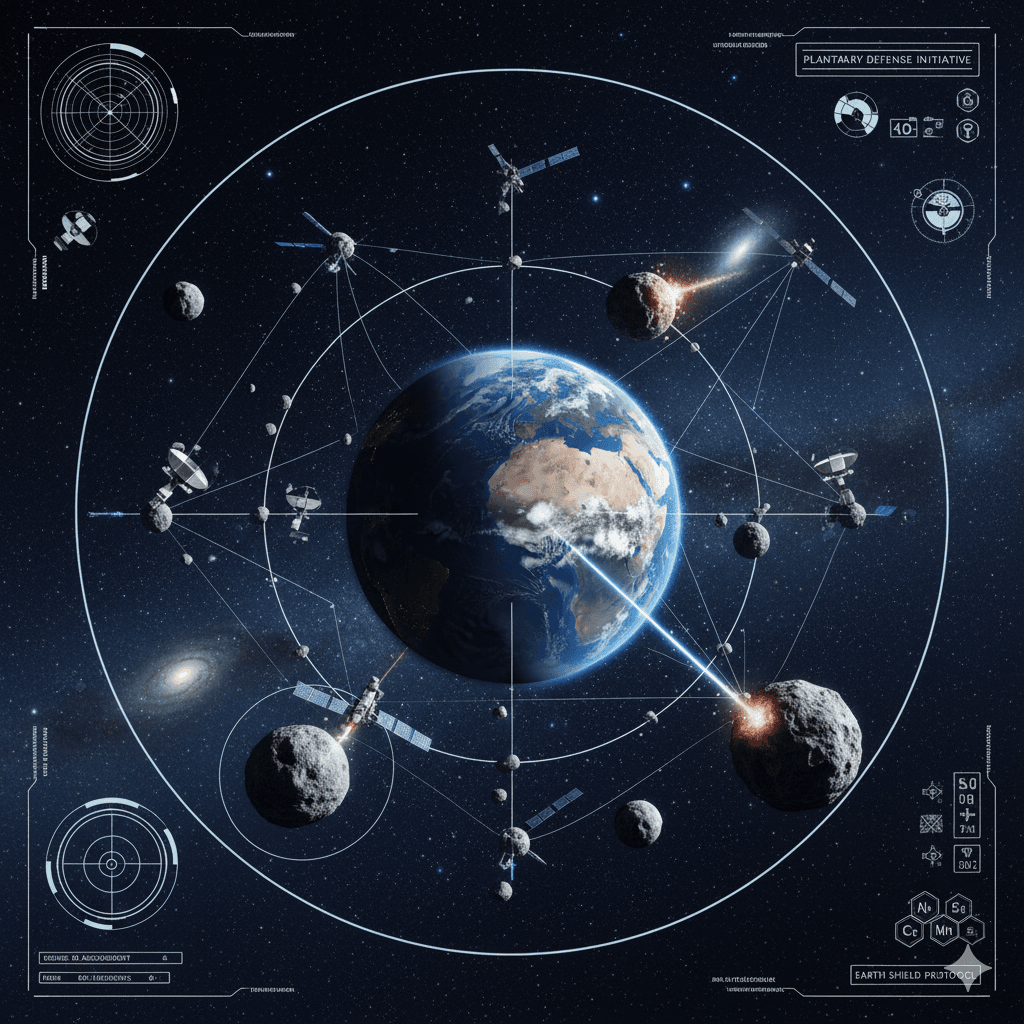
Space Defense (Generated by Artificial Intelligence)
Space security was shaped during the Cold War by the competition between two superpowers the United States and the Soviet Union and was initially regarded as a supporting element for military capability. Satellite reconnaissance early warning and communication systems became integral components of military operations during this period.
After the Cold War the diversification of international security perceptions led to the recognition of space as a strategic domain not only due to military considerations but also because of economic and technological dependencies. The growing number of actors and the expansion of commercial space activities have transformed space security into a multidimensional concept.
Space activities have since their inception possessed dual-use characteristics. Systems developed for communication observation or navigation have also supported military missions. This has complicated efforts to manage space solely under the principle of “peaceful use”.
Although the international community has sought to limit armament through various agreements the existing legal framework explicitly prohibits only the placement of weapons of mass destruction in orbit. The development of anti-satellite systems the emergence of new space actors and the declining cost of technology have intensified competition in space and accelerated debates on armament.
The foundational regulations for the peaceful use of space have been established through outer space treaties and negotiations conducted within international organizations. The current framework governs the prohibition of weapons of mass destruction in space the provision of equal access for all states and state responsibility for activities conducted in space. Due to the limited scope of these provisions military satellite activities space-based intelligence and defensive early warning systems are not considered violations. This has hindered efforts to maintain space as a completely demilitarized domain.
For states space infrastructure constitutes critical elements that directly affect modern warfare functions such as command and control intelligence navigation and communications. Consequently the possibility of interference by a rival actor holds a significant place in national security planning. The perception of threats encompasses a broad spectrum including anti-satellite weapons cyberattacks signal jamming systems orbital debris from collisions and the military satellite capabilities of adversarial states. Within this framework defense planning includes mechanisms for physical protection against threats as well as continuous monitoring of the orbital environment.
Concepts of warfare in space involve dynamics distinct from those of land sea and air domains. Orbital mechanics force distribution access times and maneuverability are fundamental determinants of these operations. Conflict in space is largely focused on rendering target satellites ineffective disrupting communications or degrading an adversary’s situational awareness. Within theoretical frameworks classical military principles such as surprise maneuver deception and concentration on critical points are adapted to the space environment. This approach underscores that achieving superiority in space is decisive for power projection across all domains of operations.
Technological advancements and increasing threats have prompted many states to establish independent space forces. These forces assume responsibility for operating protecting monitoring and if necessary intervening in space-based systems. In some countries this structure evolved as part of existing air forces while in others it was organized as a separate branch. The infrastructure of these forces includes satellite launch facilities radar networks intelligence centers command and control systems and space surveillance radars.
Military and civilian satellite systems form the foundation of space security. These systems include reconnaissance and surveillance satellites communication satellites navigation satellites meteorological satellites and early warning satellites. This infrastructure performs critical functions across a wide range of areas from modern military operational planning to missile defense networks. Space-based positioning systems missile detection radars and optical surveillance networks have become integral components of national strategic deterrence architectures.
Disarmament efforts in space have made limited progress due to technological advancements and strategic differences among states. Anti-satellite weapon tests the creation of orbital debris and doctrines pursued by some states aiming for space dominance have complicated the emergence of a common approach to space security. Nevertheless the international community continues to develop transparency measures behavioral norms and information-sharing mechanisms to enhance stability in space. The sustainability of space is regarded as a fundamental prerequisite for more comprehensive disarmament arrangements in the future.
The future of space defense is evolving into a more complex structure driven by the proliferation of low-cost launch systems the advancement of autonomous space vehicles and the widespread adoption of new technologies such as lasers and electromagnetic effect systems. Military doctrines increasingly regard the space domain as critical as land sea air and cyberspace in warfare. Concurrently it is expected that competition and cooperation dynamics among states will shift and that superiority in space technology will become the most decisive factor in determining strategic balance.
Defense Intelligence Agency. *Challenges to Security in Space: Space Reliance in an Era of Competition*. 2022. Accessed February 6, 2026. https://www.dia.mil/Portals/110/Documents/News/Military_Power_Publications/Challenges_Security_Space_2022.pdf.
Ercan, Arda, and Serap Gürsel. "Değişen Uluslararası Güvenlik Bağlamında Uzay Güvenliği ve Uzayda Silahsızlanma Çabaları." *Gaziantep University Journal of Social Sciences* 21, no. 2 (2022): 881–896. Accessed February 6, 2026. https://dergipark.org.tr/en/download/article-file/2163530.
Graczyk, Rafal, Paulo Esteves-Verissimo, and Marcus Voelp. "Sanctuary Lost: A Cyber-Physical Warfare in Space." *arXiv preprint arXiv:2110.05878* (2021). Accessed February 6, 2026. https://arxiv.org/abs/2110.05878.
Gürbüz, Ersin. "Ulusal Güvenlik Alanında Uzay Kuvvetleri (Rusya Federasyonu Uzay Kuvvetleri Modeli)." Master's thesis, Gaziantep Üniversitesi, 2020. Accessed February 6, 2026. https://tez.yok.gov.tr/UlusalTezMerkezi/tezDetay.jsp?id=nrkBCq0UO950MCJZcMT-KA&no=5708543PuWT9xR6_Gbqsxw.
Hagen, Regina and Jürgen Scheffran. "Is a Space Weapons Ban Feasible? Thoughts on Technology and Verification of Arms Control in Space." In *Making Space for Security?* Geneva: UNIDIR, 2019. Accessed February 6, 2026. https://unidir.org/files/publication/pdfs/making-space-for-security-en-346.pdf.
Kleinberg, H. "On War in Space." *Astropolitics* 5, no. 1 (2007): 1–27. Accessed February 6, 2026. https://doi.org/10.1080/14777620701544600.
Pavur, James, and Ivan Martinovic. "SOK: Building a Launchpad for Impactful Satellite Cyber-Security Research." *arXiv preprint arXiv:2010.10872* (2020). Accessed February 6, 2026. https://arxiv.org/abs/2010.10872.
Peled, Roy, Eran Aizikovich, Edan Habler, Yuval Elovici, and Asaf Shabtai. "Evaluating the Security of Satellite Systems." *arXiv preprint arXiv:2312.01330* (2023). Accessed February 6, 2026. https://arxiv.org/abs/2312.01330.
Penny, Alan, Laura Spitler, Jill Tarter, Dan Werthimer, et al. "Searching for Extraterrestrial Intelligence with the Square Kilometre Array." *arXiv preprint arXiv:1412.4867* (2014). Accessed February 6, 2026. https://arxiv.org/abs/1412.4867.
Rovetto, Robert John, and T. S. Kelso. "Preliminaries of a Space Situational Awareness Ontology." *arXiv preprint arXiv:1606.01924* (2016). Accessed February 6, 2026. https://arxiv.org/abs/1606.01924.
Zapp, Mike. "Speaking Out to Outer Space: An Analysis of Humanity’s Messages to Extraterrestrial Intelligent Life, 1962–2018." *Journal of Globalization Studies* 14, no. 1 (2023). Accessed February 6, 2026. https://doi.org/10.30884/jogs/2023.01.10.
İçel, Pelin. "Uzay Güvenliği Bağlamında NATO Üyesi Devletlerin Uzay Politikalarının Analizi." Master's thesis, Bursa Uludağ Üniversitesi, 2025. Accessed February 6, 2026. https://acikerisim.uludag.edu.tr/server/api/core/bitstreams/daaad28a-f54a-4dcc-b517-a29f5fb661bb/content.

Evolution of the Concept of Space Security
Militarization and Armament of Space
International Legal Framework
Perception of Threats and Defense Doctrines in Space
Logic of Military Operations in Space
Emergence of Space Forces
Role of Satellite Systems in Defense
Disarmament Efforts and International Initiatives in Space