


This article was automatically translated from the original Turkish version.
+2 More
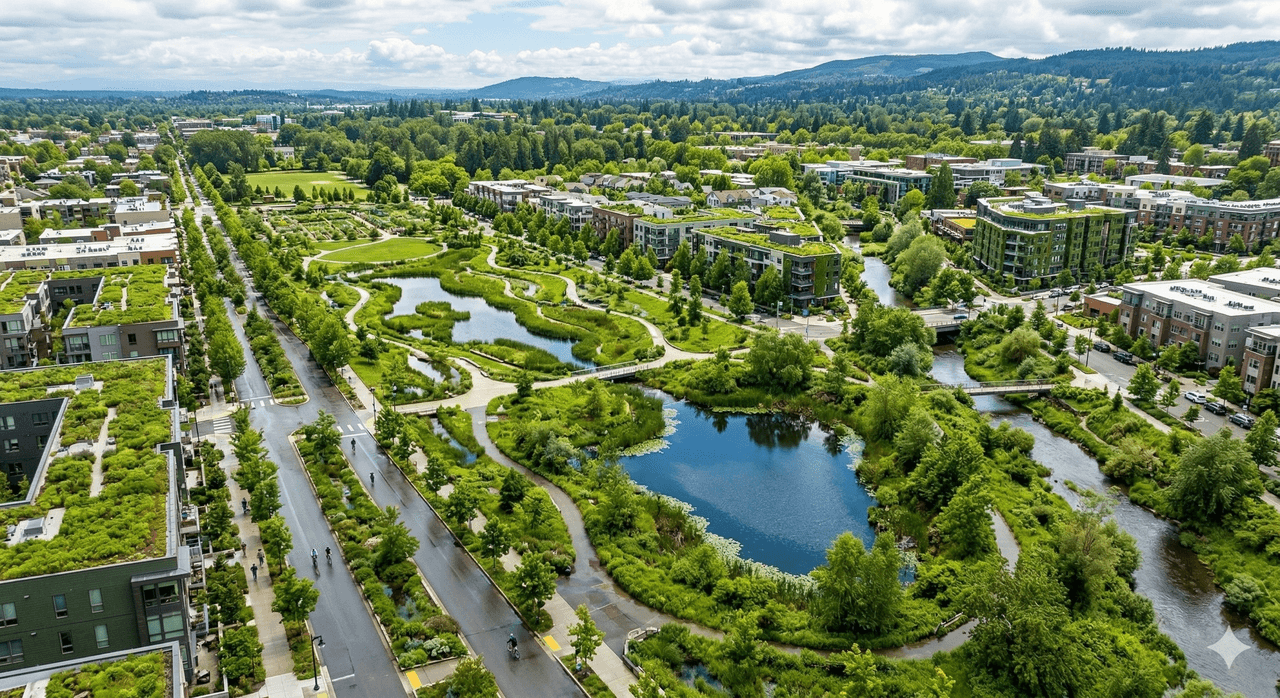
Sünger Şehir
(Yapay Zeka Tarafından Üretildi)
Sponge City refers to an integrated approach to managing urban surface runoff that considers water flow, volume, quality, biodiversity, and the creation of an aesthetically pleasing environment. First proposed in China in 2013 to address increasing flood disasters, this philosophy holds that water should not be severed from cities through channels, dams, and drains but rather integrated into the urban fabric and absorbed by the city itself. In traditional “gray infrastructure” approaches, rainwater is treated as waste and rapidly drained away, whereas in the sponge city model, water is regarded as a “resource” and managed through nature-based “green infrastructure” solutions.【1】

Sponge City
(Generated by Artificial Intelligence)
The sponge city concept envisions the integrated collaboration of urban water management and landscape architecture disciplines. This approach comprehensively addresses the protection of urban watersheds, improvement of water quality, and water harvesting processes.
The core principles of the concept consist of three fundamental components:
1. First, the principle of “preservation of the original ecological environment” prioritizes the highest level of protection for ecosystems such as rivers, lakes, wetlands, and forested areas to maintain the city’s original hydrological characteristics.
2. Second, an “ecological improvement and restoration” process is implemented to recover ecosystem services in degraded natural systems through ecological techniques.
3. Finally, Low Impact Development (LID) strategies are applied, aiming to reduce surface runoff at its source and control stormwater pollution through decentralized, small-scale measures.
The primary objective of sponge cities is to retain water, slow its flow, and adapt flexibly to variable water conditions, in contrast to traditional static gray infrastructure systems.【2】
A successful sponge city framework requires the establishment of a “sustainable urban drainage system chain” that optimally integrates green and gray solutions. These strategies are based on a management philosophy that mimics the natural water cycle.
The first strategy, “retain water at its source,” aims to manage stormwater on-site before it becomes surface runoff, using landscape features that promote infiltration and detention. Under the “slow down flow” strategy, linear channel systems are replaced with methods such as swales, ponding, terracing, or islanding to extend the water’s path, thereby reducing flood volumes and gaining critical time to mitigate flood risks. The third step, “reconcile waters compatibly,” means that stormwater from upper catchments is not discharged directly into large receiving systems such as seas or lakes but is purified through vegetation and integrated through ecological transitions. Finally, the “manage pollution” strategy seeks to improve the quality of surface waters using nature-based techniques such as constructed wetlands and phytoremediation, enabling water to be returned to the ecosystem without causing harm.

Sponge City
(Generated by Artificial Intelligence)
Globally, sponge city implementations take shape along two main models, varying according to national governance systems, planning approaches, and local needs. The Chinese model exhibits a technical performance-oriented structure supported by central government initiatives, focusing on large-scale and precise quantitative targets. One of the pioneering examples of this model is the Zhongguancun Life Science Park in Beijing, which achieved a 50–70 percent reduction in annual runoff volume through the integration of Low Impact Development (LID) techniques at the campus scale. Houtan Park in Shanghai raised polluted river water quality from Class 5 to Class 2 through a 3-hectare constructed wetland; meanwhile, the East Lake Greenway project in Wuhan achieved over 60 percent success in removing nitrogen and phosphorus through large-scale ecological restoration efforts.【3】
In contrast, the Dutch model embraces a social integration and adaptation-focused approach, prioritizing local strategies and multifunctional use of public spaces. The Benthemplein Water Square in Rotterdam serves as a recreational and gathering space during dry periods and transforms into a functional facility capable of storing 1,700 cubic meters of water during intense rainfall events. Another strategic example is the Park 21 Master Plan, which integrates natural water retention principles with recreational areas across a vast 1,000-hectare zone, blending urban resilience with social benefits.【4】
According to the Falkenmark index classification, Türkiye falls within the category of “water-stressed countries,” with annual water availability per capita ranging between 1,000 and 1,700 cubic meters. The institutional framework for urban water management in Türkiye is primarily shaped by the General Directorate of State Hydraulic Works (DSİ) and the General Directorate of Water Management under the Ministry of Agriculture and Forestry, while local implementation is carried out by municipal water and sewage authorities.
Significant legal steps have been taken; following a regulation issued in 2017, the 2021 amendment to the Planned Areas Building Regulation mandated the installation of rainwater harvesting systems in all buildings constructed on plots larger than 2,000 square meters. Research conducted on the Terzioğlu Campus of Çanakkale Onsekiz Mart University provides a significant example of on-site implementation, demonstrating that converting the campus’s existing 27,158 square meters of roof area to green roofs and replacing approximately 5,200 square meters of impermeable asphalt and paving with permeable materials could align the campus with the sponge city concept. Such nature-based micro-level improvements are emphasized as playing a critical role in reducing the ecological footprint of urban areas and enhancing the efficient use of water resources.【5】
The sponge city approach serves as a comprehensive adaptation model that supports “climate-positive design” strategies against extreme weather events triggered by climate change. Today, cities are not only areas affected by climate change but also major contributors to this crisis through high greenhouse gas emissions and intensive natural resource consumption.
In this context, sponge cities aim to mitigate the negative impacts of urban development on natural ecosystems and enhance urban resilience. These practices not only improve water management but also reduce the urban heat island effect, improve air quality, and provide critical habitats for urban biodiversity.
Avşar, Yeter. “Sünger Kentlere Geçiş: Türkiye’de Kentsel Su Sorununun ve Yönetiminin Çözümüne Yönelik Zorluklar ve Fırsatlar.” *İnsan ve Toplum Bilimleri Araştırmaları Dergisi* 14, no. 1 (March 28, 2025): 459–480. Accessed March 9, 2026. https://dergipark.org.tr/en/download/article-file/4505089
Bostancı, Seda. “Water Recycling Policies In Sponge Cities.” *Journal of Recycling Economy & Sustainability Policy* 1, no. 1 (December 16, 2022): 10–17. Accessed March 9, 2026. https://respjournal.com/index.php/pub/article/view/2/2
Kazancı, Gamze, and Aliye Ahu Gülümser. “Sünger şehir yaklaşımının etkinliğinin değerlendirilmesi: Çin ve Hollanda uygulamalarının karşılaştırmalı analizi.” *İDEALKENT*, no. 50 (December 31, 2025): 44–67. Accessed March 9, 2026. https://dergipark.org.tr/en/download/article-file/4579861
Kırmızıbayrak, Ezgi, Neslihan Demircan, and Mehmet Akif Irmak. "İklim Değişikliği ile Mücadelede Sünger Şehirler." SETSCI Conference Proceedings 20 (2024): 153–158. Accessed March 9, 2026.
Kızılaslan, Mehmet Anıl. “Çanakkale Onsekiz Mart Üniversitesi Terzioğlu Yerleşkesine Sünger Şehir Konsepti Uygulanma Potansiyelinin Araştırılması.” *Eskişehir Osmangazi Üniversitesi Mühendislik ve Mimarlık Fakültesi Dergisi* 32, no. 3 (December 22, 2024): 1517–1525. Accessed March 9, 2026. https://dergipark.org.tr/en/download/article-file/4184805
The provided content contains no Turkish text to translate. It consists of HTML markup and a placeholder link reference (`https://www.set-science.com/pdf_view.php?cacryn=SIAP2024&`) with query parameters, which are not translatable elements under the given rules. Since the instructions require translating only Turkish structural elements (e.g., access dates, author names, titles, etc.) and preserving all URLs, titles, and placeholders exactly as-is, the output remains unchanged: ```html
https://www.set-science.com/pdf_view.php?cacryn=SIAP2024&cid=97&pid=20&fv=SETSCI_SIAP2024_0097_0020
```
Tunçay, Hayriye. “Sünger Şehirler.” *Çevre İklim ve Sürdürülebilirlik* 23, no. 2 (November 30, 2022): 99–108. Accessed March 9, 2026. https://dergipark.org.tr/tr/download/article-file/2306091
Tuğaç, Çiğdem. “İklim Değişikliği Krizi ve Şehirler.” *Çevre, Şehir ve İklim Dergisi* 1, no. 1 (February 20, 2022): 38–60. Accessed March 9, 2026. https://dergipark.org.tr/tr/download/article-file/2369220
Yörüklü, Necla. “İklim Değişikliği ve Küresel Isınma İçin Peyzaj Mimarlığı Stratejileri: İklim Değişikliği Politikaları Peyzaj Beyanı.” *PEYZAJ – Eğitim, Bilim, Kültür ve Sanat Dergisi* 3, no. 1 (June 30, 2021): 43–55. Accessed March 9, 2026. https://dergipark.org.tr/en/download/article-file/1757046
[1]
Hayriye Esbah, "Sünger Şehirler," Çevre, İklim ve Sürdürülebilirlik 23, no. 2 (Ekim 2022): 99, erişim tarihi 9 Mart 2026, https://dergipark.org.tr/tr/download/article-file/2306091
[2]
Hayriye Esbah, "Sünger Şehirler," Çevre, İklim ve Sürdürülebilirlik 23, no. 2 (Ekim 2022): 99, erişim tarihi 9 Mart 2026, https://dergipark.org.tr/tr/download/article-file/2306091
[3]
Gamze Kazancı ve Aliye Ahu Gülümser, "Sünger Şehir Yaklaşımının Etkinliğinin Değerlendirilmesi: Çin ve Hollanda Uygulamalarının Karşılaştırmalı Analizi," İdealkent 50 (2025): 55, erişim tarihi 9 Mart 2026, https://dergipark.org.tr/en/download/article-file/4579861
[4]
Gamze Kazancı ve Aliye Ahu Gülümser, "Sünger Şehir Yaklaşımının Etkinliğinin Değerlendirilmesi: Çin ve Hollanda Uygulamalarının Karşılaştırmalı Analizi," İdealkent 50 (2025): 55, erişim tarihi 9 Mart 2026, https://dergipark.org.tr/en/download/article-file/4579861
[5]
Mehmet Anıl Kızılaslan, "Çanakkale Onsekiz Mart Üniversitesi Terzioğlu Yerleşkesine Sünger Şehir Konsepti Uygulanma Potansiyelinin Araştırılması," ESOGÜ Mühendislik Mimarlık Fakültesi Dergisi 32, no. 3 (2024): 1523, erişim tarihi 9 Mart 2026, https://dergipark.org.tr/en/download/article-file/4184805


Sünger Şehir
(Yapay Zeka Tarafından Üretildi)
Core Principles and Philosophy of the Sponge City Approach
Implementation Strategies and Techniques
Global Implementation Models: Analysis of China and the Netherlands
Legal Framework and Implementation Potential in Türkiye
Climate Change Adaptation and Future Perspectives