This article was automatically translated from the original Turkish version.
Scientific Name(s) | Vanellus spinosus | ||||||||
|---|---|---|---|---|---|---|---|---|---|
Family | Charadriidae (Plovers) | ||||||||
Order | 25–28 cm | ||||||||
Conservation Status | Least Concern | ||||||||
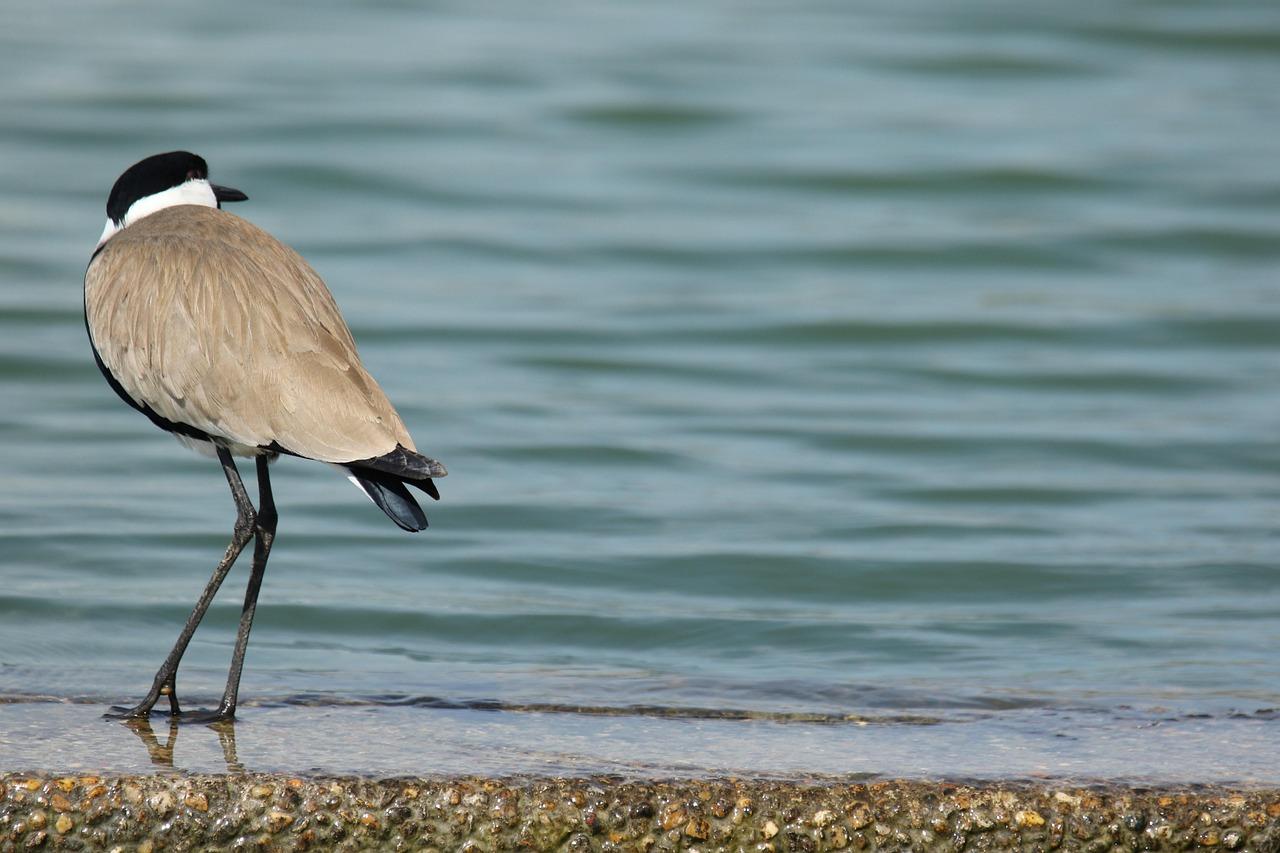
Spur-winged Plover, a long-legged and elegant shorebird.
The cheeks and sides of the neck are white, while the crown, throat and belly are black. The back and shoulder feathers are brown, the wing coverts are black and separated by a white stripe. The underwing coverts are white. A small spur is present at the wrist. The base of the tail is white, with black tips on the tail feathers. Flight is relatively slow, with wings beaten in sharp, forceful strokes held below body level. When viewed from above, the wings display three distinct colors: black, white and brown. A broad black band runs across the white tail. The long legs become prominent during flight, extending beyond the tail. Body length is 25–28 cm. Males and females are similar in appearance, with no pronounced sexual dimorphism.

Spur-winged Plover (flickr)
In Türkiye, it is a summer migrant that breeds along the Mediterranean, Aegean, Southeastern Anatolian, Southern Marmara coasts, the Aegean coast of Thrace, and in wetlands of Central Anatolia. Outside Türkiye, it occurs in northern Greece and countries along the eastern Mediterranean coast. Populations in Greece and Türkiye are migratory. During winter, it migrates to southern Sahara, Arabia and Western Africa.
It inhabits and nests near lagoons, lakes, saline and brackish marshes, and other wetland areas.
It is usually seen in small groups. As a summer migrant, it breeds in the Mediterranean, Aegean, Marmara and Central Anatolia regions. It builds its nest as a simple depression in the ground. Eggs are earth-colored, providing camouflage. The female lays 3–4 eggs. Incubation lasts 22–24 days. Individuals reach sexual maturity at approximately one year of age.
The Spur-winged Plover primarily feeds on insects and small invertebrates. It forages along the edges of wetlands, in shallow waters and muddy areas. Its diet consists mostly of ants, grasshoppers, fly larvae and aquatic insects. Earthworms, mollusks and crustaceans are also part of its food sources. While feeding, it walks with rapid steps, following movements on the soil or water surface, and captures prey with short, sudden pecks. It sometimes feeds in agricultural fields, playing a beneficial role in reducing populations of pest insects in crop fields.
It can display aggressive behavior toward potential threats approaching its nest, diving at intruders to drive them away.
The Spur-winged Plover (Vanellus spinosus) is classified as “Least Concern” on the IUCN Red List. The species has a wide distribution and its overall population is stable, even showing an increasing trend. Therefore, it is considered to have a low risk of extinction at the global level. However, at the regional level, threats such as habitat loss and degradation of wetlands may exert pressure on local populations.
Flickr. “Paimio Sanatorium JPG.” Flickr. Accessed August 16, 2025. https://flic.kr/p/yea2JV
Ornito. "Mahmuzlu Kızkuşu." Ornito.org. Accessed August 16, 2025. https://ornito.org/Bird/Detail/363
Pixabay. "Kuş Mahmuz Kanatlı Tur - Pixabay'de ücretsiz fotoğraf JPG." Accessed August 16, 2025. https://pixabay.com/tr/photos/ku%C5%9F-mahmuz-kanatl%C4%B1-kanatl%C4%B1-tur-do%C4%9Fa-4018410/
İzkuş. "Mahmuzlu Kızkuşu." İzmir Kuş Cenneti. Accessed August 16, 2025. https://izmirkuscenneti.gov.tr/2022/12/02/mahmuzlu-kizkusu/

Scientific Name(s) | Vanellus spinosus | ||||||||
|---|---|---|---|---|---|---|---|---|---|
Family | Charadriidae (Plovers) | ||||||||
Order | 25–28 cm | ||||||||
Conservation Status | Least Concern | ||||||||
No Discussion Added Yet
Start discussion for "Spur-winged Lapwing (Vanellus spinosus)" article
Morphological Characteristics
Distribution and Habitat
Biology and Breeding
Diet
Behavior
Conservation Status