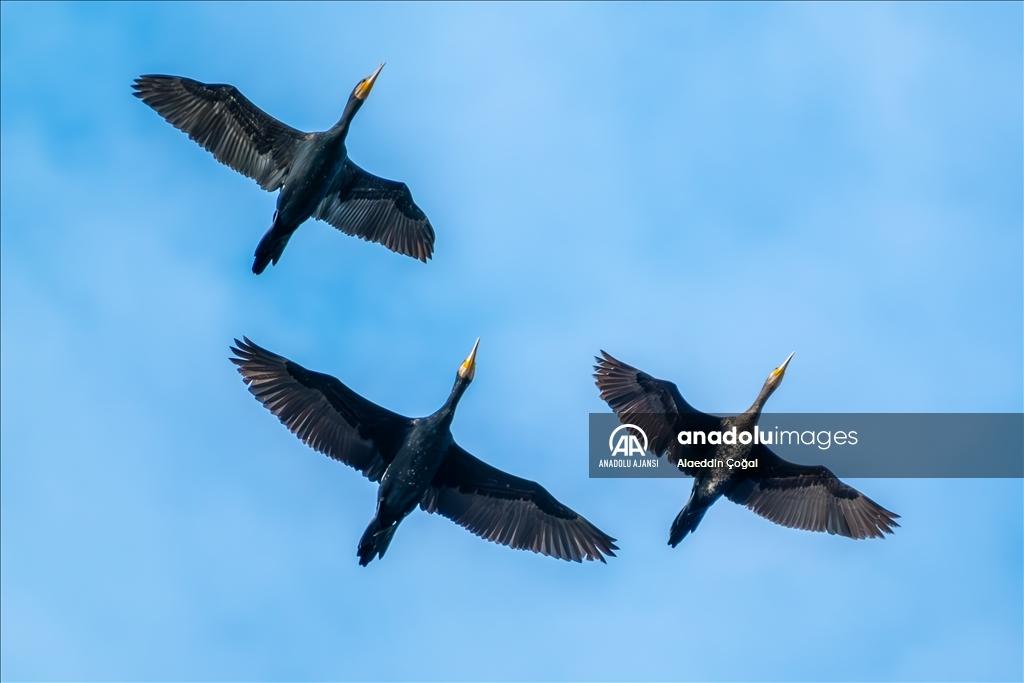
This article was automatically translated from the original Turkish version.
Location | Karataş / Adana / Türkiye | ||||||||
|---|---|---|---|---|---|---|---|---|---|
Area(s) | 14 000 hectares | ||||||||
Length(s) | 17 km | ||||||||
Width | Maximum 4 km | ||||||||
Protection Status | Natural Site First- and Second-Degree Protected Area Wildlife Conservation Area | ||||||||
Prominent Species | Coastal birds Kocagöz Reedsnipe Little bustard Flamingo Sea turtles | ||||||||
Akyatan Lagoon is one of the largest lagoon ecosystems on the Mediterranean coast of Türkiye, located within the boundaries of the Karataş district in Adana Province in southern Türkiye. The lagoon is part of the Çukurova Delta, formed by alluvial deposits carried by the Seyhan and Ceyhan rivers, and is recognized as Türkiye’s largest lagoon lake. Akyatan Lagoon has a triangular shape oriented northwest-southeast and covers an area of approximately 14,000 hectares. It is about 17 kilometers long and reaches a maximum width of approximately 4 kilometers. The lagoon connects to the sea via a narrow channel 2 kilometers long in the southwest direction, with its connection to the sea characterized by seasonally variable flow directions.
The lagoon formed historically due to changes in the course of the Ceyhan River and sediment deposition from the Seyhan River. Over time, the coastline advanced southward and coastal dunes coalesced into a barrier, separating the lagoon from the sea. Between the lagoon and the sea, dune ridges rise to heights of up to 20 meters. The surrounding terrain, particularly in the north, is dominated by agricultural land.
Akyatan Lagoon was designated as a Wildlife Conservation Area in 1989 and declared a first- and second-degree protected site in 1997. On 13 August 2020, it was officially registered as both a “Natural Site – Qualified Natural Conservation Area” and a “Natural Site – Sustainable Conservation and Controlled Use Area.” The lagoon holds international significance as a wetland ecosystem according to Ramsar criteria and is among Türkiye’s most important sites for birds and plant species.
Akyatan Lagoon supports a rich diversity of flora and fauna characteristic of the Mediterranean biogeographic region. It is particularly significant as a convergence point for two major bird migration routes: one originating from the Balkans and the other from the Caucasus. Observations conducted in 1990 identified 250 bird species in the region, including shorebirds, duck species, flamingos, and small marsh birds. Akyatan is also one of the most important nesting grounds in the Mediterranean for endangered species such as Chelonia mydas (green sea turtle) and Caretta caretta (loggerhead sea turtle).
The coastal dunes to the south of the lagoon provide suitable microhabitats for turtle reproduction. Under initiatives led by the Foundation for the Protection of Natural Life (WWF-Türkiye), monitoring, protection, and nest identification activities are carried out in this area. These efforts, conducted by volunteers and regional environmental directorates, aim to protect eggs, ensure hatchlings reach the sea, and reduce threats to nesting success.
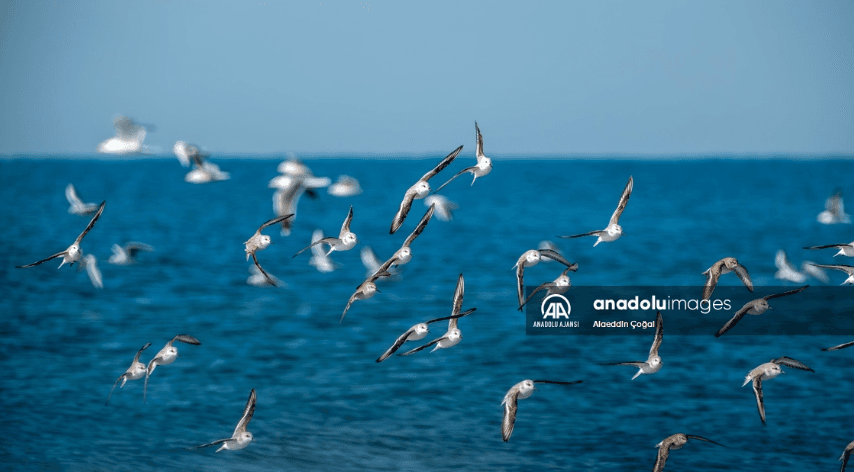
Akyatan Lagoon Hosts Numerous Bird Species (AA)
The lagoon exhibits hypersaline characteristics, with salinity, electrical conductivity, dissolved solids, and chloride concentrations in its western regions measured at 1.5 to 2 times higher than those of seawater. During summer months, high evaporation rates cause the lagoon’s surface area to shrink, impacting the lagoon ecosystem. Fertilizer and pesticide residues from surrounding agricultural lands enter the lagoon via drainage channels, contributing to water pollution, particularly in the western sector. Although nitrite, nitrate, total phosphorus, and chemical oxygen demand (COD) levels decline during summer, studies using geographic information systems have documented spatial and temporal variations in pollution levels within the lagoon.
In recent years, wetland areas around Akyatan Lagoon have shrunk due to the expansion of agricultural activities, resulting in degradation of natural vegetation. Agricultural lands in the northern region exert significant pressure on wetland functions. Additionally, summer drought and high evaporation rates lead to declining water levels and a reduction in the lagoon’s surface area. The natural structure of the dunes has been disrupted by the planting of eucalyptus, acacia, and pine trees for dune stabilization.
Akyatan Lagoon is one of the most important wetlands in Türkiye and the Mediterranean region, both in terms of biodiversity and ecosystem services. In addition to serving as a critical breeding ground for endangered sea turtles, it provides essential habitat and wintering grounds for migratory birds. However, pressures from agricultural activities, climate-related impacts, and pollution threaten the sustainability of this ecosystem. Therefore, the continuity of conservation and monitoring efforts around the lagoon is of vital importance.
Demir, Ayşegül. *Akyatan Lagününde Tuzluluk ve Bazı Kirlilik Düzeylerinin Saptanarak Coğrafi Bilgi Sistemi Destekli Dağılımlarının Belirlenmesi*. Master's thesis, Çukurova Üniversitesi, 2008. Accessed July 15, 2025. https://libratez.cu.edu.tr/tezler/6963.pdf
General Directorate for the Protection of Natural Assets. "Akyatan Lagünü Designation Announcement." *Ministry of Environment, Urbanization and Climate Change*. Accessed July 15, 2025. https://tvk.csb.gov.tr/akyatan-lagunu-tescil-ilani-duyuru-410134
Karataş Belediyesi. “Akdeniz’in Parlayan İncisi Karataş.” Karataş Municipality. Accessed July 15, 2025. https://www.karatas.bel.tr/karatas-hakkinda/akyatan-kus-cenneti/
Sönmez, Mehmet Emin, and Cüneyt Aytuk. “Akyatan Lagünü Çevresinde Arazi Kullanımındaki Değişimlerin Zamansal İncelenmesi ve Ekosistem Üzerindeki Olumsuz Etkilerinin Belirlenmesi.” *Sosyal Bilimler Dergisi* 1, no. 1 (2011): 25–28. Accessed July 15, 2025. https://dergipark.org.tr/tr/download/article-file/717524
Çoğal, Alaeddin. “Akyatan Lagünü Birçok Kuş Türünü Ağırlıyor.” Anadolu Ajansı. Accessed July 15, 2025. https://www.aa.com.tr/tr/pg/foto-galeri/akyatan-lagunu-bircok-kus-turunu-agirliyor/17
Şahin, Oğuz. “Adana Akyatan Lagünü Deniz Kaplumbağaları Koruma Stratejileri.” *International Anatolia Academic Online Journal* 11, no. 2 (2025): 277–279. Accessed July 15, 2025. https://dergipark.org.tr/tr/download/article-file/4140910

Location | Karataş / Adana / Türkiye | ||||||||
|---|---|---|---|---|---|---|---|---|---|
Area(s) | 14 000 hectares | ||||||||
Length(s) | 17 km | ||||||||
Width | Maximum 4 km | ||||||||
Protection Status | Natural Site First- and Second-Degree Protected Area Wildlife Conservation Area | ||||||||
Prominent Species | Coastal birds Kocagöz Reedsnipe Little bustard Flamingo Sea turtles | ||||||||
Geomorphological Features
Ecological Importance and Conservation Status
Flora and Fauna
Water Quality and Ecological Issues
Land Use and Threats