
This article was automatically translated from the original Turkish version.
+1 More
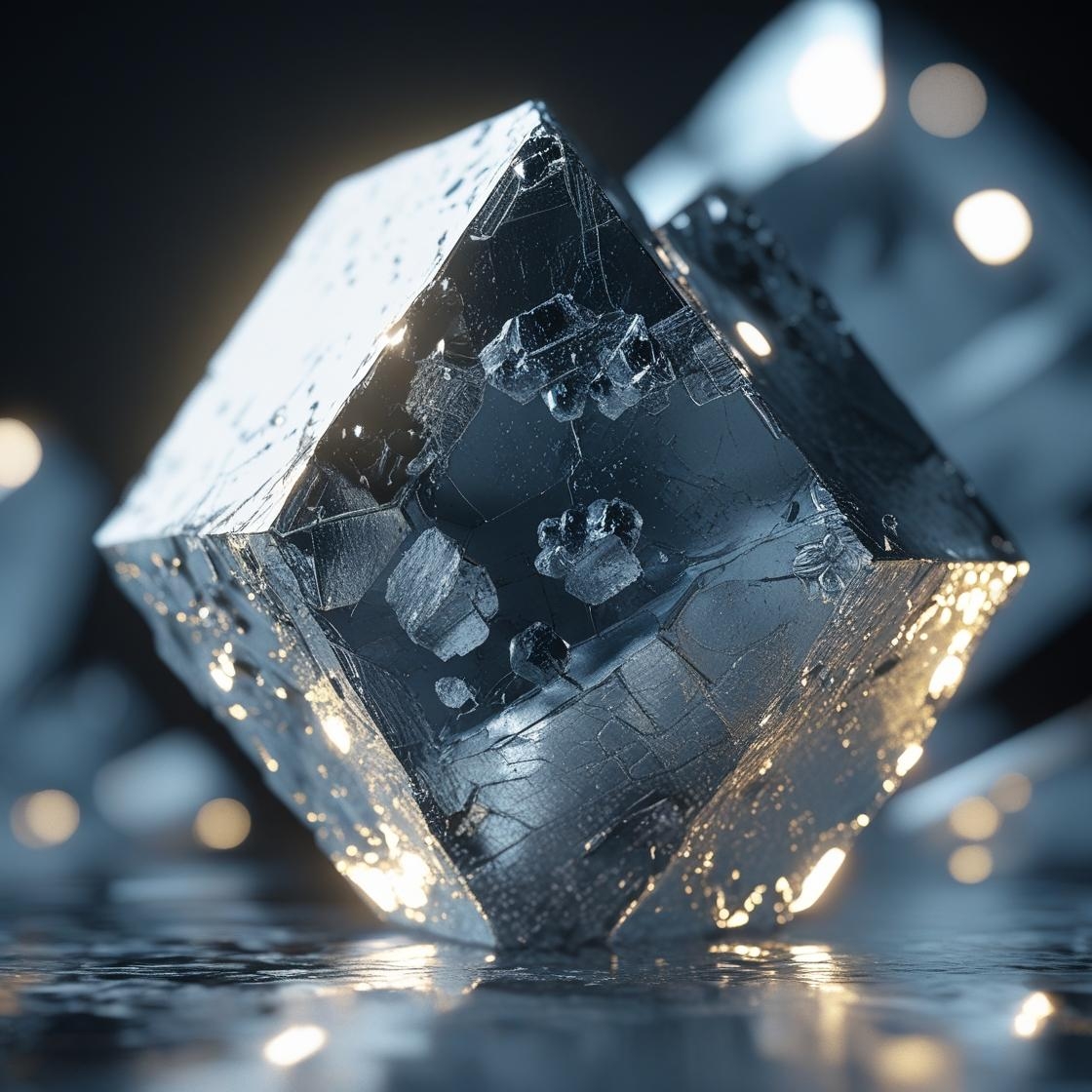
Strontium is a metallic element with atomic number 38 and chemical symbol Sr, belonging to the alkaline earth metals group in the periodic table. It is a soft, silvery-white metal that is easily workable.
Strontium is an alkaline earth metal located in the second group (2A) of the fifth period of the periodic table. Its electron configuration is [Kr]5s², and the presence of two valence electrons in its outermost shell determines its chemical behavior. Strontium tends to lose these two electrons to form a +2 ion (Sr²⁺). This property makes strontium a chemically active metal that typically forms ionic bonds in its compounds. At room temperature, it exists in the solid state and can rapidly oxidize upon contact with air, acquiring a yellowish tint.
Strontium was identified in 1790 by Adair Crawford and William Cruickshank as a new “earth” (oxide) within the mineral strontianite. Metallic strontium was first isolated in 1808 by Sir Humphry Davy through the electrolysis of molten strontium chloride.
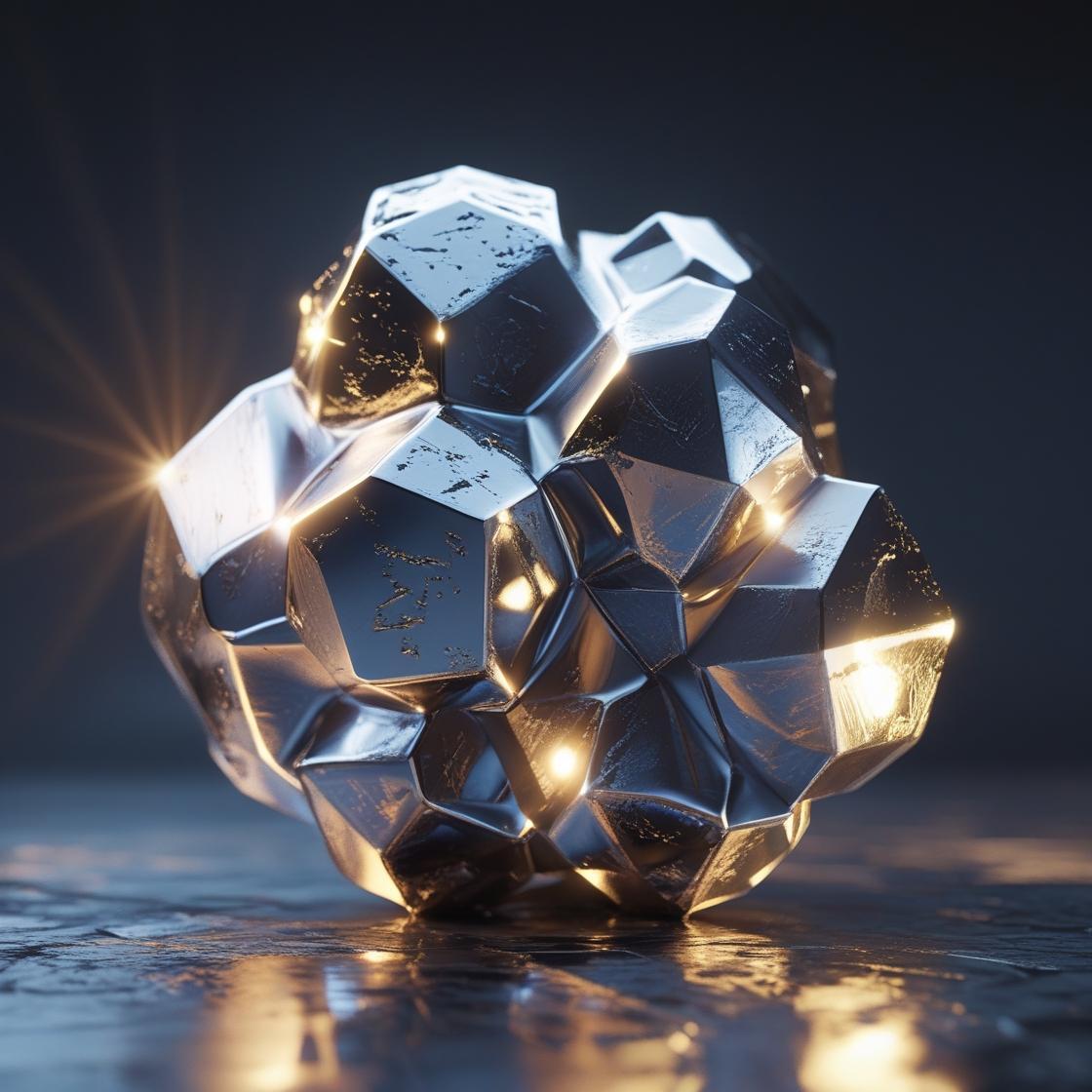
Strontium (Generated by Artificial Intelligence)
The name strontium derives from the village of Strontian in Scotland, where the mineral strontianite was first discovered and from which the element was originally identified. The element is named after this village.
Strontium has an electron configuration of [Kr]5s² and a density of 2.64 g/cm³. Its melting point is 777 °C and its boiling point is 1377 °C. With an atomic radius of 2.49 Å, strontium has an electron affinity of 4.631 kJ/mol and an electronegativity of 0.95 on the Pauling scale. This element is silvery-white with a metallic luster that tends toward yellow and exists in the solid state at room temperature. Chemically highly reactive, strontium oxidizes rapidly upon exposure to air.
It reacts with water to produce strontium hydroxide and hydrogen gas, and also reacts with acids to form strontium salts. Its chemical properties resemble those of calcium and barium.
Strontium is primarily found in the minerals celestine (SrSO₄) and strontianite (SrCO₃). Metallic strontium is typically obtained by the electrolysis of strontium chloride.
The naturally occurring stable isotopes of strontium include ⁸⁶Sr, ⁸⁷Sr and ⁸⁸Sr. In addition, numerous radioactive isotopes have been synthesized artificially. Strontium-90 (⁹⁰Sr) is the most well-known and significant radioactive isotope. It is produced as a byproduct in nuclear reactors and during nuclear explosions. Its half-life is approximately 28 years. It is a strong beta emitter. Due to its chemical similarity to calcium, it can accumulate in bones when ingested, posing health risks.
Strontium and its compounds are used in various fields:
Stable strontium isotopes have not been identified as having a significant biological role in humans and are generally not considered toxic. Due to its chemical similarity to calcium, it can be absorbed by the body, particularly by bones. It has been noted to occur in the shells of some deep-sea organisms and to play a role in certain coral formations.
The isotope strontium-90 (⁹⁰Sr), however, is radioactive and poses health risks. It is found in nuclear waste and can be released into the environment through nuclear power plant accidents or nuclear explosions. Because of its structural similarity to calcium, when ingested it accumulates in bones in place of calcium. This can impair bone marrow function and lead to various health problems, including cancer. Children and young people, whose bone development is still ongoing, are particularly vulnerable to the adverse effects of this isotope.

Classification and Fundamental Properties
Discovery
Etiymology
Physical and Chemical Properties
Natural Occurrence and Extraction
Isotopes
Applications
Biological Role and Effects