


This article was automatically translated from the original Turkish version.
+2 More
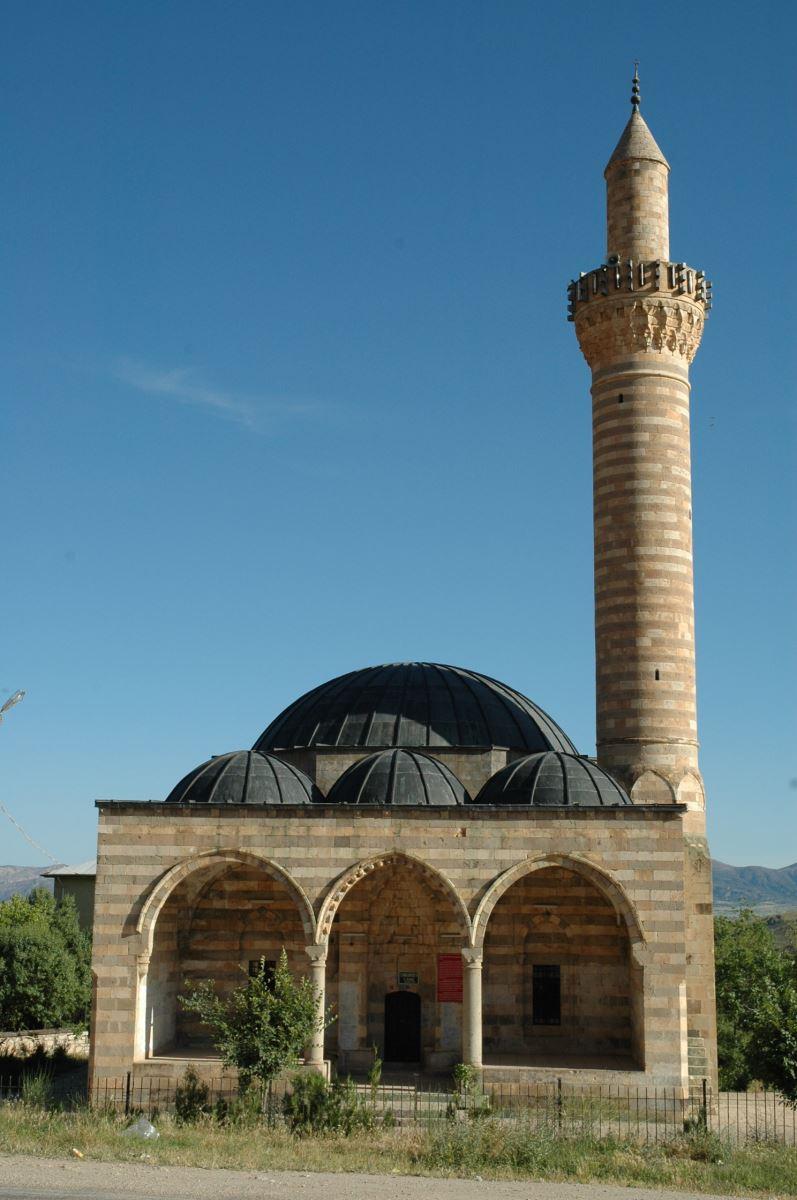
Sungur Bey Camii (Kültürportalı)
Plan(lar) | Square-plan main worship space and three-domed final congregation area | ||||||||
|---|---|---|---|---|---|---|---|---|---|
Material(s) | Two-colored cut stone | ||||||||
Cultural Significance | One of the first mosques in Türkiye preserved by relocation | ||||||||
Usage Status | Open for worship | ||||||||
Relocation | In 1971, all stones were numbered and moved to Pertek center where they were reconstructed | ||||||||
Architectural Elements | Pointed arch windows, stone crowned entrance, stone mihrab, adjacent minaret | ||||||||
Dome | Single large dome placed on an octagonal drum | ||||||||
Patron | Sungur Bey | ||||||||
Year of Construction | 1577 | ||||||||
Location | Pertek district center Tunceli | ||||||||
Sungur Bey Camii is a historic Ottoman mosque originally constructed on the banks of the Murat River within the boundaries of Pertek district, Tunceli Province. Today, it is located in the center of Pertek town. Saved from submersion due to the construction of the Keban Dam, the mosque was relocated and preserved; it is among the oldest and most architecturally significant Islamic structures in the region. It continues to serve both as a place of worship and as a cultural heritage asset.
The mosque was commissioned in the 16th century during a period when the Ottoman administration was strengthening its provincial governance by Sungur Bey, the sanjak bey of Pertek. Sungur Bey was the grandson of the Sufi mystic Pir Hüseyin of Çemişgezek and the son of Rüstem Bey. According to records from the Tunceli Provincial Directorate of Culture and Tourism and the Pertek Subgovernorship, the mosque’s construction year is accepted as 1577. Although no original inscriptive plaque survives, written sources indicate that the mosque was built after the reign of Kanuni Sultan Süleyman.

Sungur Bey Camii (Culture Portal)
Sungur Bey Camii is designed in accordance with classical Ottoman stone mosque architecture. Its plan consists of a square-based main prayer hall and an adjacent three-domed rear prayer area. The main prayer hall is covered by a single large dome resting on an octagonal drum. The use of two-colored stone material is a distinctive feature of the structure. These stones create visual contrast, particularly in the rear prayer area and the minaret, contributing to an aesthetic appearance.
The window openings are designed with columned pointed arches, a common feature in Ottoman architecture. Windows are positioned on the eastern, western, and southern facades, serving both to provide natural illumination and to facilitate air circulation within the interior space.
The main entrance portal is an example of refined stone craftsmanship. The high stone arch surrounding the entrance is adorned with symmetrically arranged surface stones. The mosque’s mihrab, set into the inner wall, features carved stone details and exhibits a simple yet functional form. The minaret, built adjacent to the main structure, follows the classical Ottoman minaret design.

Sungur Bey Camii (Culture Portal)
In the 1970s, the construction of the Keban Dam threatened to submerge the original settlement of Pertek, along with numerous villages and structures in the Murat River basin. Consequently, in a collaborative effort between the General Directorate of Foundations of the Republic of Turkey and the Restoration Department of Middle East Technical University (METU), a decision was made to relocate the mosque to preserve it.
The relocation process, carried out in 1971, was conducted with strict adherence to preserving the building’s integrity. Each stone of the mosque was numbered, carefully dismantled, and then reassembled on a suitable site in the new Pertek town center, following the original design. This project is recorded as one of the first applications in Turkey to save a historic structure through scientific relocation methods.

Sungur Bey Camii (Culture Portal)
After relocation, Sungur Bey Camii was reopened for worship. Today, it is actively used by the people of Pertek for daily prayers, especially for Friday and holiday congregational prayers. The mosque’s architectural uniqueness has been preserved; no modern interventions during the relocation altered its historical character. In publications by the Tunceli Provincial Directorate of Culture and Tourism, the mosque is described as “one of the most original examples of Ottoman-era architecture in the province.” Records from the Culture Portal highlight the mosque’s stone masonry, arch structures, and relocation process as exemplary practices in the preservation of cultural heritage.

Sungur Bey Camii (Culture Portal)
Ministry of Culture and Tourism of the Republic of Turkey. “Sungur Bey Camii.” *Kültür Portalı*, February 26, 2013. Accessed July 15, 2025. https://www.kulturportali.gov.tr/turkiye/tunceli/gezilecekyer/sungur-bey-camii
T.C.Pertek Kaymakamlığı Governorship. "Sungur Bey Camii." Accessed July 15, 2025. http://www.pertek.gov.tr/sungur-bey-camii
T.C.Tunceli İl Directorate of Culture and Tourism. "Cami ve Türbeler." Accessed July 15, 2025. https://tunceli.ktb.gov.tr/TR-57264/cami-ve-turbeler.html
T.C.Tunceli İl Directorate of Culture and Tourism. "Sungurbey Camii." Accessed July 15, 2025. https://tunceli.ktb.gov.tr/TR-57299/sungurbey-camii.html

Sungur Bey Camii (Kültürportalı)
Plan(lar) | Square-plan main worship space and three-domed final congregation area | ||||||||
|---|---|---|---|---|---|---|---|---|---|
Material(s) | Two-colored cut stone | ||||||||
Cultural Significance | One of the first mosques in Türkiye preserved by relocation | ||||||||
Usage Status | Open for worship | ||||||||
Relocation | In 1971, all stones were numbered and moved to Pertek center where they were reconstructed | ||||||||
Architectural Elements | Pointed arch windows, stone crowned entrance, stone mihrab, adjacent minaret | ||||||||
Dome | Single large dome placed on an octagonal drum | ||||||||
Patron | Sungur Bey | ||||||||
Year of Construction | 1577 | ||||||||
Location | Pertek district center Tunceli | ||||||||
No Discussion Added Yet
Start discussion for "Sungur Bey Mosque (Pertek – Tunceli) " article
Historical Background
Architectural Features
Relocation and Reconstruction
Current Status