


This article was automatically translated from the original Turkish version.
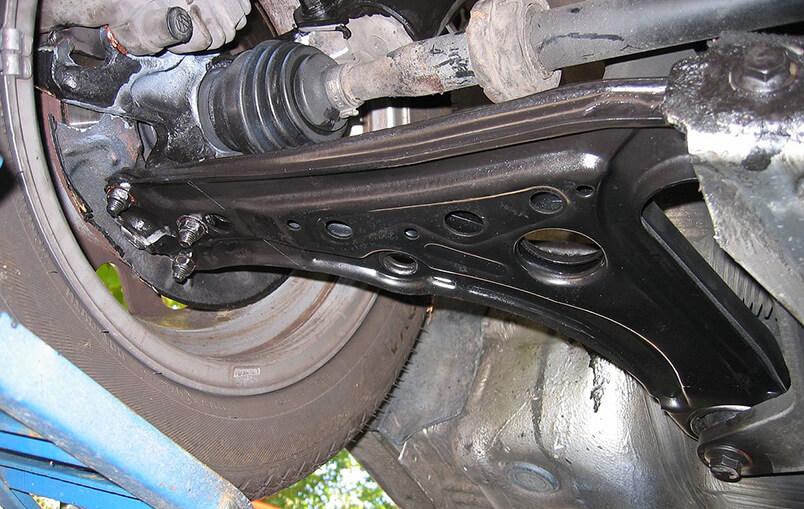
Swings (Upper and Lower Control Arms) Definition
Part Type | Suspension Control Arm | ||||||||
|---|---|---|---|---|---|---|---|---|---|
Varieties | Upper Control Arm, Lower Control Arm | ||||||||
Component(s) | Bearing Bolt Connection Rotor | ||||||||
Function(s) | Wheel Steering and Angle Control | ||||||||
Assembly Location | Between Chassis and Wheel | ||||||||
Control arms, also known as wishbones, are components in vehicle suspension systems that connect the wheels to the chassis and guide their vertical movement. They are divided into upper and lower control arms and are commonly used in double wishbone suspension systems. These elements directly influence handling, ride comfort, and steering control, playing a critical role in maintaining suspension geometry.
Control arms are typically shaped like a triangle (A-arm). One end is fixed to the vehicle frame using ball joints, bushings, and mounting bolts, while the other end connects to the wheel hub carrier.
The lower control arm connects the wheel hub to the chassis from below. It supports the hub and bears the majority of the vehicle’s weight. It is generally larger and more robust than the upper control arm.
The upper control arm connects the top of the wheel hub to the chassis. It balances the wheel’s angle and vertical movement, particularly aiding body control during cornering.
In some modern vehicles, only a lower control arm is present; the upper connection function is handled by a MacPherson strut assembly.
Control arms can be manufactured from forged steel, aluminum alloy, or high-strength sheet metal. Steel variants are durable but heavy. Aluminum alloy versions are lightweight and corrosion-resistant. Components are typically formed using welding, casting, or forging methods.
Bushings made of rubber or polyurethane dampen noise and vibration. Ball joints serve as the movable connection point.
Sports cars and high-performance vehicles commonly feature double wishbone suspension systems. This design maintains optimal tire contact angle during high-speed cornering, ensuring stability. In SUVs and pickup trucks, control arms are designed with thicker, more durable construction to enhance longevity and strength.
Over time, bushings may crack, ball joints may develop play, or control arm arms may bend. These issues manifest as:
During routine inspections, control arm bushings, ball joint play, and mounting bolts should be checked.
Millî Eğitim Bakanlığı (MEGEP). *Süspansiyon Sistemleri*. Ankara: MEB Yayınları, 2013. Accessed June 17, 2025. https://megep.meb.gov.tr/mte_program_modul/moduller_pdf/S%C3%BCspansiyon%20Sistemleri.pdf.
Millî Eğitim Bakanlığı (MEGEP). *Ön Düzen ve Tekerlekler*. Ankara: MEB Yayınları, 2012. Accessed June 17, 2025. https://megep.meb.gov.tr/mte_program_modul/moduller_pdf/%C3%96n%20D%C3%BCzen%20Ve%20Tekerlekler.pdf.

Swings (Upper and Lower Control Arms) Definition
Part Type | Suspension Control Arm | ||||||||
|---|---|---|---|---|---|---|---|---|---|
Varieties | Upper Control Arm, Lower Control Arm | ||||||||
Component(s) | Bearing Bolt Connection Rotor | ||||||||
Function(s) | Wheel Steering and Angle Control | ||||||||
Assembly Location | Between Chassis and Wheel | ||||||||
No Discussion Added Yet
Start discussion for "Swings (Control Levers)" article
Structural Characteristics and Placement
Lower Control Arm
Upper Control Arm
Functions
Materials and Manufacturing
Applications and Performance
Failure Symptoms and Maintenance