

This article was automatically translated from the original Turkish version.
Length(s)(Text) | 10.8 m | ||||||||
|---|---|---|---|---|---|---|---|---|---|
Engine(s) | 12N360 Twin-Turbo Diesel 1.100 kW (1500 hp) | ||||||||
Transmission(s) | 12-speed automatic transmission | ||||||||
Height(s)(Text) | 3.3 m | ||||||||
Width(Text) | 3.5 m | ||||||||
Weight(s)(Text) | 50+ tons | ||||||||
Type(s) | Main Battle Tank | ||||||||
Producer(s) | Uralvagonzavod | ||||||||
Nationality(ies) | Russia | ||||||||
Maximum Speed | 75–80 km/h | ||||||||
Operational Range | 500 km | ||||||||
Suspension System | Hydropneumatic suspension | ||||||||
Other Weapons | 12.7 mm (0.50 in) Kord machine gun (6P49), 7.62 mm (0.30 in) PKTM machine gun (6P7K) | ||||||||
Main Weapon | 2A82-1M 125 mm smoothbore gun with 45-round capacity | ||||||||
Armor | 44S-sv-Sh1000–1100 mm APFSDS, 1200–1400 mm HEAT | ||||||||
Barrel Diameter | 125 mm | ||||||||
Production Quantity | 20+ | ||||||||
Unit Cost | 3.7 million dollars | ||||||||
Design Date | 2009 - 2014 | ||||||||
Designer | Ural Transport Machinery Manufacturing Design Bureau, Uralvagonzavod | ||||||||
Service | 2015 - Present | ||||||||
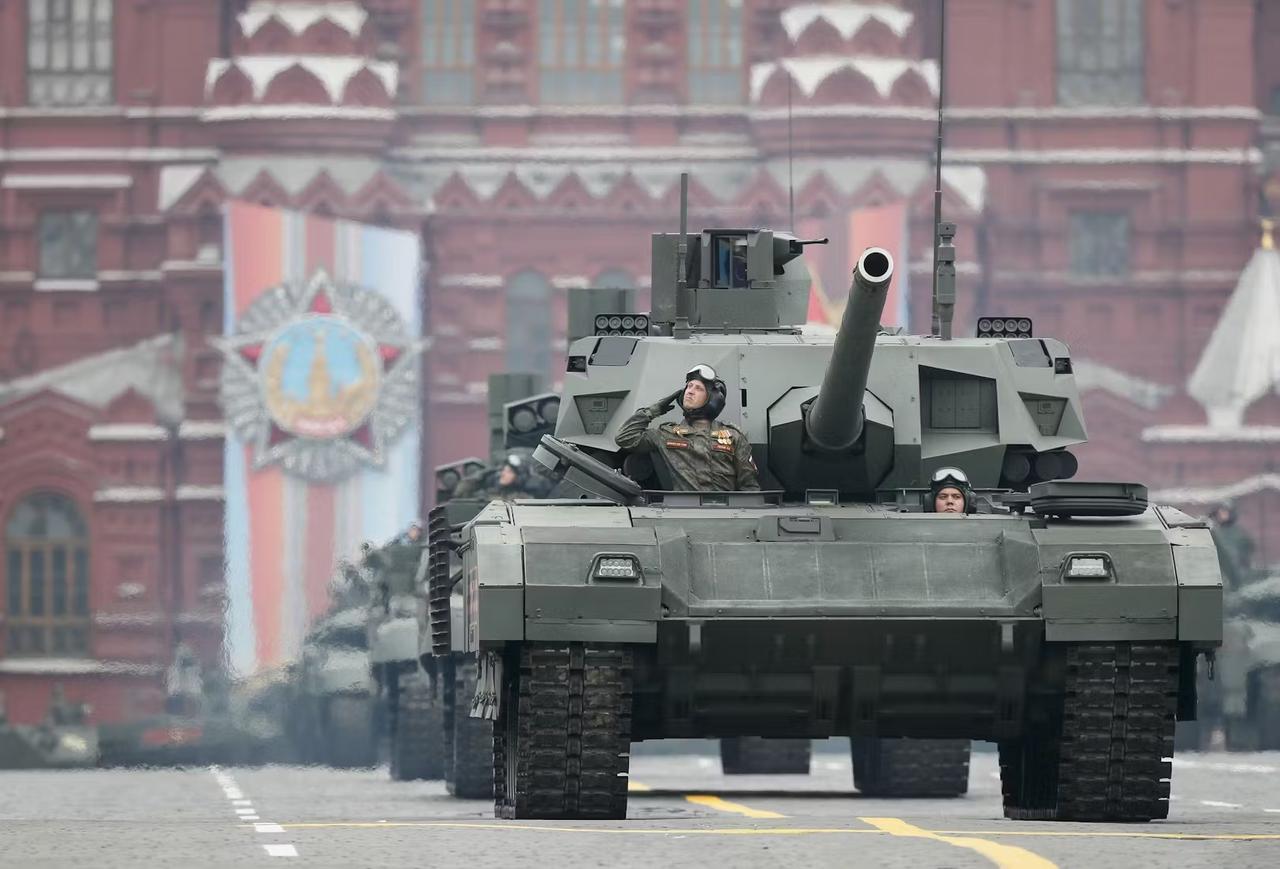
T-14 Armata (industrial designation “Object 148”) is Russia’s next-generation main battle tank developed on the Armata universal tracked platform by UralVagonZavod (UVZ). It was first publicly displayed during the 2015 Victory Day parade. The vehicle incorporates unconventional technical solutions such as an unmanned turret a crew capsule armored within the hull and the Afghanit active protection system (APS).
The Armata program began in the early 2010s as an effort to replace outdated Soviet-era designs with a new platform. Design priorities included crew survivability automation and network connectivity. The program experienced years of delays due to cost industrial capacity and technical challenges resulting in a reduced planned production scale.
The T-14 Armata was developed as Russia’s next-generation main battle tank based on the Armata universal tracked platform. The tank’s most distinctive feature is the placement of the crew inside an armored capsule within the hull and the operation of its weapons via an unmanned turret. This configuration aims to reduce the direct impact of turret damage on the crew while significantly increasing their chances of survival. The protection systems are multilayered combining composite armor modular add-ons explosive reactive armor (ERA) blocks and the Afghanit active protection system (APS) to provide both soft-kill and hard-kill countermeasures. Although the Afghanit system is claimed to have both countermeasure and direct interception capabilities actual combat performance data remains limited.
The T-14’s main armament is a 125 mm smoothbore gun equipped with an autoloader capable of firing a variety of ammunition including gun-launched guided missiles. The fire control system includes modern components such as multispectral sights a laser rangefinder and a ballistic computer. The tank is designed to support networked operations enabling it to share situational awareness and targeting data with digitalized combat units. In terms of mobility and mechanics prototypes have been fitted with modern diesel engines and a seven-roadwheel torsion bar suspension system. Mobility characteristics vary depending on the production variant due to the added weight of protection and system upgrades.
The Armata platform encompasses a broader family beyond the T-14 MBT. This family is built around a universal tracked chassis and includes various types such as heavy infantry fighting vehicles assault guns engineering vehicles and command variants. The T-14 is the main battle tank variant of this family. Other prototypes such as the T-15 heavy IFV demonstrate the adaptability of the Armata chassis for different missions. While all these designs and systems make the T-14 a technologically advanced MBT with high protection levels practical limitations persist due to high cost technical complexity and limited production.

T-14 Armata Sketch Study (Drawing Database)
The Armata concept extends beyond the T-14: the Armata universal tracked platform was designed to standardize logistics and mobility across mechanized forces by accommodating multiple variants including heavy infantry fighting vehicles assault guns engineering vehicles and command variants. The T-14 is the MBT variant; other prototypes such as the T-15 heavy IFV on the same chassis have been exhibited in parades and trials. Widespread adoption of the entire family has remained limited due to industrial and financial constraints.
Russia’s official statements and state media have occasionally indicated that T-14s have entered service and are being used in limited roles. Independent news sources have confirmed the presence of a small number of T-14s in training exercises. According to a report by Reuters the RIA news agency claimed in 2023 that Armata systems were deployed in positions in Ukraine. However large-scale operational deployment has not been verified by extensive visual evidence.
Russia’s initial plans (prior to 2015) envisioned hundreds to thousands of Armata vehicles. Subsequent plans have been revised multiple times. In the mid-2020s senior Russian officials publicly announced that T-14 production targets had been lowered citing cost and industrial limitations and reaffirmed their continued reliance on modernized older tanks such as the T-72B3 and T-90M to meet force requirements. Analysts assess that the Armata platform will continue to be developed and production may gradually increase if costs and supply chain issues are resolved but it is unlikely to rapidly replace existing fleets in the near term. Strategic decisions will depend on industrial recovery export opportunities and the proven combat performance of Armata systems including the Afghanit APS under real battlefield conditions.
Strengths: advanced crew protection concept (armored capsule + unmanned turret) modern sensor and network architecture integrated active protection and potential for commonality across the Armata family.
Limitations: high unit cost and technical complexity low production numbers to date logistical and sustainment demands and uncertainty regarding the combat-proven performance of the APS and electronics in contested electronic warfare environments. Recent reports indicate that Russian planners view the T-14 as a valuable but currently impractical platform for mass deployment when compared to upgraded lower-cost older tanks.
Army Technology. n.d. "T-14 Armata Main Battle Tank," *Army-Technology*. Accessed October 20, 2025. https://www.army-technology.com/projects/t-14-armata-main-battle-tank/.
ArmyRecognition. "Analysis: What is Russian T-14 Armata’s active protection system?" July 10, 2024. https://www.armyrecognition.com/focus-analysis-conflicts/army/analysis-defense-and-security-industry/analysis-what-is-russian-t-14-armatas-active-protection-system.
DrawingDatabase. n.d. “T-14 Armata — Three-View Blueprint & Technical Drawing.” DrawingDatabase. Accessed October 20, 2025. https://drawingdatabase.com/t-14-armata/.
Gady, Franz-Stefan. 2018. “Russia Will Not Mass-Produce T-14 Armata Main Battle Tank.” *The Diplomat*, August 1, 2018. https://thediplomat.com/2018/08/russia-will-not-mass-produce-t-14-armata-main-battle-tank/.
Palman, Roman. 2023. “Putin wirft jetzt seinen 'Super-Panzer' in die Schlacht” [Putin Now Deploys His ‘Super Tank’ into Battle]. *Heute.at*, April 27, 2023. https://www.heute.at/s/ukraine-krieg-putin-wirft-super-panzer-t14-armata-in-schlacht-100268225.
Reuters. 2023. “Russia’s New T-14 Armata Battle Tank Debuts in Ukraine.” *Reuters*, April 25, 2023. https://www.reuters.com/world/europe/russias-new-t-14-armata-battle-tank-debuts-ukraine-ria-2023-04-25/.
“T-14 Armata.” n.d. *Tank-AFV*. Accessed October 24, 2025. https://tank-afv.com/modern/Russia/T-14-armata.php.

Length(s)(Text) | 10.8 m | ||||||||
|---|---|---|---|---|---|---|---|---|---|
Engine(s) | 12N360 Twin-Turbo Diesel 1.100 kW (1500 hp) | ||||||||
Transmission(s) | 12-speed automatic transmission | ||||||||
Height(s)(Text) | 3.3 m | ||||||||
Width(Text) | 3.5 m | ||||||||
Weight(s)(Text) | 50+ tons | ||||||||
Type(s) | Main Battle Tank | ||||||||
Producer(s) | Uralvagonzavod | ||||||||
Nationality(ies) | Russia | ||||||||
Maximum Speed | 75–80 km/h | ||||||||
Operational Range | 500 km | ||||||||
Suspension System | Hydropneumatic suspension | ||||||||
Other Weapons | 12.7 mm (0.50 in) Kord machine gun (6P49), 7.62 mm (0.30 in) PKTM machine gun (6P7K) | ||||||||
Main Weapon | 2A82-1M 125 mm smoothbore gun with 45-round capacity | ||||||||
Armor | 44S-sv-Sh1000–1100 mm APFSDS, 1200–1400 mm HEAT | ||||||||
Barrel Diameter | 125 mm | ||||||||
Production Quantity | 20+ | ||||||||
Unit Cost | 3.7 million dollars | ||||||||
Design Date | 2009 - 2014 | ||||||||
Designer | Ural Transport Machinery Manufacturing Design Bureau, Uralvagonzavod | ||||||||
Service | 2015 - Present | ||||||||
Development History
Technical Structure
Variants
Operational History and Combat Reports
Production and Deployment
Representative Technical Data