


This article was automatically translated from the original Turkish version.
+1 More
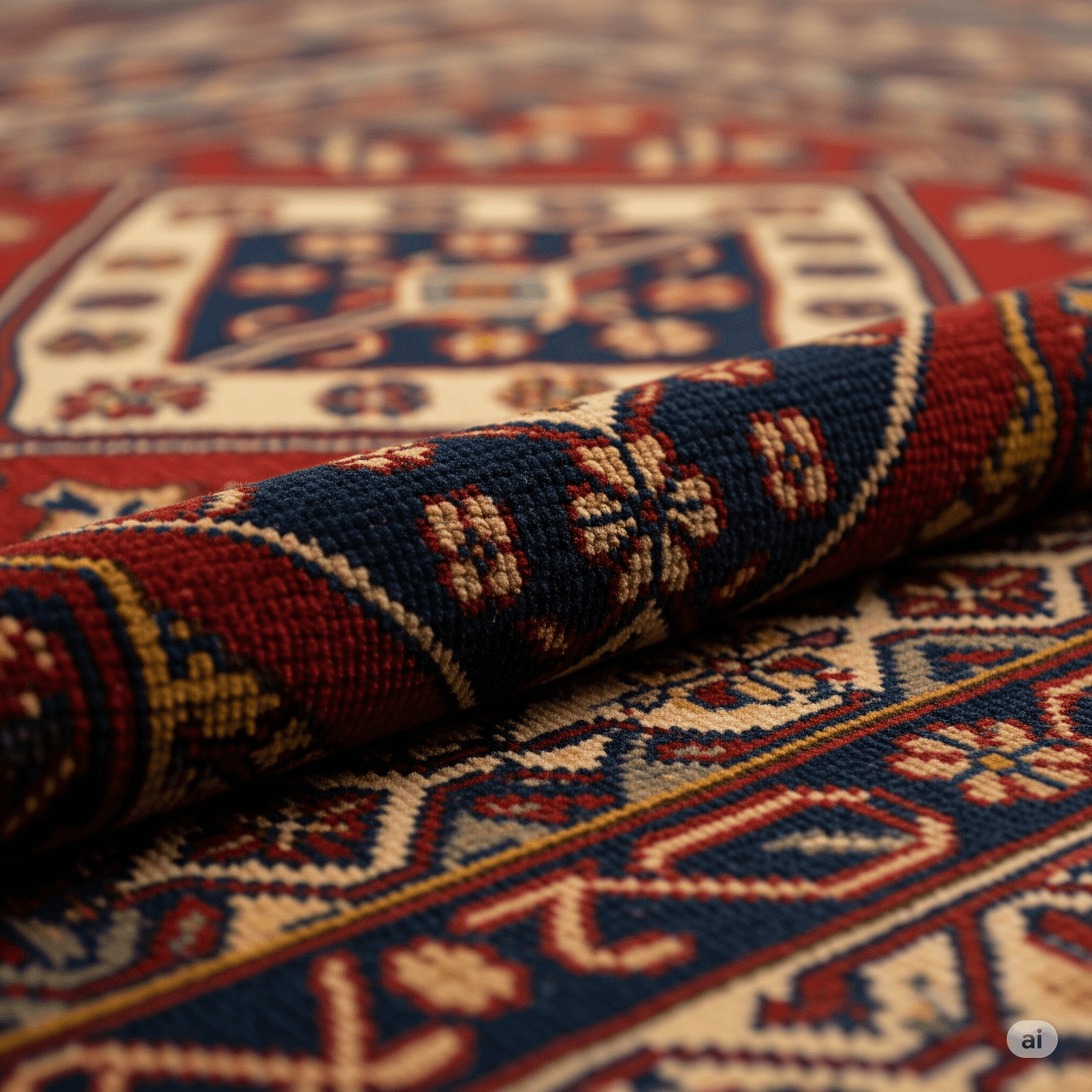
Taşkale Carpet
Type of Geographical İndication | Mahreç Sign | ||||||||
|---|---|---|---|---|---|---|---|---|---|
Application Date | 6 September 2022 | ||||||||
Registration Number | 1332 | ||||||||
Registration Date | 30 January 2023 | ||||||||
Product / Product Group(s) | Rugs and kilims | ||||||||
Applicant/Registrant(s) | Karaman Provincial Directorate of Culture and Tourism | ||||||||
Production Characteristics | Back burning process Surface shaving process Kirkitleme process Hav kırkımı process Weaving on wooden or metal looms Natural dyeing Local wool sourcing | ||||||||
Taşkale carpet is a fringed carpet type woven in Taşkale Village, located in the central district of Karaman Province, made entirely from sheep’s wool. Known also as “Kızıllar,” its history extends back to the 17th and 18th centuries, originating when a group from the Kızıllar tribe, migrating from Central Asia, settled in Taşkale Village and began weaving this carpet.
The carpet is woven using the double knot technique known as the Gördes (Turkish) knot. It has an average of 16 knots per square centimeter and a pile height of 6–8 mm. This technique ensures a long lifespan for the carpet. Wool from Karaman-breed sheep, sheared on 15 May, is used; it is twisted with a spindle or kirman and dyed using natural methods. Carpets typically woven as kilims, prayer rugs, or runners are produced in pairs to be laid out as matching sets.
Taşkale carpets are woven on traditional wooden looms specific to the region. Compression is applied every two to three rows to secure the knots firmly. Pile trimming is carried out sequentially with scissors. After weaving, the surface is trimmed, the back is brushed, the knot count is verified, measurements are taken, the carpet is washed, and stretched. The fringe length ranges from 10 to 15 cm and is woven using the knotting technique.
The most commonly used color in Taşkale carpets is a deep brown tone close to what is called “tetir.” This color is derived from walnut shells. A beige color obtained by boiling walnut leaves is also frequently used. In the 19th century, the dominant ground color was red, later succeeded by navy blue. Red symbolizes richness, happiness, and joy; green represents paradise; blue signifies nobility and grandeur; yellow stands for protection from evil; and black denotes liberation from worldly troubles.
Brown and gray tones are also intensively used alongside other colors. Red is obtained from the roots of madder plants (Rubia tinctorum), especially those dug up in autumn. Red and navy blue serve as the primary colors, complemented by motifs in white, black, green, yellow, and blue. In the 20th century, the dominance of red diminished, and multi-colored contrasts began to be introduced. To prevent color variations (abrazh errors) during dyeing, more yarn than required is prepared. Wool can also be used without dyeing.
In the dyeing process, dyes that are difficult to dissolve are soaked in water for at least one day. The dye bath volume is adjusted to 30 to 40 liters per kilogram of wool. Five to ten grams of alum are added to the water along with plant leaves or fruits, and the mixture is gently heated. Once the water begins to warm, the yarn is placed in the pot and heated over low flame for approximately 40 to 50 minutes—sufficient time for the dye to fully penetrate the fibers. A handful of ash (to darken the color), 10 grams of alum (to fix the color), or 5 to 7 grams of lemon salt (to reduce dullness and enhance color brilliance) may be added to the bath. Frequent stirring and turning of the yarn during the dye bath are essential to prevent color streaking (abrazh). After removal from the dye bath, the yarn is left to rest in a pot containing a handful of ash. Once the desired shade is achieved, the yarn is removed, rinsed thoroughly with water, and dried in a shaded area.

Taşkale Carpet (Türkiye Culture Portal)
In Taşkale carpets, stylized botanical and figural ornaments are presented in a mixed style. The ground and border are considered holistically. Sharp contrasts in color or line are employed, avoiding Western perspective. The primary colors are red and navy blue, with other colors applied in a non-naturalistic, untoned manner. Taşkale carpets are classified into three main compositional groups:
More than 40 motifs are used in Taşkale carpets, grouped into two main categories:

Production of Taşkale Carpet (Anadolu Agency)
After weaving is completed, surface trimming and back brushing are carried out in sequence. The brushing process, performed with a pürmüz tool, prevents yarn imperfections from compromising carpet quality and facilitates use. Subsequently, knot count per square meter and length-width measurements are taken for quality control, followed by washing.
The washing process is conducted on large surfaces using pool water, typically with traditional Arabic soap and brushing. After thorough rinsing, the carpet is hung upside down in a shaded area to dry. Following washing, if dimensional discrepancies are detected, the carpet is stretched on the loom. Stretching is performed by first pulling the carpet along its width and then its length on a pegged loom to correct measurement inconsistencies. The fringe length of Taşkale carpets ranges from approximately 10 to 15 cm. Once the fringe is woven using the knotting technique, the carpet is ready for sale. When intended for a dowry chest, the carpet is wrapped in a fabric cover and accompanied by walnut leaves for preservation.
The Taşkale carpet holds an important place in the economy and culture of Taşkale Village. It is included in dowry chests and presented as gifts to mosques, leading to the formation of carpet collections in local mosques. Among the valuable gifts sent by Karamanoğlu Mehmetbey to congratulate Ottoman Sultan I. Murat on his Balkan victories was a Taşkale carpet.
The Taşkale carpet is a traditional product officially registered with geographical indication status by the Turkish Patent and Trademark Office. This designation requires that production occur exclusively within a specific geographical area—namely, Taşkale Village in Karaman—and that the transmission of local knowledge, skills, and cultural heritage be preserved.
Oversight procedures are coordinated by the Karaman Provincial Directorate of Culture and Tourism. The inspection body consists of one official from this directorate, one expert from the Faculty of Art, Design and Architecture at Karamanoğlu Mehmetbey University, and a representative from the Karaman Provincial Directorate of National Education. Inspections are conducted at least once annually; additional inspections may be carried out as needed or upon complaint. Inspection reports are submitted annually to the Turkish Patent and Trademark Office.
The scope of oversight includes all stages of production, marketing, and sales. Key control criteria are as follows:
This system aims to preserve the identity, quality, and authenticity of the product, ensuring the sustainable continuation of the Taşkale carpet’s traditional character.
Anadolu Ajansı. “Unutulmaya Yüz Tutmuş Taşkale Halısı İçin Kadınlar Yeniden Tezgâh Başında.” Accessed July 17, 2025. https://www.aa.com.tr/tr/yasam/unutulmaya-yuz-tutmus-taskale-halisi-icin-kadinlar-yeniden-tezgah-basinda/3342049
T.C. Ministry of Culture and Tourism. "Taşkale Halısı - Karaman." Türkiye Kültür Portalı. Accessed July 17, 2025. https://www.kulturportali.gov.tr/turkiye/karaman/nealinir/taskale-halisi
Turk Patent and Trademark Office. "Taşkale Halısı Coğrafi İşaret Tescil Belgesi." *Coğrafi İşaretler Portalı.* Accessed July 17, 2025. https://ci.turkpatent.gov.tr/Files/GeographicalSigns/6dbd1456-da7e-4f8f-a10a-abcec63aa62e.pdf
Turk Patent and Trademark Office. "Taşkale Halısı." Geographical Indications Portal. Accessed July 17, 2025. https://ci.turkpatent.gov.tr/cografi-isaretler/detay/7443
Taşkale Carpet
Type of Geographical İndication | Mahreç Sign | ||||||||
|---|---|---|---|---|---|---|---|---|---|
Application Date | 6 September 2022 | ||||||||
Registration Number | 1332 | ||||||||
Registration Date | 30 January 2023 | ||||||||
Product / Product Group(s) | Rugs and kilims | ||||||||
Applicant/Registrant(s) | Karaman Provincial Directorate of Culture and Tourism | ||||||||
Production Characteristics | Back burning process Surface shaving process Kirkitleme process Hav kırkımı process Weaving on wooden or metal looms Natural dyeing Local wool sourcing | ||||||||
Distinctive Features and Production Method
Color Character
Dyeing Process
Composition and Motif Groups
Key Motifs and Their Meanings
Post-Weaving Processes
Cultural and Economic Significance
Geographical Indication and Oversight