

This article was automatically translated from the original Turkish version.
+1 More
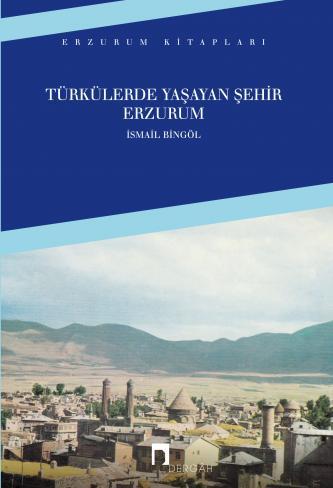
"The City Alive in Folk Songs: Erzurum" is an essay and research book written by İsmail Bingöl and published as part of Dergâh Publications' "Erzurum Library" series. It explores Erzurum’s cultural identity, its people, its architecture, and its language through folk songs. In the face of the city’s changing face, the work reflects a deep love for Erzurum and a sense of cultural responsibility, described as "the writings of a sensitive and loyal pen." First published in 1999, the book comprises 345 pages and reached its second edition as of April 2018.
The work titled "The City Alive in Folk Songs: Erzurum" brings a new dimension to recent studies on urban identity by examining Erzurum through a unique approach. According to the author, the book is the product of a sensitive and loyal pen written "in the face of the city’s decay and disappearance." In this study, İsmail Bingöl, as "a lover of Erzurum who commits what remains in words to writing," strives to keep alive the city’s culture, people, architecture, and language. His aim is to inscribe this historic city, its people, institutions, and living culture into history.
The central theme of the book is how Erzurum’s spirit and identity are lived through its folk songs. Folk songs are important cultural texts that carry a city’s social memory, emotional world, historical events, daily life, and human relationships. İsmail Bingöl uses Erzurum folk songs as documents to decode the city’s socio-cultural fabric. This is not merely a musical analysis but an effort to uncover the hidden layers of meaning within the lyrics of these songs, thereby understanding Erzurum’s unique way of life, the emotions and thoughts of its people, and the characteristics of the "dadaş" identity.
The book offers İsmail Bingöl’s responses to those seeking to understand Erzurum and its people, particularly those searching for the meaning of the "dadaş" identity. In addition to folk songs, the book examines Erzurum’s geography, character types, social structure, architectural features, and local linguistic usage—all connected to the folk songs. Thus, it demonstrates how an organic bond between the city and its songs emerged and how each nourished the other. Through this work, Bingöl emphasizes that urban identity is not constructed solely through tangible elements but also through oral cultural products preserved in the collective memory of the people.
The language and style of İsmail Bingöl’s work "The City Alive in Folk Songs: Erzurum" reflect an intimate, fluid tone infused with deep attachment to the city. The author skillfully blends his academic knowledge with an accessible, literary narrative. The text presents Erzurum’s cultural richness in a neutral and descriptive manner while also incorporating the author’s personal observations and emotional connection. There is no trace of advertising or praise; instead, the book aims to treat the local heritage with a scholarly and loyal approach.
İsmail Bingöl is a researcher and writer known for his studies on Erzurum’s cultural and folkloric values. Through this work, he has made a significant contribution by highlighting the role of local music and oral culture in shaping urban identity.
"The City Alive in Folk Songs: Erzurum" holds great importance as an original study demonstrating how a city’s identity can be read through folk songs. The book is a valuable resource not only for Erzurum but also for students, academics, and general readers engaged in urban identity research, oral culture, folklore, and the sociology of literature. It offers a distinct perspective on how abstract cultural heritage, alongside tangible heritage, shapes the identities of cities and communities.

No Discussion Added Yet
Start discussion for "The City Alive in Folk Songs: Erzurum (Book)" article
Content and Thematic Structure
Language and Style
The Author’s Position and the Work’s Significance