


This article was automatically translated from the original Turkish version.
The Class of Hababam Awakens (Film)
Director(s) | Ertem Eğilmez | ||||||||
|---|---|---|---|---|---|---|---|---|---|
Screenwriter(s) | Sadık Şendil (Original idea: Rıfat Ilgaz) | ||||||||
Lead Roles | Münir Özkul (Mahmut Hoca), Kemal Sunal (İnek Şaban), Şener Şen (Badi Ekrem), Halit Akçatepe (Güdük Necmi), Adile Naşit (Hafize Ana), Ahmet Sezerel (Çalışkan Ahmet) | ||||||||
Production Year | 1976 | ||||||||
Duration | 1 hour 34 minutes | ||||||||
IMDb Rating | 8.7/10 | ||||||||
Genre | Dramatic Comedy | ||||||||
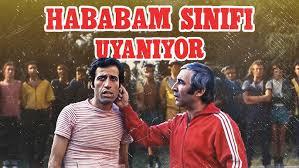
Hababam Sınıfı Uyanıyor, is the third film in the cult Turkish cinema series Hababam Sınıfı, released in 1977. Directed by Ertem Eğilmez and based on the novel of the same name by Rıfat Ilgaz, the screenplay was written by Sadık Şendil. Produced and distributed by Arzu Film, the movie brings together legendary figures of Turkish cinema including Münir Özkul, Kemal Sunal, Şener Şen, Halit Akçatepe, Adile Naşit, and newcomer Ahmet Sezerel. Set at Özel Çamlıca Lisesi, the story follows new student Ahmet as he encounters the Hababam Class and explores the tension between education and mischief. The film premiered in Türkiye in 1977 and has since secured its place in Turkish cinema history as one of the most beloved entries in the series.
Hababam Sınıfı Uyanıyor continues the adventures of the mischievous students of Özel Çamlıca Lisesi with the arrival of a new student, Ahmet (Ahmet Sezerel). Orphaned after his father’s death, Ahmet is the son of an old friend of Mahmut Hoca (Münir Özkul) and comes to school with his support to complete his education. A diligent and disciplined student, Ahmet struggles when confronted by the mocking and unruly behavior of the Hababam Class. His classmates assume he is a “nerd” and tease him, but over time Ahmet gradually adapts to this chaotic environment. The film humorously and emotionally portrays the clash between Ahmet’s belief in the value of education and the Hababam Class’s playful yet disruptive energy. Themes of education, friendship, and personal growth form the core of the narrative.
Hababam Sınıfı Uyanıyor Film (Arzu Film)
Hababam Sınıfı Uyanıyor was filmed in Istanbul in 1976. The screenplay, written by Sadık Şendil and inspired by Rıfat Ilgaz’s novel, offers a more original story compared to the earlier films in the series. Produced and directed by Ertem Eğilmez under the production approach of Arzu Film, the movie achieved a strong balance of humor and emotion despite its low budget. Most of the filming took place at Adile Sultan Kasrı and various schools across Istanbul, authentically capturing the atmosphere of 1970s Turkish high schools. Cinematographer Hüseyin Özşahin’s use of natural light and colorful imagery supports the film’s cheerful tone. The music is composed by Melih Kibar, and the “Hababam Sınıfı March,” an iconic element of the series, is also featured in this film.
Education and Diligence: The film emphasizes the importance of education through Ahmet’s determination to study. The contrast between Ahmet’s disciplined nature and the Hababam Class’s mischief humorously questions both the shortcomings and potential of the education system.
Friendship and Adaptation: Ahmet’s initial conflict with the Hababam Class and his eventual integration highlight themes of friendship and solidarity. Though the class’s teasing initially appears cruel, it gradually transforms into acceptance and loyalty.
Emotional Depth and Loss: The death of Ahmet’s father and his resulting orphanhood add emotional depth to the film. Mahmut Hoca’s paternal demeanor provides Ahmet with a sense of family, offering viewers poignant and touching moments.
Hababam Sınıfı Uyanıyor premiered in Türkiye in 1977 and attracted significant audience interest from its initial screenings. With approximately 1.8 million viewers at the box office, it became one of the most-watched films in the series. Critics generally praised the film, particularly Ahmet Sezerel’s sincere performance as Çalışkan Ahmet, the comedic chemistry between Kemal Sunal and Şener Şen, and the film’s emotional moments. However, some critics noted that the story was less innovative compared to the first two films. Over time, the film has become a classic of Turkish cinema, leaving a lasting mark on popular culture through its memorable lines and scenes. It continues to reach wide audiences on television and digital platforms.
Hababam Sınıfı Uyanıyor did not win any official awards in 1977, but it has been widely recognized by Turkish cinema audiences as one of the most beloved comedy films. It was screened at the 14th Antalya Golden Orange Film Festival (1977) but did not receive an award. The film has been honored in various retrospectives and commemorative events for its contributions to Turkish cinema history.
Arzu Film. "Hababam Sınıfı Uyanıyor." Arzu Film Youtube Kanalı. Accessed May 2, 2025. https://www.youtube.com/watch?v=4rAnNKCxlnc.
Beyazperde. "Hababam Sınıfı Uyanıyor." Accessed May 2, 2025. https://www.beyazperde.com/filmler/film-186610/.
IMDb. "Hababam Sınıfı Uyanıyor." Accessed May 2, 2025. https://www.imdb.com/title/tt0252490/?ref_=ls_t_8.
Sinemalar.com. "Hababam Sınıfı Uyanıyor." Accessed May 2, 2025. https://www.sinemalar.com/film/813/hababam-sinifi-uyaniyor.
The Class of Hababam Awakens (Film)
Director(s) | Ertem Eğilmez | ||||||||
|---|---|---|---|---|---|---|---|---|---|
Screenwriter(s) | Sadık Şendil (Original idea: Rıfat Ilgaz) | ||||||||
Lead Roles | Münir Özkul (Mahmut Hoca), Kemal Sunal (İnek Şaban), Şener Şen (Badi Ekrem), Halit Akçatepe (Güdük Necmi), Adile Naşit (Hafize Ana), Ahmet Sezerel (Çalışkan Ahmet) | ||||||||
Production Year | 1976 | ||||||||
Duration | 1 hour 34 minutes | ||||||||
IMDb Rating | 8.7/10 | ||||||||
Genre | Dramatic Comedy | ||||||||
No Discussion Added Yet
Start discussion for "The Class of Hababam Awakens (Film)" article
Plot
Cast
Production
Thematic Structure
Release and Reception
Awards and Nominations