


This article was automatically translated from the original Turkish version.
+2 More
The Advocate of the Devil (Latin: Advocatus Diaboli) is the popular name for the legal office within the Catholic Church’s canonization process, officially known as the Promotor Fidei (Promoter of the Faith). The primary function of this office is to systematically raise objections against candidates proposed for sainthood in order to safeguard the integrity of Church law and doctrine. The Promotor Fidei investigates flaws in the candidate’s life, seeks natural or medical explanations for alleged miracles, and ensures the procedural compliance with canonical norms. Over time, the term has detached from its theological origins and evolved into a secular concept used in law, philosophy, and the social sciences to describe the deliberate generation of counterarguments to test the validity of an argument, decision, or theory.
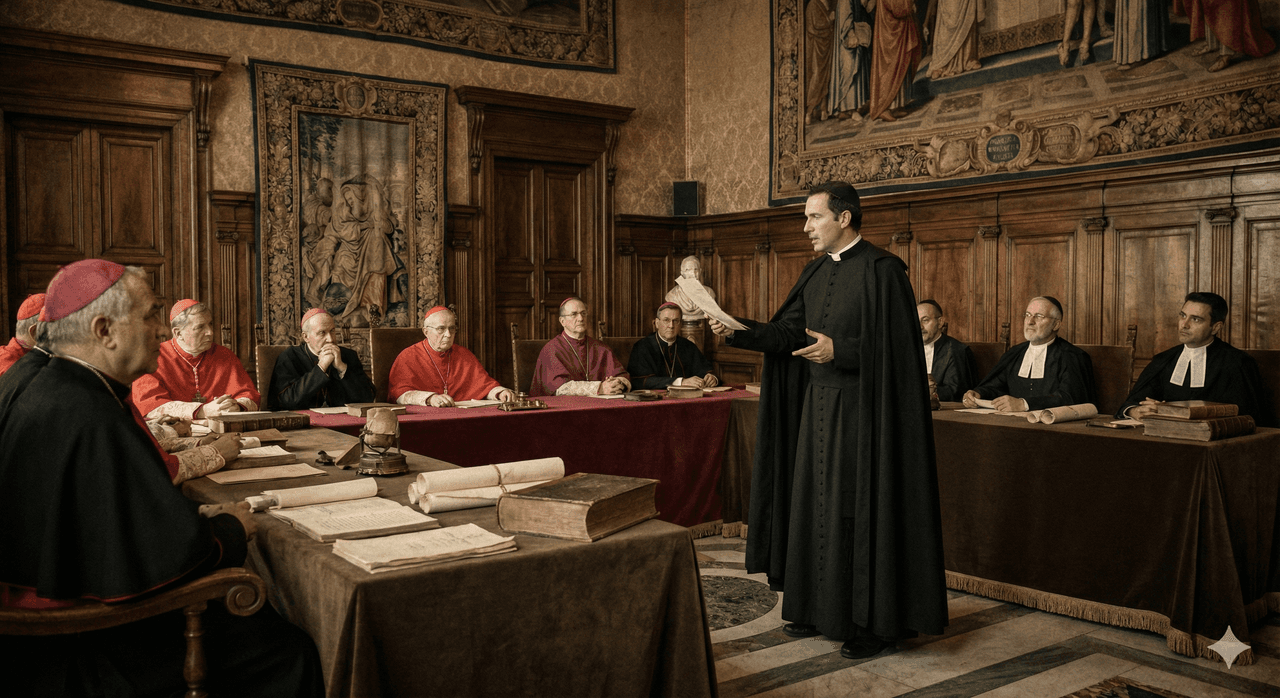
A Canonization Hearing in the Vatican (Generated by Artificial Intelligence)
The office traces its origins to the Promotor Fiscalis (Legal or Financial Promoter), an official tasked with safeguarding the public interest in ecclesiastical courts. During the 13th century, under Pope Innocent III, judicial procedures shifted from an accusatorial system to an inquisitorial one, necessitating an independent official to represent the prosecution and preserve judicial impartiality. This figure gradually became the defender of the Church’s interests in canonization cases.
The office acquired its permanent and formal status during the papacy of Urban VIII (1623–1644). In 1631, Antonio Cerri was appointed the first permanent Promotor Fidei, and the office’s authority was expanded. The reforms of this period transformed the canonization process into a rigid “contentious trial” format, in which a dialectical debate unfolds between the Postulator (Advocate of God), who defends the candidate, and the Promotor Fidei (Advocate of the Devil), who opposes it.
The duties of the office were most comprehensively codified in the 1917 Code of Canon Law (Codex Iuris Canonici). According to the Code, the Promotor Fidei’s responsibilities include:
The process underwent fundamental change with Pope John Paul II’s 1983 apostolic constitution Divinus Perfectionis Magister. The adversarial judicial model was replaced by an “academic review” model grounded in historical-critical methodology. With these reforms:
The historical function of the Advocate of the Devil is based on the contradictorium principle, which holds that truth emerges only through the clash of thesis and antithesis.
The process involves three key elements: the accusing party (Postulator), the opposing party (Promotor Fidei), and the impartial judge. The Promotor Fidei is not a passive observer but an active participant who may summon witnesses and request additional documentation.
When examining miracle claims—typically unexplained healings—the Promotor Fidei collaborates with medical experts and scientists. The goal is not to determine whether an event is supernatural, but whether it can be explained by natural causes. For instance, pioneers in forensic medicine such as Paolo Zacchia in the 17th century guided the Promotor Fidei by analyzing natural decomposition processes, mummification techniques, and environmental factors in cases of bodily incorruption.
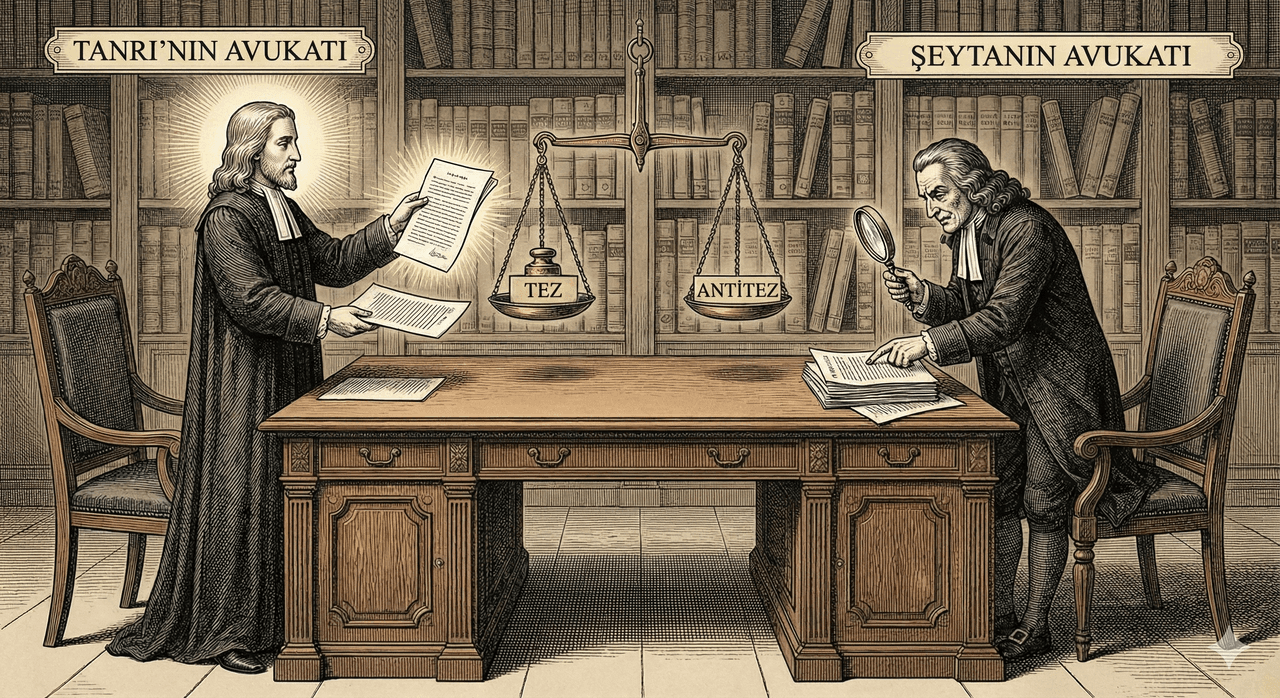
Clash of Thesis and Antithesis (Generated by Artificial Intelligence)
Having detached from its theological roots, the concept has become a critical method in modern systems of thought.
In social psychology, the Advocate of the Devil is a technique used to break group conformity and prevent the error of “groupthink.”
In the philosophy of religion, the Advocate of the Devil method is used to test the logical consistency of theistic arguments. For example, arguments for God’s existence such as the Design Argument or the Ontological Argument are examined to determine whether they could equally support the existence of an absolute evil being (“Antigod”). If an argument can be used with equal logical force to prove both God and His exact opposite, this demonstrates the argument’s inadequacy in establishing God’s specific attribute of goodness.


No Discussion Added Yet
Start discussion for "The Devil's Advocate" article
Historical Development and Institutional Structure
Origins and the “Promotor Fiscalis” (13th–16th Century)
Institutionalization and the Reforms of Urban VIII (17th Century)
The 1917 Code of Canon Law
1983 Reforms and Structural Transformation
Functional Methodology: The Contradictorium Principle
Judicial Procedure
Medical and Scientific Examination
Modern and Secular Applications
Social Psychology and Organizational Behavior
Philosophy and Logic