


This article was automatically translated from the original Turkish version.
Name of the Theory | The Social Construction of Reality | ||||||||
|---|---|---|---|---|---|---|---|---|---|
Founders | Thomas Luckmann Peter L. Berger | ||||||||
Key Work | The Social Construction of Reality (1966) | ||||||||
Core Processes of the Theory | Internalization Objectification Externalization | ||||||||
The Social Construction of Reality is a sociological theory that posits society as both an objective phenomenon and a continuous creation shaped by individuals through the subjective meanings they assign to their actions. This approach was systematized in the 1966 work The Social Construction of Reality: A Treatise in the Sociology of Knowledge by Peter L. Berger and Thomas Luckmann, which frames the relationship between the individual and society as a dialectical process. The theory’s central thesis is summarized in three propositions:
"Society is a human product. Society is an objective reality. Man is a social product"【1】.
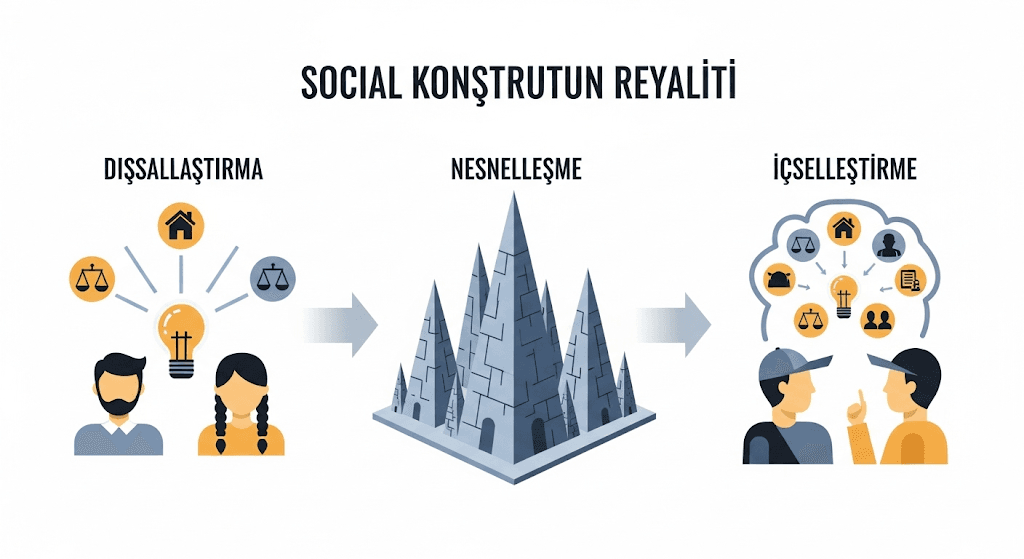
Within this framework, the theory aims to explain how individuals create the social world through their actions (externalization), how this world acquires an objective reality independent of its creators (objectivation), and how this objective reality is internalized by individuals to become part of their own consciousness (internalization).

Social Reality Is a Human Creation (Generated by Artificial Intelligence)
The social construction of reality refers to the process by which knowledge and phenomena accepted as reality are collectively produced and sustained through interactions among individuals and groups. According to this approach, "reality" is not an absolute, independent entity but rather a construction that acquires meaning within the shared perceptions and everyday practices of a particular society. Placing the sociology of knowledge at its core, this theory identifies the central question as: "How can subjective meanings become objective facts?"【2】 Products emerging from individual interactions gradually become institutionalized, appearing to individuals as an external, coercive reality that is transmitted to subsequent generations through socialization.
The theory of the social construction of reality emerged in the 1960s as an effort to synthesize two major traditions in sociology. The first is the objectivist approach of Émile Durkheim, who treated social facts as "things." The second is the interpretive (subjectivist) tradition of Max Weber, which focused on the "subjective meaning" of action【3】. Berger and Luckmann sought to demonstrate that these two approaches were not contradictory but complementary, arguing that society rests simultaneously on objective regularities and subjective meanings.
The most decisive influence on this synthesis came from Alfred Schutz’s phenomenological sociology. Berger and Luckmann grounded their theory in Schutz’s analyses of the intersubjective world of everyday life, typifications, and the "taken-for-granted" reality. Other key intellectual origins of the theory include:
Berger and Luckmann explain the social construction of reality through three dialectical moments: externalization, objectivation, and internalization. These processes operate simultaneously and complement one another.
Externalization is the process by which human beings, through their physical and mental activities, act upon the world and create meanings and products. According to Berger and Luckmann, humans are biologically "unfinished" beings, open to the world. Their underdeveloped instinctual equipment compels them to construct their environment and, consequently, their own nature in order to survive and establish order. This process of production is always a social endeavor. People collectively create order by turning actions into habits (habitualization) and mutually typifying these habits. This process demonstrates that social order is a human creation and is continuously produced through ongoing externalization.
Objectivation is the process by which human products, once externalized, acquire the character of an objective reality independent of their creators. In this process, the human-made world is experienced as something external, resistant, and coercive. Objectivation occurs through two primary mechanisms: institutionalization and legitimation.
An extreme form of objectivation is reification【5】. Reification occurs when human products are perceived as if they were the creations of non-human, natural, or divine forces. In this state, individuals become alienated from their own creations and forget they are their producers.
Internalization is the process by which the objectified social world is adopted by the individual and becomes part of their subjective consciousness. This occurs through socialization. The individual becomes a member of society by internalizing the objective world. Internalization unfolds in two stages:
These three processes exist in a continuous dialectical relationship. Individuals create society through externalization; society becomes an objective reality through objectivation; and this objective reality shapes individuals—new social products—through internalization.
The theory of the social construction of reality has been applied across many subfields of sociology and other social sciences. It has been particularly influential in media and communication studies, especially in analyses of how media constructs and presents reality. A contemporary model developed in this context is the Crystallization Model.
Proposed by D. Y. Wohn and B. J. Bowe to explain the role of social media in reality construction, this model is grounded in the theory of the social construction of reality. According to the model:
This model demonstrates that social media does not merely reflect existing reality but actively participates in the production of social reality.
Alongside its contributions to sociology, the theory of the social construction of reality has faced several criticisms. The main critiques are as follows:
[1]
Bekir Balkız ve Vefa Saygın Öğütle, Peter L. Berger ve Thomas Luckmann’ın ‘Gerçekliğin Sosyal İnşâsı’ Teorisi ve Eleştirisi, Sosyoloji Dergisi 27 (2012): 35. Bu makalede atıf yapılan asıl kaynak: Berger ve Luckmann, Gerçekliğin Sosyal İnşâsı, 2008 baskısı, s. 92.
[2]
Bekir Balkız ve Vefa Saygın Öğütle, Peter L. Berger ve Thomas Luckmann’ın ‘Gerçekliğin Sosyal İnşâsı’ Teorisi ve Eleştirisi, Sosyoloji Dergisi 27 (2012): 35, Bu makalede atıf yapılan asıl kaynak: Berger ve Luckmann, Gerçekliğin Sosyal İnşâsı, 2008 baskısı, s. 28.
[3]
¹ Bekir Balkız ve Vefa Saygın Öğütle, Peter L. Berger ve Thomas Luckmann’ın ‘Gerçekliğin Sosyal İnşâsı’ Teorisi ve Eleştirisi, Sosyoloji Dergisi 27 (2012): 35, Bu ifade makalede Berger ve Luckmann’ın 2008 baskısı, s. 28’ye dayandırılmaktadır.
[4]
Pınar Bayram, Sosyal Medyada Gerçekliğin Sosyal İnşası Bağlamında Kristalleşme Modelinin Betimsel Bir Analizi, İletişim Kuram ve Araştırma Dergisi 2020.50 (2020): 49,.Bu bölümde aktarılan tanım, yazar tarafından Berger ve Luckmann’a (2008) atfedilmektedir.
[5]
İbrahim Yücedağ, Bir Sentez Girişimi Olarak Gerçekliğin Sosyal İnşâsı, Journal of Graduate School of Social Sciences17, no. 2 (2013): 21, Erişim 11 Temmuz 2025, Bu ifade, makalede Berger ve Luckmann’ın 2008 baskısı, s. 130’a dayandırılmaktadır.

Name of the Theory | The Social Construction of Reality | ||||||||
|---|---|---|---|---|---|---|---|---|---|
Founders | Thomas Luckmann Peter L. Berger | ||||||||
Key Work | The Social Construction of Reality (1966) | ||||||||
Core Processes of the Theory | Internalization Objectification Externalization | ||||||||
No Discussion Added Yet
Start discussion for "The Social Construction of Reality Theory" article
Definition
Historical Development and Intellectual Origins
Theoretical Approach: Core Concepts and Processes
Externalization (Society Is a Human Product)
Objectivation (Society Is an Objective Reality)
Internalization (Man Is a Social Product)
Applications
Critiques