 Recently Added:
This article was automatically translated from the original Turkish version.
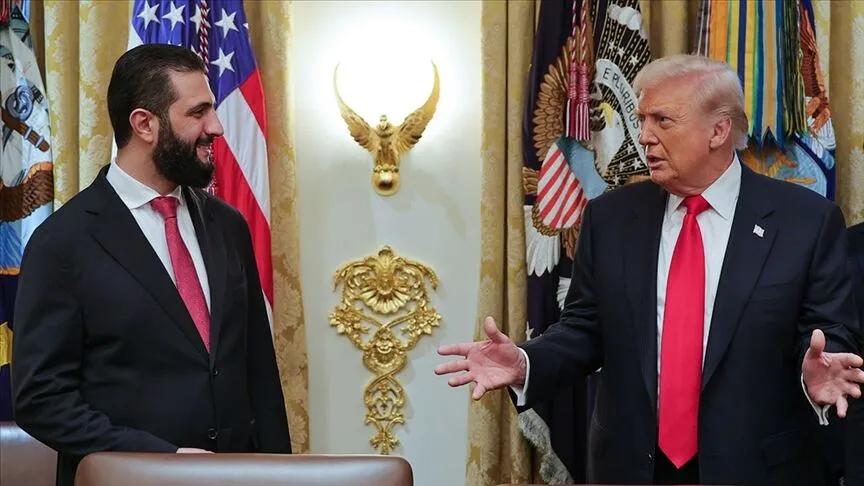
The administration of U.S. President Donald Trump formally initiated the process to remove Syria from the list of State Sponsors of Terrorism (SST) in July 2026. The first step in this process was taken following a meeting between Trump and Syrian President Ahmed Şara during the 36th NATO Summit of Heads of State and Government held in Ankara. The interaction between the two leaders at the summit has been regarded as one of the most significant diplomatic developments in the normalization process between the United States and Syria, which began in 2024.
Following the meeting, Trump announced that Syria would be removed from the State Sponsors of Terrorism list, emphasizing that this decision was not merely a political signal but would also trigger the official legal process in the United States. In accordance with this, Trump formally notified the U.S. Congress to initiate the legal procedure for Syria’s removal from the list.
Under U.S. law, the President cannot implement such a decision directly. After the President’s formal notification to Congress, the decision enters a 45-day review period. If Congress does not block the decision during this period, Syria’s removal from the list becomes official.
The Trump administration stated that this step was taken to support the political transformation in Syria that began with the new government’s assumption of power, accelerate the country’s reconstruction process, and normalize U.S.-Syria relations.
The meeting between Trump and Ahmed Şara took place at the Beştepe Presidential Complex in Ankara during the NATO Summit. Discussions covered the future of bilateral relations, the lifting of sanctions, economic development, international investment, and regional security.
Following the meeting, Trump, in an official letter addressed to Ahmed Şara, declared that a new era had begun in the United States’ approach toward Syria. According to the letter published by Reuters, Trump affirmed that he was fulfilling a prior commitment and emphasized that obstacles to Syria’s reconstruction would be removed.
The letter stated that the United States aimed not only to ease sanctions but also to encourage American companies to invest in Syria. Trump indicated that U.S. firms were ready to invest in various sectors, including energy, infrastructure, industry, and trade, and stressed that such investments would contribute significantly to Syria’s economic recovery.
Trump also highlighted the importance of international capital access for Syria to rebuild its economy after decades of civil war, and affirmed that the Washington administration would continue to support this process.
The letter is considered a significant document because it demonstrates that the United States is not only lifting sanctions but also expressing a clear intent to reestablish economic and diplomatic relations with the Damascus government.
Following Trump’s notification to Congress, the U.S. Department of State announced that the official process to remove Syria from the State Sponsors of Terrorism list had begun.
In a statement issued by the Department of State, it was confirmed that the required notification to Congress had been sent under the instructions of President Donald Trump, and that the process is being conducted under the U.S. Export Administration Act, the Foreign Assistance Act, and other relevant federal regulations.
The statement noted that the new government in Syria has provided assurances that it will not support international terrorism, has taken steps contributing to regional stability, and that the United States has taken these developments into account.
The Department of State further emphasized that lifting sanctions will not only facilitate diplomatic relations but also ease Syria’s reintegration into the international economic system. The statement indicated that supporting Syria’s reconstruction, increasing foreign investment, and improving the economic conditions of the Syrian people are among the top priorities of the U.S. administration.
The U.S. State Sponsors of Terrorism (SST) list is one of the most comprehensive sanction mechanisms applied to states deemed to systematically support international terrorist activities. The list is prepared by the U.S. Department of State, and a country may be included if it is determined to provide financial, military, logistical, or political support to international terrorist organizations.
This mechanism is used as one of the tools of U.S. foreign policy in combating terrorism. Sanctions imposed on listed countries affect not only diplomatic relations but also defense industry cooperation, foreign aid, export licenses, access to international financing, and ties to the U.S. financial system. Consequently, inclusion on the list can have severe economic and diplomatic consequences for the affected country.
The removal of a country from the list does not occur solely through a political decision. The U.S. President must formally notify Congress, and it must be determined that the country has ceased supporting international terrorism. Only after the completion of the 45-day congressional review period following the notification can the decision take effect.
If the process to remove Syria from the list is completed by 2026, it is anticipated that only Iran, North Korea, and Cuba will remain on the U.S. State Sponsors of Terrorism list.
Syria was added to the U.S. State Sponsors of Terrorism list in 1979. The primary justification at the time was the assessment that the regime of Hafez al-Assad provided support to various Palestinian armed groups, permitted some of these organizations to operate from Damascus, and hosted structures linked to international terrorist activities.
In subsequent years, the rationale for Syria’s continued inclusion on the list expanded. Its close ties with Hezbollah in Lebanon, its strategic partnership with Iran, and its connections with groups designated by the United States as terrorist organizations have all played a key role in Washington’s sustained sanctions policy against Syria.
After the Syrian civil war began in 2011, relations between the United States and Damascus deteriorated further. Economic sanctions against the Bashar al-Assad regime were expanded, and additional restrictions were imposed on Syria’s access to the international financial system. As a result, Syria’s designation as a State Sponsor of Terrorism became one of the primary legal foundations for other sanction programs targeting the country.
Following the end of the Bashar al-Assad regime in 2024 and the establishment of a new transitional government under Ahmed Şara, the U.S. administration began to reassess its Syria policy. The new government’s efforts to improve relations with the international community have led to a gradual lifting of sanctions and the initiation of a review of the SST list.
Syria’s removal from the State Sponsors of Terrorism list is regarded as one of the most important developments in recent years for its reintegration into the international economic system. Syria, which has long faced difficulties accessing the international banking system due to prolonged sanctions, is expected to rebuild its ties with global financial markets once the decision takes effect.
One of the most significant outcomes of the decision is expected to be the opening of the door to foreign investment. The Trump administration has stated that American companies are prepared to invest in Syria, particularly highlighting potential new opportunities in the energy, infrastructure, transportation, construction, and telecommunications sectors.
Safwat Raslan, Governor of the Central Bank of Syria, also assessed the U.S. decision as a major development for the country’s economic recovery. Raslan stated that the decision would enhance international investors’ confidence in Syria, facilitate the reestablishment of relations with financial institutions, and accelerate the country’s integration into the global economy.
The decision is also expected to have significant implications for Gulf countries. Several Gulf states, led by Saudi Arabia, have announced plans for billions of dollars in investment projects aimed at Syria’s reconstruction. With the easing of U.S. sanctions, these projects are expected to be implemented more easily.
In addition, renewed interest from international companies in the Syrian market could create important economic opportunities by facilitating the repair of infrastructure severely damaged by the war and increasing employment. However, the reconstruction process is expected to be shaped by numerous factors, including security conditions, political stability, and the approach of international financial institutions.
Since the beginning of the new political transition in Syria in 2024, Türkiye has been among the countries supporting Damascus’s reintegration into the international community. Ankara has identified the preservation of Syria’s territorial integrity and political unity, the strengthening of its central state institutions, the elimination of terrorist elements, and the country’s reconstruction as the core priorities of its Syria policy.
In this context, Türkiye has engaged in diplomatic initiatives calling for the lifting of sanctions, increased international engagement, and support for Syria’s economic recovery. It has also declared its readiness to support the Damascus government through bilateral agreements in areas such as security, infrastructure, transportation, energy, and other critical sectors.
Sources at the Ministry of Foreign Affairs further emphasized that the successful completion of Syria’s reconstruction requires the removal of international sanctions and the strengthening of regional cooperation. Türkiye has stated that it continues its diplomatic efforts with the United States, the European Union, and regional countries in this direction.
U.S. President Donald Trump, in press remarks following his meetings at the 36th NATO Summit of Heads of State and Governmentin Ankara, addressed not only theprocess of removing Syria from the State Sponsors of Terrorism listbut also made assessments regarding other regional developments in the Middle East. These remarks are significant as they demonstrate that U.S. policy toward Syria is being considered within the broader framework of regional security strategy.
Trump indicated that the Syrian government could contribute to stability in Lebanon and stated that the Ahmed Şara administration could play a constructive role in regional security matters. In response to questions regarding Hezbollah’s activities, he suggested that Syria could assist in addressing the issue, though he noted that the process would unfold over time. These remarks signal that Washington views the new Damascus government not only in terms of bilateral relations but also as part of its regional security policy.
Regarding developments along the Israel-Lebanon border, Trump noted that he had discussed these issues with Israeli Prime Minister Benjamin Netanyahu and expressed positive expectations regarding Israel’s withdrawal from southern Lebanon. He emphasized that the implementation of agreements between the parties is crucial for regional stability and affirmed his support for the establishment of a more durable security environment between Israel and Lebanon.
Iran was another major topic in Trump’s remarks. Following military operations by the United States and Israel against Iran, Trump reiterated that Iran’s acquisition of nuclear weapons is unacceptable and stressed the importance of keeping nuclear activities under international oversight. He also argued that the technical capacity to control nuclear materials in Iran is largely located in the United States and stated that, in the event of an agreement, this process could be conducted through international cooperation.
Trump also commented on relations with Türkiye, praising Türkiye’s role within NATO and its position in regional security. He described his dialogue with President Recep Tayyip Erdoğan as constructive, affirmed Türkiye’s critical role as a NATO ally, and noted Ankara’s significant involvement in numerous diplomatic initiatives in recent times. These assessments indicate that U.S. policy on Syria is being considered in connection with Türkiye’s diplomatic efforts.
Diplomatic contacts initiated after the political change in Syria in 2024 have reached a new stage with the formal initiation by the United States in 2026 of the process to remove Syria from the State Sponsors of Terrorism list. This step by the Washington administration marks a significant shift in a sanctions policy that has been in place for nearly half a century.
The Trump administration has stated that it aims to support the new Syrian government in restoring stability and reintegrating into the international community, and assesses that lifting sanctions will not only improve diplomatic relations but also accelerate the country’s economic recovery. Key objectives of this policy include encouraging international investment, facilitating financial transactions, and supporting reconstruction projects.
However, for the process to be completed, the U.S. Congress must complete its 45-day review period. If no obstacles arise at the end of this period, Syria will be formally removed from the State Sponsors of Terrorism list, from which it has been listed since 1979.
ABC News. “Trump Says He’ll Remove Syria from State Sponsor of Terrorism List ‘in Time’.” Accessed July 9, 2026.https://abcnews.com/Politics/trump-hell-remove-syria-state-sponsor-terrorism-time/story?id=134586488
Al Jazeera. "Trump Says He Will Remove Syria from the State Sponsor of Terrorism List." Accessed July 9, 2026.https://www.aljazeera.com/video/newsfeed/2026/7/9/trump-says-he-will-remove-syria-from-the-state-sponsor-of-terrorism-list
Anadolu Agency. “Trump Formally Notifies Congress of Intent to Remove Syria from Terrorism Sponsor List.” Accessed July 9, 2026.https://www.aa.com.tr/en/americas/trump-formally-notifies-congress-of-intent-to-remove-syria-from-terrorism-sponsor-list/3992209
Anadolu Ajansı. "ABD Başkanı Trump, Suriye’yi ‘Teröre Destek Veren Devletler Listesinden’ Çıkaracağını Söyledi." Anadolu Ajansı, July 8, 2026. Accessed July 9, 2026.https://www.aa.com.tr/tr/dunya/abd-baskani-trump-suriyeyi-terore-destek-veren-devletler-listesinden-cikaracagini-soyledi/3991571
Anadolu Ajansı. "Türkiye, Suriye'nin Yeni Döneminde Desteklerini Sürdürecek." Anadolu Ajansı, May 1, 2025. Accessed July 9, 2026.
Reuters. “Trump Says He Thinks He Will Remove Syria from U.S. Terrorism Sponsor List.” Accessed July 9, 2026.
TRT World. “US Moves to Remove Syria from State Sponsor of Terrorism List.” Accessed July 9, 2026.https://www.trtworld.com/article/00ba2a18d669
U.S. Department of State. “Initiating Rescission Process of Syria’s Designation as a State Sponsor of Terrorism.” Accessed July 9, 2026.https://www.state.gov/releases/office-of-the-spokesperson/2026/07/initiating-rescission-process-of-syrias-designation-as-a-state-sponsor-of-terrorism/

U.S. President Donald Trump formally notified Congress of his intention to remove Syria from the list of "State Sponsors of Terrorism." The 45-day congressional review period required for the decision to take effect is expected to be completed, and the move is anticipated to accelerate the normalization process in U.S.-Syria relations.
No Discussion Added Yet
Start discussion for "The United States' Process of Removing Syria from the List of State Sponsors of Terrorism" article
July 9, 2026
The Meeting Between Trump and Ahmed Şara and the Content of the Letter
July 9, 2026
The Official Process Initiated by the U.S. Department of State
July 9, 2026
Syria’s Inclusion on the State Sponsors of Terrorism List
July 9, 2026
Economic and Diplomatic Implications of the Decision
July 9, 2026
Türkiye’s Support for Syria’s Reconstruction Process
July 9, 2026
Trump’s Statements on Regional Agenda Following the NATO Summit
July 9, 2026
A New Era in U.S.-Syria Relations