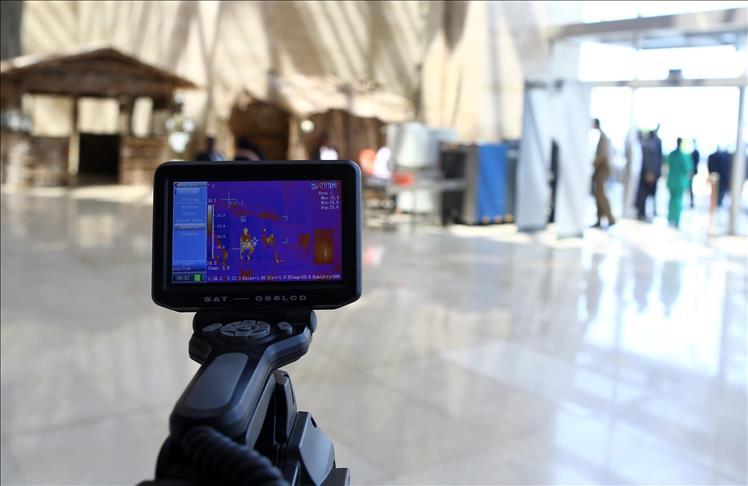


This article was automatically translated from the original Turkish version.
Type(s) | Optoelectronic Imaging Device | ||||||||
|---|---|---|---|---|---|---|---|---|---|
Working Principle | Converts temperature differences into images by detecting infrared radiation emitted by objects | ||||||||
Wavelength Range | 0.9 – 14 µm | ||||||||
Basic Components | Optical system, Detector, Cooler, Signal processing unit, Display screen | ||||||||
Detection Sensitivity | ≈0.01 °C Temperature Difference | ||||||||
Imaging Type | Thermography (color heat map or grayscale) | ||||||||
Advantage(s) | Non-contact measurement Does not contain ionizing radiation Fast and safe | ||||||||
Limitations | Humidity, Air flow, reflective surfaces and emissivity differences affect measurement | ||||||||
First Application Area | Medical and military applications (mid-20th century) | ||||||||
A thermal camera is an optoelectronic imaging device that detects infrared radiation emitted by object surfaces and converts this radiation into temperature data. Unlike conventional cameras sensitive to visible light, this system employs specialized detectors that operate in the invisible infrared region of the electromagnetic spectrum (0.9–14 µm).
All objects emit energy at temperatures above absolute zero (-273 °C). This energy occurs at different wavelengths and intensities depending on the surface temperature of the object. The thermal camera detects this energy, converts it into temperature information through electronic circuits, and displays it as a visual heat map.
This imaging method is also known as thermography. In thermography, warm areas are displayed in red, yellow or white tones while cold areas appear in blue, purple or black tones. Thus, temperature differences invisible to the naked eye become visible. Thermal cameras can display both absolute temperature measurements and relative temperature differences. Each measured pixel corresponds in real time to a specific temperature value, enabling the creation of temperature maps.

Visual of a Thermal Camera Device (Generated by Artificial Intelligence)
Thermal imaging is based on infrared radiation, which has longer wavelengths and lower frequencies than visible light. This radiation is not directly visible to the human eye but can be perceived as heat. Thermal cameras typically detect long-wave infrared (LWIR) radiation in the 8–14 micrometer range; this range is preferred because it aligns well with typical surface temperatures on Earth.
The intensity of infrared radiation depends not only on the object’s temperature but also on a surface property known as emissivity. Emissivity defines a surface’s ability to emit infrared energy. Matte surfaces have high emissivity while shiny or metallic surfaces have low emissivity. For example, human skin has an emissivity of approximately 0.98, whereas aluminum has an emissivity of 0.05. This difference is crucial for interpreting thermal images because surfaces with low emissivity may appear cooler than they actually are.
The atmosphere absorbs infrared radiation at specific wavelengths due to gases such as water vapor and carbon dioxide. Consequently, measurement accuracy can be affected by environmental factors such as distance between the camera and the target, ambient humidity, and air temperature. Thermal cameras generally measure “apparent temperature,” which may differ slightly from the object’s true physical temperature.
A thermal camera consists of several fundamental components: an optical system, a detector unit, a cooling mechanism, signal processing circuits, and an imaging/analysis unit.
Modern thermal cameras can detect temperature differences as small as one millikelvin (0.001 °C). Most models generate real-time video at 30–60 frames per second. Measurement results are recorded digitally and can be analyzed using specialized software.
Thermal cameras must be regularly calibrated to ensure accurate results. Calibration involves correcting optical, electronic, and geometric errors in the camera. During this process, reference surfaces or patterned templates with known temperature values are used.
In photogrammetric applications, chessboard-patterned templates are preferred. Experimental studies have shown that measurement accuracy improves as the template size increases and the temperature difference becomes more pronounced. Proper heating of the template ensures clear detection of corner points, thereby enhancing calibration precision.
After calibration, the electrical signal measured by each pixel corresponds to a specific temperature range. This process can be implemented via software or embedded hardware depending on the camera model.
Thermal imaging systems are categorized into three main types based on the wavelength they detect:
The choice of wavelength depends on environmental conditions and the temperature range of the target being measured.
Thermal cameras are widely used for fault detection and maintenance activities. Hotspots caused by loose connections or excessive current in electrical panels, uneven loads in transformers and motors, and friction or bearing issues in mechanical systems can be easily identified through thermography.
In the construction industry, thermal imaging is used to assess wall and roof insulation, detect moisture zones, identify thermal bridges, and analyze energy efficiency.
In industrial processes, thermography is applied for production line monitoring, furnace temperature control, steam trap testing, leak detection in pipelines, and monitoring material surface temperatures. This method enables inspection without interrupting production and reduces the risk of failure.

Thermal image of a house with insulation applied (Generated by Artificial Intelligence)
In military systems, thermal cameras are used in night vision devices, unmanned aerial vehicles, target detection systems, and heat-seeking munitions. They enable object detection based solely on temperature differences, even in darkness or foggy conditions. Thermal systems also play a significant role in border security, facility protection, and search and rescue operations.
Medical thermography analyzes the surface temperature distribution of the body to detect physiological or pathological changes. This method is non-invasive, rapid, and does not involve ionizing radiation.
Thermal cameras are used as auxiliary diagnostic tools in numerous fields including breast and skin cancer, diabetic foot, peripheral vascular diseases, rheumatoid arthritis, surgical site infections, flap viability, ophthalmological conditions, and gynecological monitoring.

Thermal image of temperature distribution on a human head (Generated by Artificial Intelligence)
For instance, tumor tissues in breast cancer have been found to emit more heat than surrounding tissues. In diabetic patients, localized temperature increases on the foot surface can indicate circulatory disorders at an early stage. This method has become a valuable complementary tool for early diagnosis.
Infrared thermography is used across various scientific fields, from extraterrestrial observations to atmospheric research. In astronomy, temperature maps of star-forming regions, supernova remnants, and dust clouds can be generated. Meteorological satellites utilize thermal imaging sensors to determine cloud density and sea surface temperatures.
Additionally, environmental monitoring can employ thermal cameras to measure emissions from power plant smokestacks and pollution levels.

Gases emitted from a power plant chimney into the atmosphere (Generated by Artificial Intelligence)
The most prominent advantage of thermal cameras is their ability to perform non-contact measurements. This feature is critical for ensuring human safety and enabling observation in hazardous environments. Since these devices do not emit ionizing radiation, they are also biologically safe. Their real-time imaging capability allows tracking of moving objects’ temperature changes.
However, thermal cameras have certain limitations. Measurement accuracy is influenced by ambient temperature, air humidity, wind, surface emissivity, and the distance between the camera and the target. Additionally, materials such as glass, polished metal, or water surfaces reflect infrared radiation, making objects behind them invisible. For measurements to be accurate, environmental conditions must be stabilized, calibration must be performed regularly, and appropriate emissivity values must be entered.
Thermal cameras are high-sensitivity optoelectronic systems that visualize temperature distributions based on the detection of infrared radiation. Originally developed for military purposes, this technology is now widely used across diverse fields including engineering, security, medicine, environmental science, and energy efficiency. Technological advances have increased resolution, enabled portability, and expanded the availability of software-supported models.
Accessed 2025.
Anadolu Ajansı. "Terör saldırısı termal kamerayla önlendi." Accessed October 19, 2025. https://www.aa.com.tr/tr/turkiye/teror-saldirisi-termal-kamerayla-onlendi/11261
Durgut, Aykut, and Özgün Akçay. “Termal Kameralarda Kalibrasyon Şablonlarının Performans Analizi.” *Uludağ Üniversitesi Mühendislik Fakültesi Dergisi* 21, no. 1 (2016): 131–144. Accessed October 19, 2025. https://dergipark.org.tr/tr/download/article-file/262952
Ministry of Environment and Urbanization of the Republic of Turkey. "Termal kamera ile Bina Isı Kayıplarının Görüntülenmesi Uygulama Esasları Kılavuzu." Ankara: Ministry of Environment and Urbanization of the Republic of Turkey, 2018. Accessed October 19
Oduncu, Emrah, Umut Kayıkcı, Kıvanç Uluca, and Mustafa Sıvaslıgil. “Termal Görüntüleme.” TÜBİTAK Bilim ve Teknik Dergisi, (Mayıs 2020): 44–51. Accessed October 19, 2025. https://bilimteknik.tubitak.gov.tr/system/files/makale/44.pdf
Çalışkan, Mücahit, and İbrahim Türkoğlu. “Termal Kameralar ve Uygulamaları.” Elektrik-Elektronik ve Bilgisayar Sempozyumu Bildirileri, Fırat Üniversitesi, Elazığ, 2011. Accessed October 19, 2025. https://www.bingol.edu.tr/documents/Termal%20Kameralar%20ve%20Uyugulamalar%C4%B1%20(FEEB).pdf
İlçe, Arzu, and Büşra Demir. "Kızılötesi Termal Kameranın Sağlık Alanlarında Kullanımı." *Sağlık, Bakım ve Rehabilitasyon Dergisi* 3, no. 1 (2024): 12–25. Accessed October 19, 2025. https://dergipark.org.tr/tr/download/article-file/3774335


Type(s) | Optoelectronic Imaging Device | ||||||||
|---|---|---|---|---|---|---|---|---|---|
Working Principle | Converts temperature differences into images by detecting infrared radiation emitted by objects | ||||||||
Wavelength Range | 0.9 – 14 µm | ||||||||
Basic Components | Optical system, Detector, Cooler, Signal processing unit, Display screen | ||||||||
Detection Sensitivity | ≈0.01 °C Temperature Difference | ||||||||
Imaging Type | Thermography (color heat map or grayscale) | ||||||||
Advantage(s) | Non-contact measurement Does not contain ionizing radiation Fast and safe | ||||||||
Limitations | Humidity, Air flow, reflective surfaces and emissivity differences affect measurement | ||||||||
First Application Area | Medical and military applications (mid-20th century) | ||||||||
Physical Basis
Structure and Operating Principle
Calibration and Measurement Accuracy
Types of Infrared Thermography
Applications
Industrial and Technical Applications
Defense and Security
Healthcare and Medicine
Astronomy, Meteorology, and Environmental Sciences
Advantages and Limitations