


This article was automatically translated from the original Turkish version.
+1 More
Time crystal is an original phase of matter that exists beyond the conventional states and has been observed in quantum systems. These structures are defined as systems that exhibit a periodic order in time, analogous to the spatial periodicity seen in classical crystals. A distinguishing feature of this phase is that the system spontaneously exhibits a repeating quantum state over time without continuous external energy input. Time crystals were first proposed theoretically in 2012 and have since been observed through various quantum simulations and experimental studies. Time crystals are not only an important subject of research in condensed matter physics but also in fundamental principles of quantum mechanics, theoretical discussions on the nature of time, and quantum computing technologies. Therefore, they are regarded as a significant advancement that expands our understanding of phases of matter from both theoretical and experimental physics perspectives.
The concept of the time crystal was first introduced on a theoretical level in 2012 by Nobel Prize-winning physicist Frank Wilczek. Wilczek’s proposal suggested that, similar to spatial symmetry breaking, spontaneous symmetry breaking could also occur in the time dimension. Initially, this hypothesis was considered theoretically controversial and experimentally difficult to verify. However, subsequent theoretical analyses and especially experimental studies on closed quantum systems demonstrated that physical realizations of these structures, termed time crystals, are indeed possible. Thus, time crystals have moved beyond being merely theoretical constructs and are now accepted as a distinct phase of matter that can be created and observed under specific conditions in laboratory environments.
In physics, symmetry refers to a system’s property of remaining unchanged under a specific transformation. Spatial symmetries imply that a physical object retains its properties despite changes in position, while temporal symmetry means the system repeatedly returns to the same physical state after specific time intervals. Classical crystals display a periodic atomic arrangement in space. In time crystals, a similar pattern manifests in the time dimension.
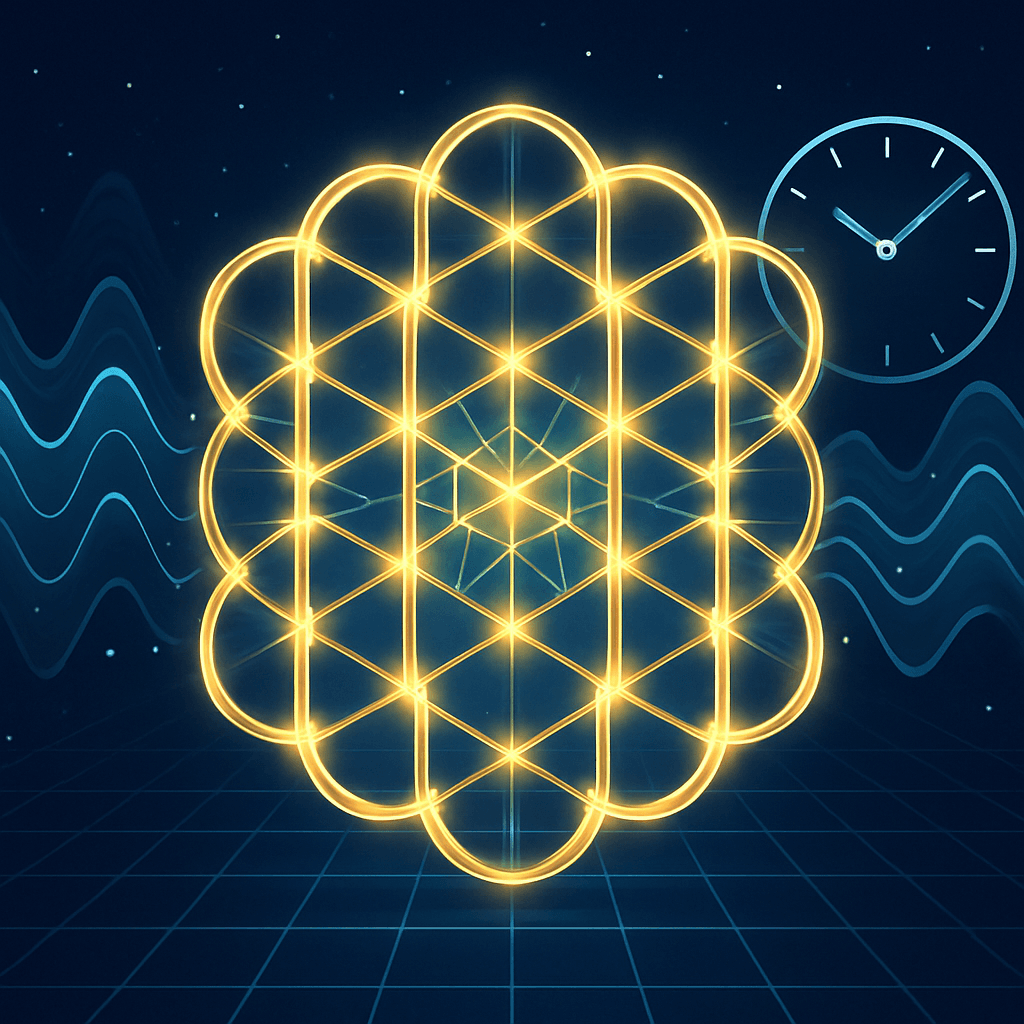
Time Crystals (Designed by Artificial Intelligence)
When a system exhibits continuous temporal symmetry, this symmetry is linked to energy conservation. However, in time crystals, this symmetry is broken. The system returns periodically to the same quantum state due to regular external energy input, but the intervals between these returns differ from the period of the external energy driving the system. This indicates that the system generates a new temporal order through its internal dynamics. This phenomenon is called “time symmetry breaking.” While not violating classical physical laws, this property is observable only in quantum mechanical systems.
The concept of the time crystal was proposed in 2012 by Frank Wilczek. In Wilczek’s model, the system’s ground quantum state was predicted to change periodically over time. However, this proposal was immediately criticized by many physicists because, according to the fundamental rules of quantum mechanics, a system in its ground state should not change over time. This contradiction revealed that time crystals can only occur in driven, non-closed quantum systems.
Therefore, time crystals are defined as systems outside thermodynamic equilibrium. Such systems are called “Floquet systems.” Floquet systems are quantum systems periodically driven by external stimuli at fixed time intervals. These systems generate an intrinsic temporal order while exchanging energy with their environment, and this order can have a longer period than the driving frequency. Thus, they exhibit time crystal behavior.
For these structures to be theoretically stable, the system must be resistant to perturbations. This resilience resembles the properties of topological quantum phases. Topological phases maintain stability against external disturbances and hold great potential for quantum information processing. In this sense, time crystals can be viewed as the temporal counterpart of topological quantum systems.
Although the theoretical definitions of time crystals have sparked considerable debate, experimental physicists have succeeded in creating them in laboratory settings. The first experimental evidence was produced in 2016 by researchers at the University of Maryland. In this experiment, a group of quantum bits (qubits) were periodically driven by a magnetic field, and quantum states that repeated periodically over time were observed. The time crystal behavior was identified by the fact that these repetitions occurred at intervals different from the period of the external driving energy.
The second major experimental confirmation was presented in 2017 by a group of physicists collaborating with Harvard University. In this study, a series of quantum spin systems were used, and time crystal behavior was observed as a result of external driving. A particularly notable feature in these experiments was the system’s stable return to the same quantum state only at specific time intervals, demonstrating temporal periodicity.
More advanced experiments conducted on Google’s Sycamore quantum processor investigated how time crystals interact with quantum processors. These experiments provided significant insights into the potential use of time crystals in quantum computing and information storage systems. Thus, time crystals have become a subject directly connected to both the fundamental principles of quantum physics and next-generation technological applications.
The working principle of time crystals fundamentally involves the periodic external driving of a quantum system and its response at a different frequency. This response enables the system to repeatedly return to the same state over time. However, because this repetition occurs at intervals distinct from the period of the external driving, the system effectively generates its own “time.”
For such a structure to form, the system must maintain a long coherence time. Coherence refers to how long a quantum system can preserve its superposition state. Time crystals can sustain coherence for extended durations, allowing them to establish a temporal order in response to external perturbations. Additionally, time crystals are highly resistant to environmental disturbances. This property is crucial for quantum information storage.
Time crystals can be classified into several subcategories. The most common types include:
1. Discrete Time Crystals (DTC): These time crystals operate under external periodic driving and generate quantum states that repeat at specific time intervals.
2. Continuous Time Crystals: Observable in more complex systems, these exhibit time symmetry breaking through their internal dynamics without external driving. They are theoretically possible but experimentally more challenging to verify.
3. Floquet Time Crystals: These are systems driven periodically by external energy. This is the type most commonly observed in experimental contexts of time crystal research.
This diversity demonstrates that time crystals can exhibit similar temporal regularities under different physical conditions.
The potential applications of time crystals hold significant importance in theoretical physics and quantum technologies. They are expected to be usable in quantum computers, quantum communication systems, and highly precise timing systems. Their long coherence time and resistance to environmental disturbances make them ideal candidates for quantum information storage.
Additionally, time crystals are thought to be applicable in quantum sensors and time-sensitive data analysis. Their ability to process information differently from classical time perception could offer significant advantages in systems requiring parallel temporal processing. Furthermore, in next-generation energy management systems, time crystals that operate regularly in response to external stimuli may provide solutions for temporal balance and synchronization.
The discovery of time crystals signifies not only a new physical structure but also a fundamental shift in our understanding of the nature of time and matter. Traditional physics defines time as a fixed, unidirectional flow. Time crystals, however, demonstrate that time can acquire a structure that repeats at regular intervals. This reveals that time is not merely a measurable quantity but also a tunable dimension. Moreover, time crystals highlight the necessity of evaluating matter not only by its spatial configuration but also by its interaction with time. This development shows that the concept of time crystals adds a fifth dimension to the classical four states of matter.
Demircan, Kozan. “Dört Boyutlu Madde Bulundu: Zaman Kristalleri.” Accessed June 12, 2025. https://khosann.com/dort-boyutlu-madde-bulundu-zaman-kristalleri/.
Ocak, Mahir E. “Zaman Kristalleri.” *TÜBİTAK*. Accessed June 12, 2025. https://bilimteknik.tubitak.gov.tr/system/files/makale/zaman.pdf.
University Continuing Education Programs. "Bilim İnsanları Maddenin Yeni Halini Buldu: Zaman Kristalleri."Anadolu Üniversitesi. Accessed June 12, 2025. https://uyep.anadolu.edu.tr/makale/44-bilim-insanlari-maddenin-yeni-halini-buldu-zaman-kristalleri.

Time Symmetry and Its Breaking
Theoretical Foundations
Experimental Observations
Operating Mechanism
Types of Time Crystals
Potential Applications
Transformation in the Understanding of Time and Matter