


This article was automatically translated from the original Turkish version.
+3 More
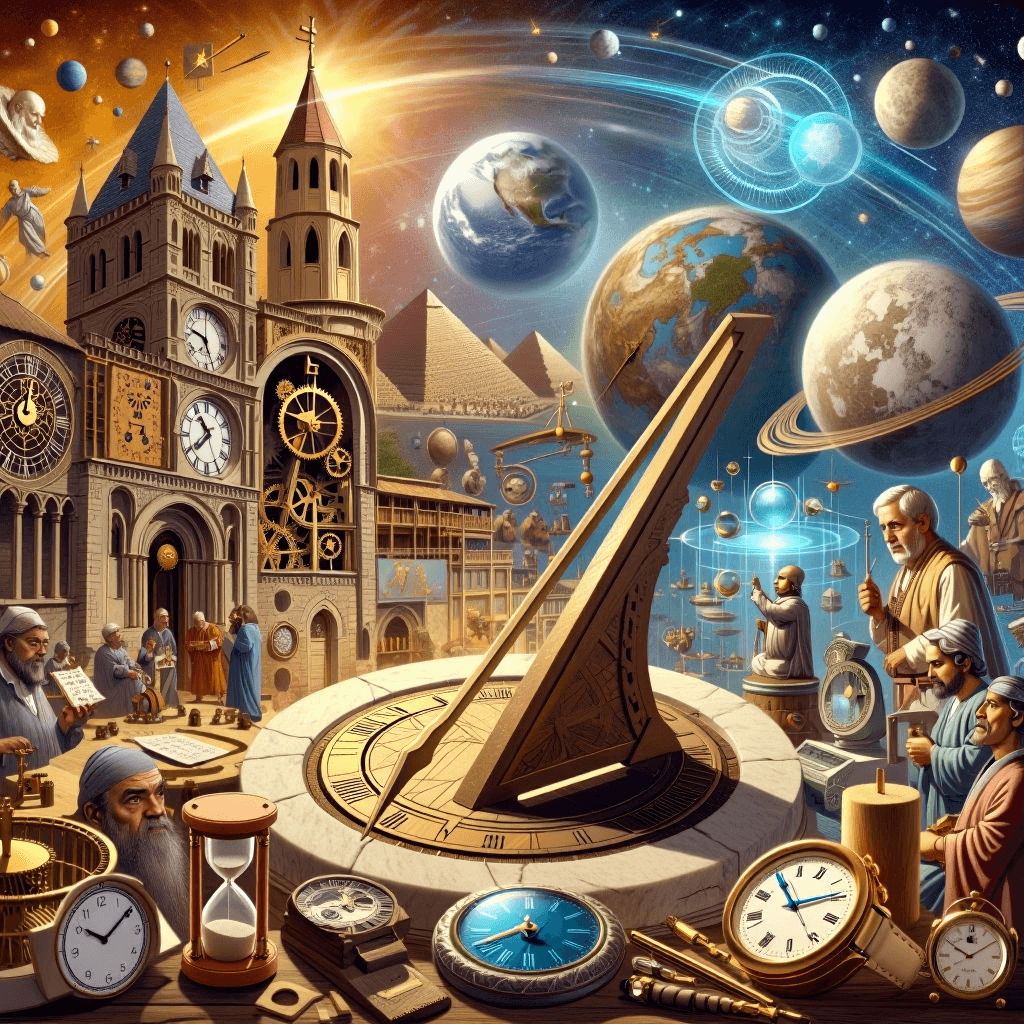
Units of Measurement and Time (Generated with Artificial Intelligence)
Base SI Units | Metre (length), Kilogram (mass), Second (time) | ||||||||
|---|---|---|---|---|---|---|---|---|---|
Mesopotamian System | Sexagesimal number system | ||||||||
Ancient Egyptian Unit of Length | Cubit | ||||||||
Ottoman Unit of Weight | Okka (approximately 1.282 kg) | ||||||||
Historical Timekeepers | Sundial, water clock, hourglass | ||||||||
Standardization | Metric system beginning with the French Revolution in the 18th century | ||||||||
Measurement is the process of quantitatively expressing phenomena observed in nature and human-made objects through standardized units. Since the earliest periods of human history, measurement has been an indispensable part of daily life and has played a fundamental role in establishing social order. Culture, on the other hand, is a holistic structure encompassing a society’s language, art, traditions, religious beliefs, technology, and accumulated knowledge. At the intersection of these two concepts emerges the culture of time and measurement, a field that examines how societies define concepts such as length, weight, volume, and time, the methods they use to measure them, and how these measurements transform social life.
The reliable conduct of trade, the planning of agricultural production, the construction of architectural structures, and the advancement of scientific research have all necessitated measurement systems. Thus, units of measurement did not merely serve a technical function but also transformed into a cultural heritage reflecting each society’s worldview, values, and level of knowledge.
The earliest measurement systems emerged as a response to vital needs such as agriculture, trade, and construction. Mesopotamia has been the site of the oldest known examples of measurement culture. The Sumerians developed a sexagesimal number system, which forms the basis of the concepts of hours and minutes still in use today. For example, the sixty-second minute and the sixty-minute hour derive from this numerical system.
In Mesopotamia, units of measurement were closely tied to agricultural production. Workers were often paid in products such as barley or beer, and taxes were calculated in wheat or barley. The shekel, which corresponded to the approximate weight of 180 barley grains—about 8.4 grams—was one of the most common units of the period. Alongside the shekel, units such as the mina and the talent were widely used in trade and for measuring precious metals. Archaeological findings have revealed copper alloy measuring rods dating to around 2650 BCE; these rods were based on the Sumerian cubit, approximately 518.5 millimeters in length, and are among the earliest known examples of standardized measuring tools.
Ancient Egypt also emerged as a major center in the development of measurement culture. The Egyptians required precise measurements to manage the flooding of the Nile River, recalculate agricultural land, and construct irrigation systems, leading them to develop instruments such as water clocks and sundials. The pyramids, the most remarkable structures of Egyptian architecture, demonstrate how vital standardized length units were. The fundamental unit of measurement here was the cubit, representing the distance from the elbow to the tip of the middle finger. Moreover, measurement carried not only practical but also symbolic meaning. In Egyptian belief, the weighing of the deceased’s heart against the feather of the goddess Maat is a significant indication of how measurement became integrated with the concept of justice.
Ancient Greek civilization made significant contributions to the culture of measurement through its scientific and philosophical endeavors. The Greeks used the stadion, equivalent to approximately 77.6 meters, for measuring distance. Scientists such as Archimedes and Hipparchus laid the foundations of geometry and trigonometry through their work on calculations of length, area, and volume. During this period, measurement played a vital role not only in scientific research but also in trade. Officials known as agoranomoi were appointed to supervise marketplaces and verify that weights and measures conformed to standards, thereby preventing fraud by merchants. In this context, the Greek measurement system illustrates how crucial reliability and oversight mechanisms were for social order.
The Roman Empire standardized its own measurement system to facilitate trade, taxation, and administration across its vast territory. For length, the pes (foot) was used; for weight, the libra (pound); and for liquid volume, the amphora. The denarius, used as currency, also functioned as a unit of weight. One of the Romans’ important inventions was the steelyard balance, a device for measuring heavy loads; this innovation was considered a major advancement in the development of trade. Additionally, the Roman right angle tool ensured precise 90-degree angles in architecture, enhancing the accuracy of construction.
The legacy of the ancient world was reinterpreted and advanced in the Islamic world during the Middle Ages. Between the 8th and 13th centuries, particularly under the Abbasids, significant progress was made in mathematics, astronomy, geography, and engineering. During this period, measurement held an important place not only in commercial and architectural activities but also in religious practices. For instance, accurately determining the times of daily prayers required precise observation of the Sun’s movement across the sky.
Islamic astronomers developed complex instruments such as the astrolabe to measure the positions of celestial bodies and determine time with greater accuracy. These instruments were used not only in astronomical studies but also in determining the direction of the qibla and in calendar calculations. Scholars such as Al-Biruni and Ibn al-Haytham advanced measurement techniques and contributed to the fields of geometry, optics, and geography. Al-Biruni, in particular, used trigonometric methods to calculate the Earth’s radius, a measurement that became one of the foundational pillars of modern science.
Measurement systems used in trade during this period also exhibited considerable diversity. Along the Silk Road, units of weight and length for goods such as gold, silver, and spices varied regionally, yet efforts were made to anchor them in specific standards to ensure the security of commerce.
The Ottoman Empire, which ruled a vast territory from the 14th century until the early 20th century, developed its own measurement system to achieve political and cultural unity, integrating it as an inseparable element of economic, administrative, and social order. Known as “Ottoman Measurements,” this system combined the inherited legacy of Byzantine and Islamic traditions with unique features reflecting the diverse ethnic and geographic needs of the empire.
The most commonly used unit of length in the Ottoman Empire was the arşın. The arşın was standardized for use in architecture, construction, and fabric measurement, with various types ranging from approximately 68 to 78 centimeters. For example, the architect’s arşın was primarily used in construction, while other types, known as zira-i mimari, were preferred for textiles and weaving. This diversity demonstrates how measurements could vary according to practical needs and specific applications.
The most common unit of weight was the okka, equivalent to approximately 1.282 kilograms, and it was used widely from market transactions to tax collection. Smaller weights were measured in dirhem, while larger scales used the kantar. As the variety of commercial goods increased, subordinate units based on this weight system gained importance. For example, products such as spices, coffee, sugar, and cotton were typically measured in terms of okka.
In volume measurements, the influence of agricultural production and grain trade was evident. The most common unit of volume was the kile, used for measuring cereals such as wheat, barley, and lentils, with minor regional variations. Additionally, units such as şerbetlik, şinik, and testi were used for liquids. This diversity reflects the vast agricultural and cultural richness of the empire’s extensive geography.
One of the most important features of the Ottoman measurement system was that it served not only an economic function but also played a role in maintaining social order and justice. To prevent fraud by vendors in markets and bazaars, officials known as ihtisap ağaları or muhtesipler were appointed to regularly inspect the accuracy of scales, weights, and measuring vessels. This practice was a critical mechanism for preserving public trust and ensuring fair trade.
However, the Ottoman measurement system was far from a universal standard. As in Europe after the fall of the Roman Empire, regional variations were inevitable in the Ottoman Empire. Units bearing the same name could represent different values in different cities. This situation often led to confusion and occasional disputes, especially in international trade. With the adoption of the metric system in Europe during the 19th century, the Ottoman Empire began standardizing its units to resolve these inconsistencies. Various reforms were introduced during the Tanzimat period, but a fundamental transformation did not begin until the late 19th century.
In medieval Europe, units of measurement were largely under the control of local authorities and feudal lords, resulting in the frequent occurrence of the same goods being measured by different units in different regions. This diversity created confusion in trade and led to issues of trust. Nevertheless, the construction of large cathedrals and castles encouraged the development of more precise methods for measuring length and angles.
During the 15th and 16th centuries, alongside the scientific revolution in Europe, measurement gradually became more standardized. Galileo Galilei’s use of the pendulum for time measurements directly contributed to the development of modern clocks. In the 17th century, Isaac Newton’s work enabled the measurable quantification of quantities such as force, mass, and acceleration, laying the foundations of modern physics.
The metric system, adopted in France in 1795 following the French Revolution, marked one of the most significant steps toward universality in units of measurement. The meter was originally defined as one ten-millionth of the distance from the North Pole to the Equator. Units such as the kilogram and the liter were also established during this period, ensuring consistency in measurements. This system rapidly spread across much of Europe and formed the basis of today’s International System of Units (SI).
The rapid industrialization of the 19th and 20th centuries, the diversification of scientific research, and the expansion of global trade necessitated the adoption of stricter and more universal standards for units of measurement. The Metre Convention, signed in 1875, established the International Bureau of Weights and Measures (BIPM) to ensure the international standardization of measurements.
The International System of Units (SI), developed in the mid-20th century, established the universal foundation for modern measurements. This system defines seven base units: the meter (length), the kilogram (mass), the second (time), the ampere (electric current), the kelvin (temperature), the mole (amount of substance), and the candela (luminous intensity). Today, these units are defined in relation to natural constants, ensuring absolute accuracy in measurements. For example, the second is now based on the vibration frequency of cesium-133 atoms; the meter is defined by the speed of light in a vacuum.
The need to measure time arose from fundamental human requirements such as determining agricultural calendars, planning migrations, and organizing daily life. The most basic units of time—the day and the year—are based on astronomical phenomena: a day is defined as one complete rotation of the Earth on its axis, and a year as one complete orbit around the Sun. In prehistoric times, humans attempted to understand the passage of time by tracking the shadow cast by a stick planted in the ground (gnomon). This primitive method formed the basis of the sundial developed in ancient Egypt. Sundials divided the day into hours by observing the movement of the shadow of a vertical rod across a circular surface marked with equal intervals.
To measure time during nighttime or cloudy conditions, different instruments were developed. The most well-known of these are the water clock (clepsydra), the hourglass, and the candle clock. The water clock operated on the principle of water flowing at a constant rate from one container to another, while the hourglass used the flow of sand based on a similar principle. The candle clock measured time according to the rate at which a candle marked with evenly spaced lines burned down. Today, time is measured using standardized units such as the second, minute, hour, day, week, month, and year. The relationships between these units (1 hour = 60 minutes, 1 day = 24 hours, etc.) are universally accepted and precisely tracked through mechanical or digital clocks.
The evolutionary journey of time and measurement units is not merely a technical progression but also a mirror of humanity’s cultural and intellectual development. This history, spanning from measurements based on barley grains in Mesopotamia to modern atomic clocks, reveals societies’ persistent efforts to generate knowledge, establish order, and understand the universe.
Today, measurement systems are indispensable not only for scientific research but also for global trade, international cooperation, technological development, and the organization of daily life. Precise time measurement plays a critical role in numerous fields, from satellite navigation systems to the synchronized operation of the internet. The culture of measurement serves as a universal bridge connecting the heritage of the past with the technologies of the future.
The historical evolution of measurement systems is directly linked to the technological advancement of measuring instruments. Simple measuring rods, stone weights, and two-pan balances used in antiquity represent humanity’s earliest attempts to understand nature quantitatively. These tools were essential for ensuring the reliability of trade, regulating agricultural production, and achieving success in construction. However, as scientific curiosity and engineering needs increased over time, the development of more precise and sophisticated measuring devices became necessary.
The 17th century witnessed the birth of modern measurement technology. The vernier caliper, invented by the French mathematician Pierre Vernier, enabled highly accurate measurements of very small lengths, revolutionizing engineering and metalworking. In the same period, the English scientist Edmund Gunter developed the Gunter’s chain, a surveying tool that ensured standardized and reliable measurements in cartography. These advancements laid the foundations of modern geodesy and engineering.
The Industrial Revolution of the 18th century, with its demands for increased production scale and precision, encouraged the invention of new measuring instruments. The micrometer made it possible to measure small components with high accuracy. The spring scale, developed during the same period, allowed portable and practical measurement of various weights, finding widespread use in trade.
In the 19th century, advances in optical science and engineering ushered in a new stage in the development of measuring instruments. The theodolite, developed during this period, enabled extremely precise measurement of horizontal and vertical angles and began to be used in architectural projects, engineering works, and topographic mapping. The importance of the theodolite became decisive in fields such as railway construction, bridge projects, and urban planning.
In the 20th and 21st centuries, measurement technologies have pushed the boundaries of scientific progress. Laser distance meters, achieving millimeter-level accuracy, have become standard in construction, engineering, and geodesy. Atomic clocks measure time with precision to one billionth of a second, enabling synchronization in satellite navigation systems, telecommunications, and internet infrastructure. Analytical balances used in laboratory environments measure masses as small as one millionth of a gram, playing critical roles in chemistry, pharmacology, and materials science.
The concept of measurement has moved beyond being merely a technical procedure and has acquired a special meaning within the cultural and institutional structure of modern societies. In this context, the concept of “performance measurement culture” has emerged prominently, particularly in management sciences and organizational studies.
Performance measurement culture is not limited to merely tracking specific indicators (KPIs—Key Performance Indicators). It also encompasses how these indicators are interpreted, how they are used in decision-making processes, and how they shape behavioral patterns within organizations. In a weak measurement culture, metrics are often used as tools for monitoring, pressuring, or punishing employees. In contrast, in a strong and healthy measurement culture, measurements serve as a guide that helps employees evaluate their own performance, improve their work, and understand how they contribute to the organization’s overall goals. In this approach, goals and action plans are designed from the outset to be measurable. Thus, measurement ceases to be merely a tool for verifying outcomes and becomes an integral part of strategy development, decision-making, and continuous improvement processes. In this sense, measurement is increasingly viewed not as a physical act but as a cognitive, behavioral, and cultural practice in modern societies. Ultimately, the culture of measurement, spanning from simple measuring rods in historical times to today’s ultra-precise instruments and from trade and agricultural systems to modern institutional management, is a universal reflection of humanity’s quest for order and progress.
Atatürk University. "Türkiye’de Kadastro Faaliyetleri." Accessed August 16, 2025. https://www.atauni.edu.tr/yuklemeler/6ca144a63ce6808a783254e87948e05b.pdf.
Delva, Pacôme, and Jérôme Lodewyck. “Atomic Clocks: New Prospects in Metrology and Geodesy.” arXiv preprint arXiv:1308.6766, 2013. Accessed August 16, 2025. https://arxiv.org/abs/1308.6766.
Fırat Üniversitesi. “Osmanlı’da Kadastro Çalışmaları.” Accessed August 16, 2025. https://openaccess.firat.edu.tr/xmlui/bitstream/handle/11508/16163/188311.pdf.
Turk Tarih Kurumu. “Osmanlı’da Arazi Düzenlemeleri.” *Belleten* 55, no. 214 (1991): 233–248. Accessed August 16, 2025. https://belleten.gov.tr/tam-metin-pdf/1444/eng.
Wallis, John. “The Application of GPS to Cadastral Surveys.” In *Proceedings of the FIG Working Week 2005*, Cairo, Egypt. Accessed August 16, 2025. https://www.fig.net/resources/proceedings/fig_proceedings/cairo/papers/wshs_01/wshs01_02_wallis.pdf.
Çelik, Hüseyin. “Kadastroda Tarihsel Gelişim Süreci.” *Türk Coğrafya Dergisi* 80 (2023): 45–60. Accessed August 16, 2025. https://dergipark.org.tr/tr/download/article-file/2417313.

Units of Measurement and Time (Generated with Artificial Intelligence)
Base SI Units | Metre (length), Kilogram (mass), Second (time) | ||||||||
|---|---|---|---|---|---|---|---|---|---|
Mesopotamian System | Sexagesimal number system | ||||||||
Ancient Egyptian Unit of Length | Cubit | ||||||||
Ottoman Unit of Weight | Okka (approximately 1.282 kg) | ||||||||
Historical Timekeepers | Sundial, water clock, hourglass | ||||||||
Standardization | Metric system beginning with the French Revolution in the 18th century | ||||||||
No Discussion Added Yet
Start discussion for "Time and Measurement Culture" article
Historical Origins of Measurement Systems
Measurement in Ancient Greece and Rome
Measurement Tradition in the Islamic World during the Middle Ages
The Ottoman Empire and Local Measurement Systems
Measurement Systems in Europe
International Standards in the Modern Era
Social Significance of the Culture of Time and Measurement
Development of Measurement Instruments
Measurement Culture in Modern Societies