This article was automatically translated from the original Turkish version.
Service Entry | 2025 is projected | ||||||||
|---|---|---|---|---|---|---|---|---|---|
Primary User | Turkish Air Forces | ||||||||
First Flight(s) | 29 August 2013 | ||||||||
Type(s) | light ground attack aircraft reconnaissance-observation aircraft Basic training aircraft | ||||||||
Other Users | Niger Armed Forces | ||||||||
Status | In serial production phase | ||||||||
Manufacturer(s) | TUSAŞ | ||||||||
Production Number | 15 | ||||||||
Variants | Hürkuş-C (light attack) Hürkuş-B (basic training) Hürkuş-A (civil use) | ||||||||
Designer | TUSAŞ | ||||||||
Crew | 2 | ||||||||
National Origin | Türkiye | ||||||||
Range(s) | 1500 km | ||||||||
Wingspan | 9.96 m | ||||||||
Empty Weight | ~2200 kg | ||||||||
Maximum Takeoff Weight | 3300 kg | ||||||||
Maximum Speed | 574 km/h (310 knots) | ||||||||
Service Ceiling | 10.577 m | ||||||||
Useful Load | 1.500 kg | ||||||||
Height(s) | 3.7 m | ||||||||
Engine(s) | 1 × Pratt & Whitney Canada PT6A-68T | ||||||||
Length(s) | 11.2 m | ||||||||
HÜRKUŞ is a two-seat, single-engine turboprop training and light attack aircraft developed by Turkish Aerospace Industries Inc. (TUSAŞ).
HÜRKUŞ, the first concrete step toward Türkiye’s goal of establishing its own pilot training fleet in the 21st century, is the first Turkish aircraft designed with domestic engineering capabilities to receive EASA certification.
Developed for use in both pre-jet pilot training and close air support missions in low-intensity conflict zones, the platform, in its various configurations (HÜRKUŞ-A, B, C), is regarded as a milestone in Türkiye’s defense industry’s localization process.

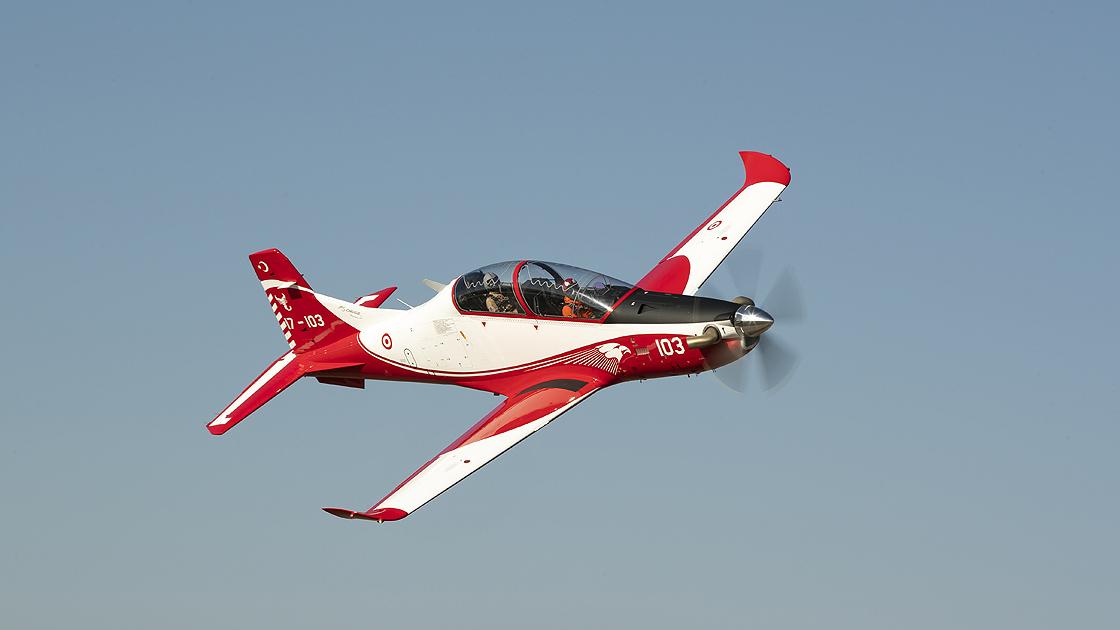
Hürkuş Front View (Anadolu Ajansı)
The HÜRKUŞ project originated from Türkiye’s strategy in the mid-2000s to reduce dependence on foreign aircraft for pilot training. Launched in 2006 by TUSAŞ, the project aimed to modernize the Turkish Air Force’s basic trainer fleet while simultaneously producing a domestically developed training aircraft for the civil aviation market. At the time, Türkiye’s inventory included T-37 and KT-1T aircraft. However, their technological obsolescence and rising maintenance costs necessitated a domestic platform.
The project was carried out with support from the Presidency of Defense Industries (SSB) and is recognized as TUSAŞ’s first original aircraft development program. The design of HÜRKUŞ was entirely undertaken by a domestic engineering team; aerodynamic structure, control systems, and cockpit ergonomics were developed using the knowledge base accumulated by TUSAŞ at the time. Both military and civil operational requirements were considered throughout the design process. As a result, HÜRKUŞ became the first Turkish aircraft eligible for certification under EASA CS-23 standards.
During the engineering phase, wind tunnel tests, static load tests, and simulation-supported aerodynamic analyses were conducted. The use of composite materials in the airframe and wing design was increased to balance lightness, fuel efficiency, and durability. Simultaneously, cabin pressurization, ejection seat integration, and flight control software were developed domestically.
The first prototype was completed in the early 2010s. On 29 August 2013, the HÜRKUŞ-A prototype made its first flight, marking the historic maiden flight of Türkiye’s first indigenously engineered aircraft. Subsequently, in 2016, the aircraft received its EASA CS-23 certification. This achievement demonstrated that HÜRKUŞ met not only national but also international safety and performance standards.
Following EASA certification, the project advanced along two main paths: civil and training-oriented HÜRKUŞ-A/B variants, and the HÜRKUŞ-C model developed for armed reconnaissance and light attack missions. During this phase, the aircraft was integrated with Roketsan munitions (CİRİT, L-UMTAS, Teber) and tested in the field. Flight tests conducted in 2018 confirmed HÜRKUŞ-C’s potential as a low-cost light attack platform.
Starting in 2019, TUSAŞ established a production line for the HÜRKUŞ-B variant to equip the Turkish Air Force training fleet. Deliveries began by 2023. By this time, the HÜRKUŞ program had evolved beyond being merely a training aircraft to become a symbolic project demonstrating Türkiye’s capacity to produce multi-role exportable airborne platforms.
The first HÜRKUŞ-A prototype was completed in 2013 and made its first flight on 29 August 2013. Flight testing was conducted at TUSAŞ’s test center (Ankara-Akıncı). During the test program, avionics systems, engine control (Pratt & Whitney Canada PT6A-68T), and flight envelope validation were completed.
Testing for EASA CS-23 certification was finalized in 2016, granting the aircraft the distinction of being the first Turkish-made aircraft to receive EASA certification.
The HÜRKUŞ-B variant was developed to meet the Turkish Air Force’s advanced pilot training requirements; it features a modern cockpit, digital avionics, a pressurized cabin, and an advanced mission recording system.
The first flight of the HÜRKUŞ-B prototype occurred on 30 January 2018. Tests covered flight dynamics, system integration, maintenance cycles, and performance limits.
The HÜRKUŞ-C variant (Light Attack / Armed Reconnaissance) was introduced in 2017 and successfully completed its first armed firing tests in 2018. Tests employed Roketsan munitions including L-UMTAS, CİRİT, and general-purpose bombs.
TUSAŞ initiated series production for the HÜRKUŞ-B variant at the beginning of the 2020s. The first six aircraft were delivered to the Air Force Command by 2023. Qualification flights for the HÜRKUŞ-C model continued between 2022 and 2024.
The project also stands out for its export potential targeting markets in Africa and Asia; deliveries to Niger and Chad fall within this framework. As of 2024, the aircraft has completed over 500 test flights.
HÜRKUŞ is designed as a low-cost, high-manoeuvrability turboprop training and light attack aircraft.
In its aerodynamic design, a low-wing configuration, tandem seating arrangement, and forward visibility are prioritized. A pressurized cabin, Martin-Baker MK T-16 ejection seat system, and digital flight instruments provide a training infrastructure compliant with NATO standards.
HÜRKUŞ is a two-seat (student and instructor) tandem turboprop training aircraft. The aircraft measures 11.2 meters in length, 9.96 meters in wingspan, and 3.7 meters in height. The wing area is approximately 20.5 square meters. Its empty weight is approximately 2,200 kilograms, with a maximum takeoff weight of 3,300 kilograms for the HÜRKUŞ-A/B models and approximately 3,700 kilograms for the HÜRKUŞ-C variant.
It is powered by a Pratt & Whitney Canada PT6A-68T turboprop engine producing 1,600 horsepower. The aircraft can reach a maximum speed of 574 kilometers per hour (approximately 310 knots). Its service ceiling is 10,577 meters, with a range of 1,500 kilometers; the HÜRKUŞ-C model can extend its range to 1,800 kilometers with external fuel tanks.
The aircraft is designed to withstand +7 and −3.5 g loads. The HÜRKUŞ-C variant has a total external payload capacity of 1,500 kilograms, distributed across six hardpoints. These structural characteristics make HÜRKUŞ a suitable platform for both basic flight training and light attack missions with high manoeuvrability.

HÜRKUŞ Technical Specifications (Anadolu Ajansı)
The HÜRKUŞ-C variant is equipped with six external weapon stations.
The HÜRKUŞ-C can perform missions with electro-optical/infrared (EO/IR) pods, laser designator systems, data links, and targeting pod integration. The HÜRKUŞ-B variant includes simulation-based versions of these systems.
Munitions such as CİRİT and UMTAS are domestically developed systems fully integrated into HÜRKUŞ-C. Additionally, interface compatibility with NATO-standard munitions (GBU-12, AGM-65 class) is planned.

Enhanced HÜRKUŞ-2 Model (Anadolu Ajansı)
Full digital “glass cockpit,” color multi-function displays, HUD, GPS/INS navigation, digital mission recording system, “Hands-On Throttle and Stick” (HOTAS) control concept, NVG-compatible cockpit lighting.
HÜRKUŞ was primarily developed to modernize the pre-jet phase of Türkiye’s pilot training pipeline. The aircraft fulfils the final stage of pre-jet training through its manoeuvrability, system control capabilities, and low operating costs. In military use, it is intended to perform effectively in armed reconnaissance, border security, and light attack missions. It is capable of providing close air support to ground forces in low-intensity conflict zones; the HÜRKUŞ-C variant is specifically armored and enhanced with increased munitions capacity for these roles.
In the civil sector, HÜRKUŞ is suitable for advanced pilot training at flight academies. Its wide field of view, pressurized cabin, and digital flight systems offer high safety and cost advantages for civil aviation training centers. When equipped with sensor and camera pods, it can also be used for surveillance, border control, and search and rescue operations.
Future plans include adapting the HÜRKUŞ platform for intelligence, surveillance, and reconnaissance (ISR) missions. The aircraft’s digital infrastructure allows integration with ground stations and training simulators, enabling its use in live-virtual-constructive (LVC) training networks. This feature transforms HÜRKUŞ from a mere training aircraft into a versatile mission platform.

HÜRKUŞ in Flight (Anadolu Ajansı)
The operational history of HÜRKUŞ began in 2013 with the first flight of the HÜRKUŞ-A prototype. In 2016, it completed EASA certification, becoming Türkiye’s first civil-certified indigenous aircraft. The first flight of the HÜRKUŞ-B variant occurred in 2018, and in the same year, successful weapon tests were conducted using Roketsan’s CİRİT and L-UMTAS munitions. Deliveries of HÜRKUŞ-C aircraft to Niger and Chad in 2022 marked Türkiye’s first export in this category. As of 2024, the program completed its 500th test flight, demonstrating TUSAŞ’s production maturity.
The primary user of HÜRKUŞ is the Turkish Air Force Command; the HÜRKUŞ-B variant has been integrated into the basic training fleet. Additionally, HÜRKUŞ-C variants have been delivered to Niger and Chad, initiating a new era in Türkiye’s defense industry exports. Discussions are ongoing with various countries in Africa and Asia. TUSAŞ has developed a comprehensive support infrastructure for user nations, including maintenance, spare parts, and pilot-technician training.
HÜRKUŞ is evaluated in the same class as global turboprop training and light attack aircraft such as the Pilatus PC-21, Embraer EMB-314 Super Tucano, and Beechcraft T-6 Texan II. Its key advantages include domestic munition integration, low operating costs, NATO-compatible avionics, and domestic maintenance and modernization capacity. However, its global sales network and spare parts supply chain remain limited. As the program matures, its competitiveness—particularly in terms of cost-effectiveness—is expected to increase.
Dinç Söğüt, İrem Pelin. “TUSAŞ’ın Yeni Nesil Temel Eğitim Uçağı HÜRKUŞ’un Özellikleri.” *Tabya Dijital*, June 1, 2025. Accessed October 30, 2025. https://tabyadijital.com/tusasin-yeni-nesil-temel-egitim-ucagi-hurkusun-ozellikleri/.
Ministry of National Defense. "HÜRKUŞ Eğitim Uçağı ve Varyantları." *Millî Savunma*, 2017. Accessed October 30, 2025. https://www.millisavunma.com/hurkus-c-yeni-nesil-hafif-saldiri-ucagi/.
SavunmaTR. “HÜRKUŞ-C Hafif Taarruz Uçağı: Teknik Özellikler ve Yetenekler.” SavunmaTR, January 7, 2022. Accessed October 30, 2025. https://www.savunmatr.com/hurkusun-turk-hava-kuvvetlerine-teslimati-basliyor/.
TUSAŞ – Türk Havacılık ve Uzay Sanayii A.Ş. "HÜRKUŞ Ürün Sayfası." TUSAŞ Resmî Web Sitesi, n.d. Accessed October 30, 2025. https://www.tusas.com/urunler/ucak/ozgun-gelistirme/hurkus.
Yıldırım, Göksel. “HÜRKUŞ 2 İlk Uçuşuna Hazırlanıyor.” Anadolu Ajansı, May 6, 2024. Accessed October 30, 2025. https://www.aa.com.tr/tr/savunma-sanayisi/hurkus-2-ilk-ucusuna-hazirlaniyor/3101058.
Yıldırım, Göksel. “HÜRKUŞ HYE’nin Tip Sertifikası Çalışmaları Tamamlandı.” Anadolu Ajansı, February 22, 2022. Accessed October 30, 2025. https://www.aa.com.tr/tr/bilim-teknoloji/hurkus-hyeunun-tip-sertifikasi-calismalari-tamamlandi/2509782.
Yıldırım, Göksel. “İlklerin Uçağı HÜRKUŞ: Sivil ve Askeri İhtiyaçları Karşılayacak.” Anadolu Ajansı, June 24, 2020. Accessed October 30, 2025. https://www.aa.com.tr/tr/turkiye/ilklerin-ucagi-hurkus-sivil-ve-askeri-ihtiyaclari-karsilayacak/1887941.


Service Entry | 2025 is projected | ||||||||
|---|---|---|---|---|---|---|---|---|---|
Primary User | Turkish Air Forces | ||||||||
First Flight(s) | 29 August 2013 | ||||||||
Type(s) | light ground attack aircraft reconnaissance-observation aircraft Basic training aircraft | ||||||||
Other Users | Niger Armed Forces | ||||||||
Status | In serial production phase | ||||||||
Manufacturer(s) | TUSAŞ | ||||||||
Production Number | 15 | ||||||||
Variants | Hürkuş-C (light attack) Hürkuş-B (basic training) Hürkuş-A (civil use) | ||||||||
Designer | TUSAŞ | ||||||||
Crew | 2 | ||||||||
National Origin | Türkiye | ||||||||
Range(s) | 1500 km | ||||||||
Wingspan | 9.96 m | ||||||||
Empty Weight | ~2200 kg | ||||||||
Maximum Takeoff Weight | 3300 kg | ||||||||
Maximum Speed | 574 km/h (310 knots) | ||||||||
Service Ceiling | 10.577 m | ||||||||
Useful Load | 1.500 kg | ||||||||
Height(s) | 3.7 m | ||||||||
Engine(s) | 1 × Pratt & Whitney Canada PT6A-68T | ||||||||
Length(s) | 11.2 m | ||||||||
Development Process
Project Initiation and Background
Prototype Stages and Testing
Transition to Series Production and Developments
Technical Specifications and Variants
General Technical Assessment
Technical Specifications
Munitions and Capabilities
Electronic Warfare and Reconnaissance Systems
Domestic and Foreign Weapon Integrations
Current and Planned Variants
Avionics and System Components
Purpose and Missions
Operational History and Achievements
User Countries and Integration
International Comparison and Competitor Systems