
This article was automatically translated from the original Turkish version.
+2 More
İkiz Gemiler (Çağrı Bey and Yıldırım) refer to the seventh-generation ultra-deepwater drilling vessels, completed in South Korea in 2024 and equipped with the most advanced technology available.
The Çağrı Bey and Yıldırım vessels have been integrated into the Turkish Petroleum Corporation (TPAO) to elevate Türkiye’s hydrocarbon exploration and production capacity to a strategic level. These two new platforms, possessing identical high technical capabilities, are designed to operate both within national waters and international waters in alignment with Türkiye’s energy independence goals. Indeed, seventh-generation drilling vessels are highly advanced floating platforms used to access oil and natural gas reserves located thousands of meters beneath the seabed. The “İkiz Gemiler” joining Türkiye’s energy fleet belong to the class of “seventh-generation ultra-deepwater drilling vessels.”【1】 This classification reflects their advanced automation systems, safety equipment, and ability to maintain stable operations at depths of thousands of meters even under extreme sea conditions. The Çağrı Bey and Yıldırım vessels are defined as critical technological components of Türkiye’s “Mavi Vatan” strategy, aimed at ensuring energy supply security and reducing external dependency.
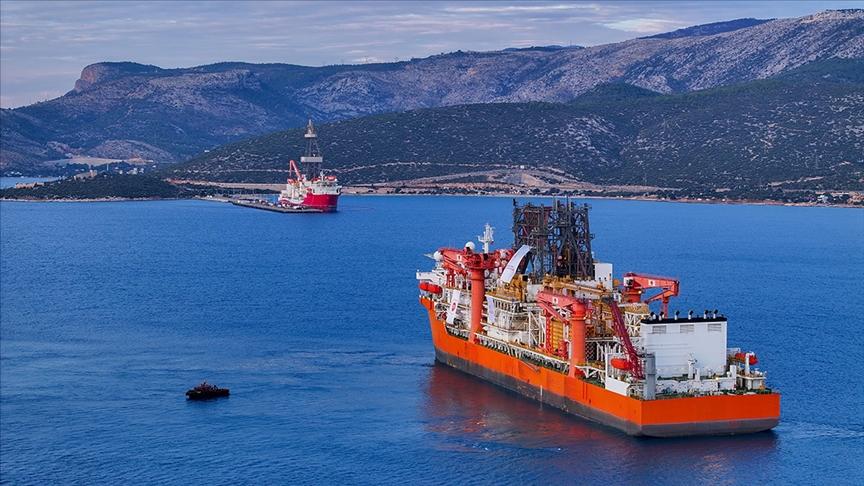
Newly Added to the Energy Fleet: Vessels “Yıldırım” and “Çağrı Bey” (Anadolu Agency)
The scientific and technical foundation for drilling operations was established by the Oruç Reis Seismic Research Vessel, which played a pioneering role in collecting essential data. Departing from Istanbul’s Dolmabahçe in October 2024 and making a stop in Somalia, the vessel conducted continuous and intensive operations for approximately nine months in Somali maritime areas, covering a licensed area of 4,465 square kilometers.【2】
Equipped with modern seismic instrumentation, Oruç Reis employed three-dimensional (3D) seismic data acquisition techniques to produce detailed imaging of the geological layers beneath the seabed. The vast volume of digital data collected during this precise survey in three distinct offshore blocks in Somalia was transmitted to data processing centers in Ankara for analysis.
Following the successful completion of Oruç Reis’s seismic data collection, according to the national strategy announced by President Recep Tayyip Erdoğan, the first drilling operations in Somali maritime areas are planned to commence within 2026.
According to the operational schedule, the Çağrı Bey Drilling Vessel, which will lead this initiative, is undergoing comprehensive preparation at Mersin Taşucu Port. The goal is to complete all preparations by the end of January 2026 and set sail toward the first drilling site in Somalia. This transition marks the stage where theoretical data is transformed into tangible discoveries. Technically, the purpose of these drills is not only to detect the presence of hydrocarbons but also to determine the commercial scale and fluid properties of the reservoir. Beginning in early 2026, this process will test the energy potential of ocean depths using technological capabilities capable of reaching depths of up to 12,000 meters.【3】
The initial quartet of vessels—Fatih, Yavuz, Kanuni, and Abdülhamid Han—which played critical roles in the discovery and development of the Sakarya Gas Field, has now been transformed into a powerful fleet with the addition of two new “twin vessels” in 2024 and 2025. With the total number of drilling vessels rising to six, Türkiye has secured the fourth position globally in terms of deepwater energy fleet size and technological capability.【4】
The newly added vessels, Çağrı Bey and Yıldırım, are equipped with seventh-generation ultra-deepwater drilling technology and possess the ability to operate under the most challenging oceanic conditions. Turkey Petroleum Corporation (TPAO) can now simultaneously increase production in the Black Sea and conduct exploration operations in other regions.
The fleet’s expansion has become a crucial element in extending Türkiye’s “Mavi Vatan” doctrine to international waters and fostering intercontinental cooperation. Supported by 11 support vessels, seismic research ships, and floating production units (FPUs), this fleet forms a “fully independent” ecosystem for unlocking national wealth hidden thousands of meters beneath the seas and integrating it into the economy.【5】
The two newest seventh-generation drilling vessels added to the fleet are named Çağrı Bey and Yıldırım. Announced by President Erdoğan, these vessels are the new vanguards of Türkiye’s energy fleet. Arriving in Türkiye on September 28 and December 4, 2024, respectively, both vessels have entered their operational preparation phase at Mersin Taşucu Port. Equipped with advanced technological systems, they are assigned to fulfill Türkiye’s strategic objectives across different seas.
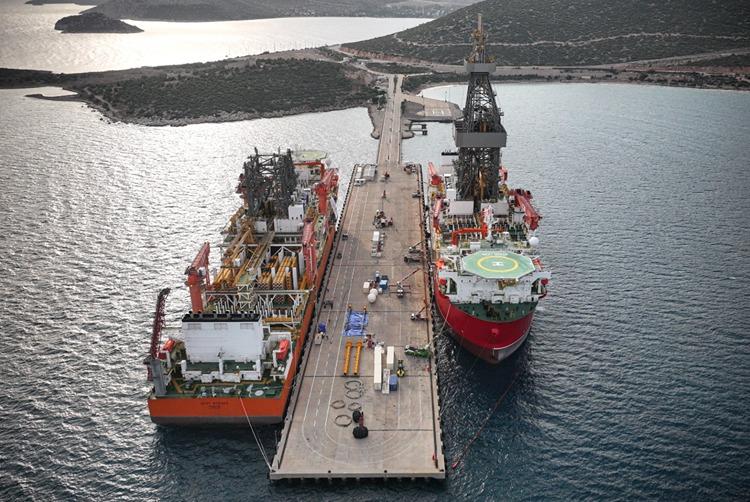
Seventh-Generation Ultra-Deepwater Drilling Vessels Yıldırım and Çağrı Bey (Anadolu Agency)
The Çağrı Bey and Yıldırım vessels, newly integrated into Türkiye’s energy fleet, belong to the class of seventh-generation ultra-deepwater drilling vessels, widely regarded in the global drilling industry as “technological marvels.” Built in South Korea in 2024, these twin vessels feature hulls measuring 228 meters in length and 42 meters in width, specifically designed for offshore engineering operations.【6】 The most fundamental feature distinguishing them from previous generations is their high levels of automation and digital control systems. Their standout technical capability is the ability to drill to depths of up to 12,000 meters (approximately 40,000 feet) from the sea surface.【7】
To ensure the sustainability of multi-month offshore operations, the vessels are equipped with living quarters capable of accommodating approximately 200 personnel.【8】 The onboard helicopter deck enables continuous air bridges for crew rotations and emergency logistical support. Additionally, advanced laboratory facilities allow for real-time analysis of core samples, providing engineers with immediate scientific data regarding the subsurface reservoir’s characteristics.
The Çağrı Bey Drilling Vessel represents a concrete and strategic step in Türkiye’s “intercontinental energy vision,” extending its successes in the Mediterranean and Black Seas to international waters. Tasked under the hydrocarbon exploration and production agreement signed between Türkiye and Somalia, the vessel will fly Türkiye’s flag off the East African coast and extend Türkiye’s deepwater exploration capabilities to an oceanic scale.
Currently stationed at Mersin Taşucu Port, Çağrı Bey is undergoing comprehensive operational preparation and technical maintenance to adapt to Somalia’s oceanic conditions. During this phase, the vessel’s drilling equipment, dynamic positioning systems, and deepwater well control units are being modernized. According to planning, all preparations are scheduled to be completed by the end of January 2026, after which the vessel will depart for Somalia. A support fleet will accompany Çağrı Bey during this long journey and drilling campaign to ensure logistical support and security.
Çağrı Bey’s mission in Somalia is not a random exploration effort but the direct outcome of the 4,465-square-kilometer dataset collected by the Oruç Reis Seismic Research Vessel and processed in Ankara. The vessel will drill precisely at the coordinates identified by seismic data as having high hydrocarbon potential.
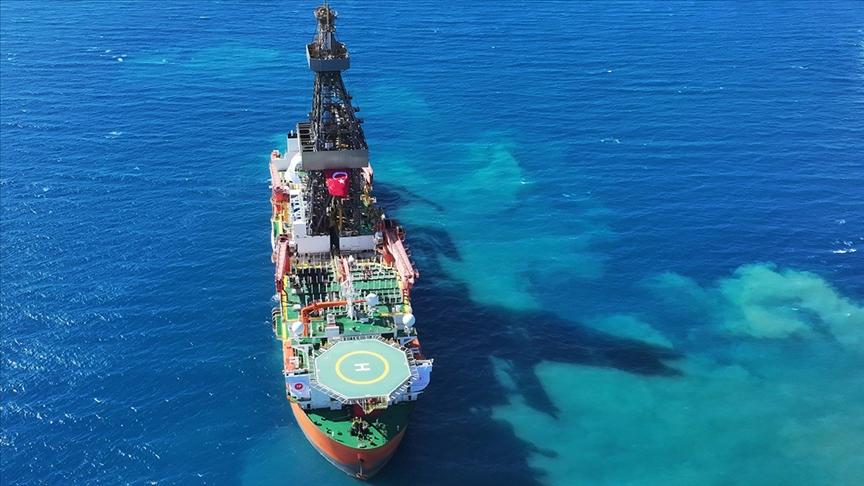
Seventh-Generation Ultra-Deepwater Drilling Vessel (Anadolu Agency)
Yıldırım, the sixth vessel added to Türkiye’s deepwater drilling fleet, has assumed a critical role in the Sakarya Gas Field Development Project, the strategic arena of Türkiye’s journey toward Black Sea energy independence. Yıldırım will join ongoing operations led by the Fatih, Yavuz, Kanuni, and Abdülhamid Han vessels to elevate production capacity to a higher level.
Expected to relocate to Filyos Port, the logistical hub of the Black Sea, in January, the vessel will undergo reassembly of its crane tower and enter its operational preparation phase. This technical preparation phase in Filyos involves calibrating Yıldırım’s “seventh-generation” technological systems to meet the specific deepwater conditions of the Black Sea.
Yıldırım’s primary mission is to directly support natural gas production in the Sakarya field by commencing its first well completion operations by the end of March 2026. To this end, the vessel will carry out “well completion” processes including the installation of subsea wellhead systems, connection of subsea pipelines, and preparation of newly drilled wells for integration into the production line.
The arrival of Yıldırım accelerates the second phase of operations aimed at increasing daily production in the Sakarya Gas Field from 10 million to 20 million cubic meters. The vessel will not only drill new wells but also serve as a technological bridge connecting subsea wells to the Osman Gazi Floating Production Unit (FPU) deployed in the Black Sea. These efforts aim to supply natural gas to eight million households and significantly reduce Türkiye’s energy import bill.【9】
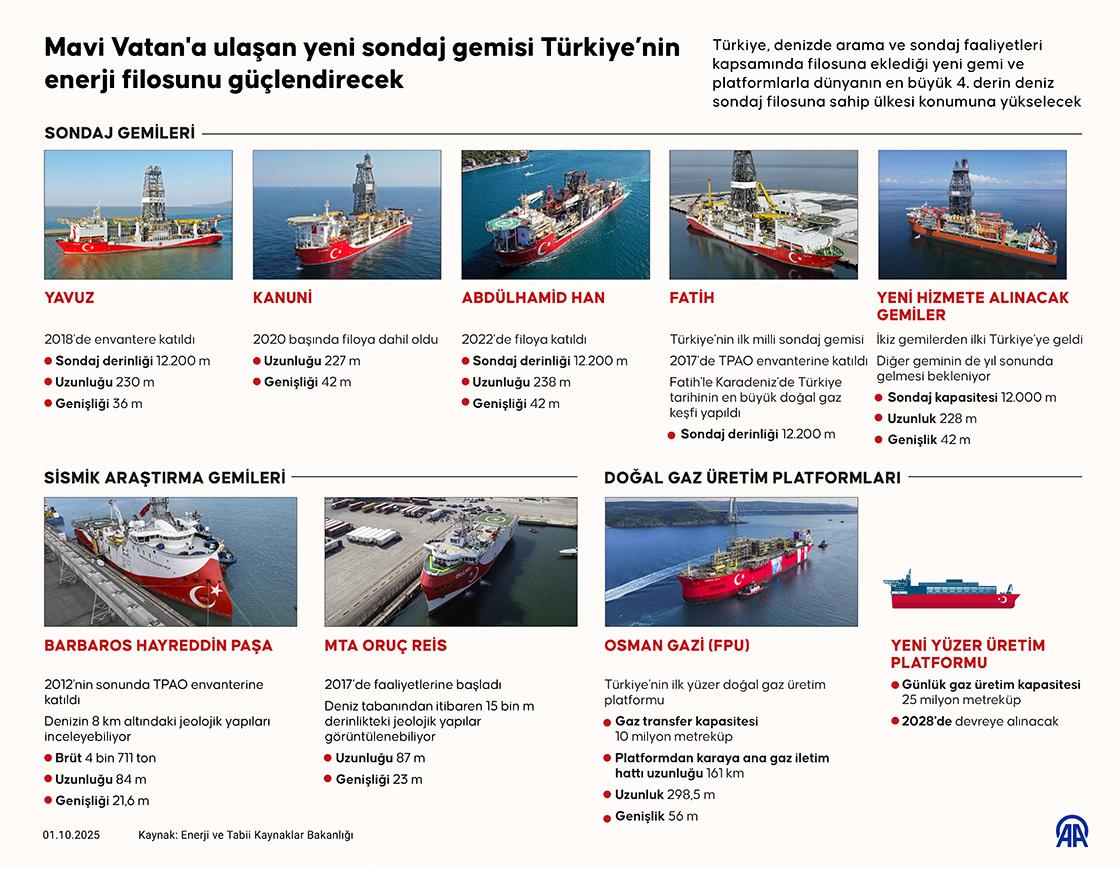
Türkiye’s Current Energy Fleet (Anadolu Agency)
Türkiye’s deepwater energy strategy is not limited to drilling vessels alone but is built upon an integrated “National Energy Fleet” capable of managing the entire process from exploration to final production. The fleet, under the Turkish Petroleum Corporation (TPAO), forms a fully autonomous ecosystem spanning seismic surveys, well completion, subsea construction, and floating platform operations.
The core of the fleet consists of the Fatih, Yavuz, Kanuni, and Abdülhamid Han drilling vessels, which simultaneously conduct exploration and well completion operations in the Sakarya Gas Field of the Black Sea. These vessels are guided by the seismic research ships Oruç Reis and Barbaros Hayrettin Paşa, which map the seabed geology. Oruç Reis, having completed its historic mission in Somalia, is now preparing for data collection in new Black Sea areas, while Barbaros Hayrettin Paşa continues uninterrupted 3D seismic surveys across different blocks of the Black Sea.
A critical element distinguishing Türkiye’s energy fleet is the “Osman Gazi” Floating Production Unit (FPU), which will manage production from the Sakarya field. This facility processes raw gas extracted from the seabed and transports it to shore, representing the newest and most sophisticated component of the fleet. Scheduled to commence full operation in mid-2026, Osman Gazi is central to the goal of increasing daily Black Sea production capacity to 20 million cubic meters.【10】 Supporting this process is a single high-tech subsea construction vessel within the fleet.
The continuity of deepwater operations is ensured by 11 modern support vessels in the fleet. These vessels transport critical materials such as fuel, drinking water, cement, and drilling mud to drilling platforms while also assuming responsibilities for maritime safety and emergency response, including firefighting and oil spill containment. Thanks to this holistic structure, Türkiye does not merely discover deepwater resources but also constructs the entire engineering infrastructure required to install subsea wellhead systems and pump gas to terminal facilities using its own capabilities.
[1]
Anadolu Ajansı, "Enerji filosuna yeni katılan "Çağrı Bey" Somali'de, "Yıldırım" Karadeniz'de görev yapacak," Anadolu Ajansı, erişim 31 Aralık 2025, https://www.aa.com.tr/tr/ekonomi/enerji-filosuna-yeni-katilan-cagri-bey-somalide-yildirim-karadenizde-gorev-yapacak/3785335
[2]
T.C. Enerji ve Tabii Kaynaklar Bakanlığı, "Enerji Filosunun Yeni Kahramanları ‘Çağrı Bey’ ve ‘Yıldırım’," enerji.gov, erişim 31 Aralık 2025, https://enerji.gov.tr/haber-detay?id=31689
[3]
Anadolu Ajansı, "Enerji filosuna yeni katılan "Çağrı Bey" Somali'de, "Yıldırım" Karadeniz'de görev yapacak," Anadolu Ajansı, erişim 31 Aralık 2025,
[4]
Anadolu Ajansı, "Enerji filosuna yeni katılan "Çağrı Bey" Somali'de, "Yıldırım" Karadeniz'de görev yapacak," Anadolu Ajansı, erişim 31 Aralık 2025,
[5]
Anadolu Ajansı, "Mavi Vatan'a ulaşan yeni sondaj gemisi Türkiye'nin enerji filosunu güçlendirecek," Anadolu Ajansı, erişim 31 Aralık 2025, https://www.aa.com.tr/tr/ekonomi/mavi-vatana-ulasan-yeni-sondaj-gemisi-turkiyenin-enerji-filosunu-guclendirecek/3703985
[6]
T.C. Enerji ve Tabii Kaynaklar Bakanlığı, "Enerji Filosunun Yeni Kahramanları ‘Çağrı Bey’ ve ‘Yıldırım’," enerji.gov, erişim 31 Aralık 2025, https://enerji.gov.tr/haber-detay?id=31689
[7]
T.C. Enerji ve Tabii Kaynaklar Bakanlığı, "Enerji Filosunun Yeni Kahramanları ‘Çağrı Bey’ ve ‘Yıldırım’," enerji.gov, erişim 31 Aralık 2025,
[8]
Anadolu Ajansı, "Mavi Vatan'a ulaşan yeni sondaj gemisi Türkiye'nin enerji filosunu güçlendirecek," Anadolu Ajansı, erişim 31 Aralık 2025,
[9]
Daily Sabah, "2nd of Türkiye's new drillships set to arrive in southern Mersin," Daily Sabah, erişim 31 Aralık 2025, https://www.dailysabah.com/business/energy/2nd-of-turkiyes-new-drillships-set-to-arrive-in-southern-mersin
[10]
Anadolu Ajansı, "Mavi Vatan'a ulaşan yeni sondaj gemisi Türkiye'nin enerji filosunu güçlendirecek," Anadolu Ajansı, erişim 31 Aralık 2025, https://www.aa.com.tr/tr/ekonomi/mavi-vatana-ulasan-yeni-sondaj-gemisi-turkiyenin-enerji-filosunu-guclendirecek/3703985


Technological Capacity and Strategic Vision
Historical Background
Oruç Reis Seismic Surveys
Transition to Drilling Phase
Expansion of the Deepwater Drilling Fleet
Çağrı Bey and Yıldırım Drilling Vessels
Technical Specifications
Çağrı Bey’s Mission in Somalia
Yıldırım’s Mission in the Black Sea
Current Energy Fleet
